The Spanish language is a rich and nuanced tapestry that enchants millions across the globe. It is a Romance language that originated on the Iberian Peninsula and boasts a wide variety of dialects and accents. Today, Spanish is spoken by over 580 million people, making it the world’s second-most spoken native language. Given its cultural significance and the challenges it poses in terms of learning, mastering Spanish can be akin to solving an intricate puzzle. This article explores the intriguing world of Spanish language puzzles, focusing specifically on the concept of scrambling words and sentences to aid in learning and comprehension.
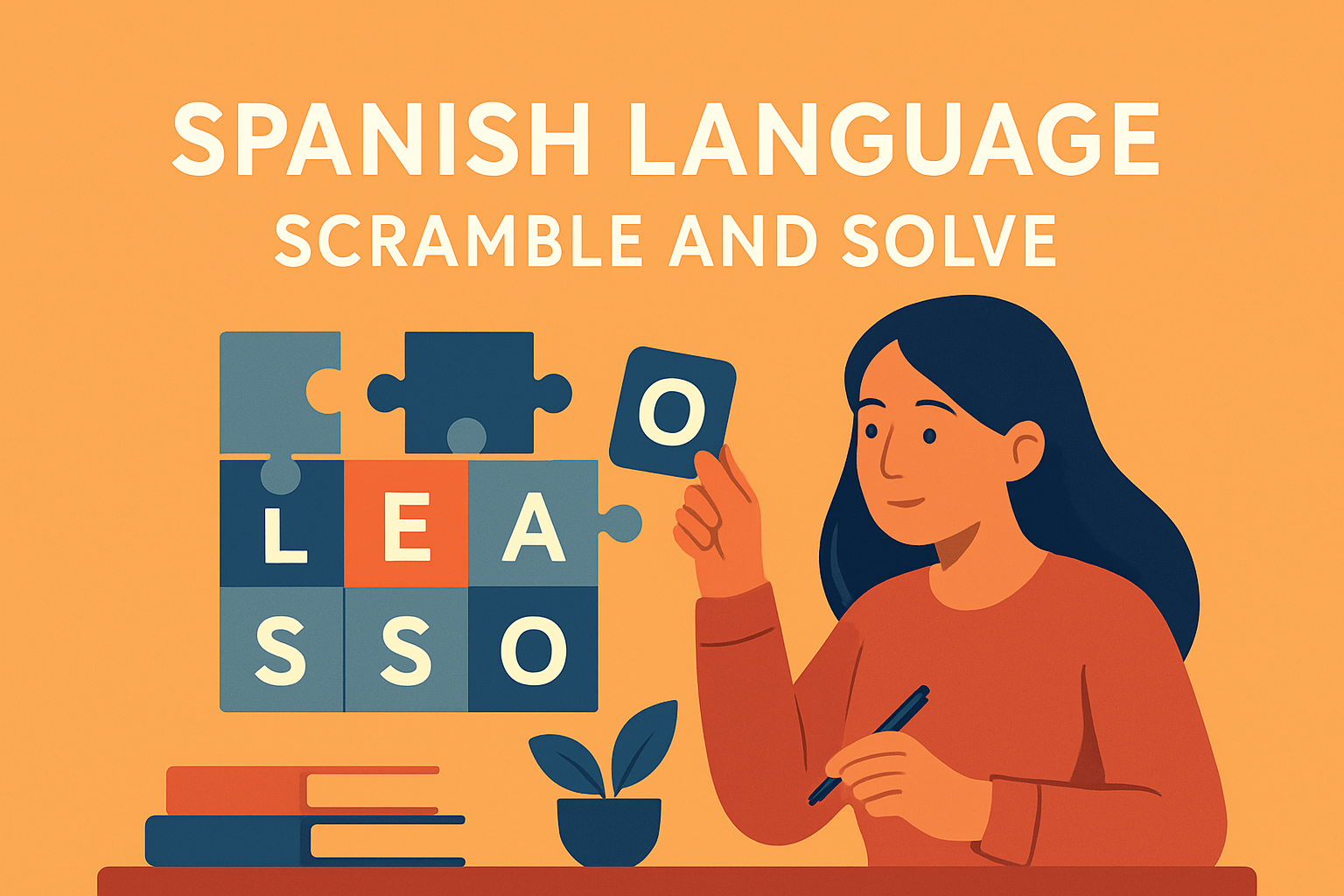
Scrambling, in linguistics, refers to rearranging the elements of a sentence or words in a non-canonical order. This technique has been used in educational settings to enhance language proficiency by demanding that learners actively engage with the syntax and structure of the language they are studying. The scramble and solve method plays a critical role in enhancing memory, improving vocabulary, and developing a deeper understanding of Spanish grammar. By unleashing the intricacies of this technique, both native and non-native Spanish speakers can enjoy a novel approach to language acquisition.
The Power of Scrambling for Language Acquisition
At its core, the power of scrambling lies in forcing the learner to interact more deeply with the material at hand. In the context of learning Spanish, scrambling involves presenting scrambled sentences or words to learners, who must then reconstruct them into their correct order. This exercise accomplishes several important objectives.
Firstly, it significantly boosts vocabulary retention. When learners are required to unscramble a jumble of Spanish words, they actively recall the vocabulary, cementing it further in their memory. For example, when faced with an assortment of Spanish words like “comer”, “manzana”, and “yo”, they must rearrange them to form a coherent sentence: “Yo como la manzana”. The cognitive process involved in this task enhances the learner’s ability to store and recall vocabulary efficiently.
Additionally, scrambling aids in improving grammar comprehension. Spanish grammar can be complex, with its conjugations, gender agreements, and adjective placements. Scrambling exercises push learners to pay attention to these details, helping them identify common grammatical patterns and nuances.
Real-World Applications of Spanish Scrambling Puzzles
While Spanish scrambling puzzles are often employed in academic environments, they have a wide range of practical applications. These puzzles are not just elementary educational tools but also enhance the linguistic capabilities of intermediate and advanced learners.
Consider the workplace environment where bilingual individuals are often seen as valuable assets. An employee proficient in Spanish would greatly benefit from scramble exercises to hone their communication skills. They can play these puzzles in real time with peers or utilize apps and websites offering these language challenges. For instance, applications like Duolingo and Babbel integrate such exercises into their Spanish learning modules, encouraging learners to rearrange sentences for correct meaning.
The use of scrambling puzzles in real-world contexts extends to cultural immersion experiences as well. A traveler visiting a Spanish-speaking country will find it helpful to engage in these exercises, allowing them to navigate conversations more adeptly. Understanding and constructing sentences as they are meant to be, despite local dialectical variations, becomes second nature after regular practice with scrambling puzzles.
Engaging with Technology in Resolving Scrambles
Modern technology has significantly streamlined the learning of languages, with Spanish being no exception. Various platforms offer interactive and engaging means for students to practice and perfect their scrambling skills.
The online platform allows for dynamic learning through instant feedback on scrambled exercises. Learners can input a scrambled Spanish sentence, receive feedback on the correct arrangement, and even understand the underlying grammatical principles that necessitate that order. As an example:
| Scrambled Sentence | Correct Sentence | Feedback |
|---|---|---|
| Casa una tengo | Tengo una casa | Here, “tengo” is the verb, “una” is an article, and “casa” is the noun. |
| Gato el duerme | El gato duerme | Articles in Spanish, like “el”, precede their nouns. |
These platforms often incorporate gamification, instilling a sense of achievement and motivation among learners. By earning points or badges for successfully unscrambling phrases, users are incentivized to continue learning.
Challenges and Solutions in Scrambling
Though effective, scrambling puzzles are not without their challenges. Learners without a foundational grasp of Spanish grammar may find themselves frustrated with the exercise’s intricacies. The key lies in ensuring a balanced approach, where foundational grammar is introduced alongside scrambling activities.
A beginner approaching the challenge might find themselves overwhelmed by the task due to a lack of understanding of basic sentence structures. To counteract this, educational programs should adopt a scaffolding approach. By starting with simple one-word exercises and progressively integrating more complex sentences, learners can gradually build confidence and proficiency.
Consider a new student grappling with scrambled exercises containing idiomatic expressions. The initial task might seem insurmountable. However, by breaking down these idioms and explaining their components, the student can slowly piece together the metaphorical meanings and become adept at interpreting nuanced phrases. Implementing visual aids and real-world examples aids significantly in overcoming these challenges.
Rethinking Spanish Learning through Puzzles
The integration of puzzles into Spanish language learning signifies a shift in traditional educational paradigms. This strategy offers a blend of entertainment and education, making the learning process not just effective but also enjoyable. The language puzzle method embraces mistakes as learning opportunities and provides learners the chance to experiment without the fear of immediate correction.
An interesting example is the “fill-in-the-blank” exercise, which needs students to arrange words correctly to fill gaps in a paragraph. This type of puzzle is excellent for reinforcing the understanding of contextual clues and prompting learners to engage actively with the material. Over time, learners develop a keener sense for recognizing correct sentence structures naturally, leading to increased fluency.
The dual emphasis on entertainment and reinforcement of language concepts emphasizes the notion that learning Spanish doesn’t have to be a chore. Rethinking language learning through puzzles ensures that the acquisition of Spanish becomes an engaging and motivating journey.
Conclusion: Scramble and Solve for Success
In the vast landscape of language learning, Spanish stands out as a beloved and widely spoken language. Understanding its intricacies might seem daunting, but by tapping into inventive methods like scrambling exercises, learners can transform this journey into a gratifying pursuit. This technique fosters robust vocabulary retention, enhances grammatical understanding, and prepares individuals for real-world applications.
The key takeaway for learners and educators is the significance of adapting teaching methodologies to capture the evolving dynamics of language acquisition. Scrambling and solving are powerful tools that cleverly tap into the brain’s problem-solving faculties, transforming learning experiences into interactive and enjoyable endeavors.
For individuals keen on mastering the Spanish language, embracing the challenge presented by the scramble and solve method is essential. As they unravel the intricate puzzles, they enhance their linguistic capabilities and inch closer to fluency. This approach encourages lifelong learning and sparks a genuine interest in linguistic proficiency. Are you ready to scramble and solve your way to mastering Spanish?
Embrace the challenge, explore the language, and enjoy the journey!
Frequently Asked Questions
1. What makes learning Spanish similar to solving a puzzle?
Learning Spanish can indeed feel like piecing together a complex puzzle, primarily because of its rich linguistic structure and variety. With Spanish being a Romance language, it shares roots with Latin, which means that while there are predictable patterns and rules, the language also comes with nuances and exceptions that require careful attention. Consider the myriad of verb conjugations that change with tense, mood, and subject pronouns—it’s akin to arranging puzzle pieces until you find the perfect fit. Similarly, mastering the various dialects and accents across the Spanish-speaking world adds another layer, as they present subtle yet significant variations in vocabulary and pronunciation. The complexity of expressing emotions through subjunctive moods or choosing the right word from a plethora of synonyms are further elements of the Spanish puzzle. Each of these components, once understood and internalized, contributes to the beautiful mosaic that is the Spanish language. Embracing these challenges with patience and curiosity can lead to a satisfying and enriching learning experience, very much like savoring the moment when the final puzzle piece falls into place.
2. How can language puzzles help in learning Spanish?
Language puzzles are an excellent resource when learning Spanish as they engage both cognitive skills and creativity. These puzzles encourage learners to think critically and analytically, akin to problem-solving, which reinforces language retention and comprehension. For instance, solving word jumbles or crosswords in Spanish can enhance vocabulary by prompting discovery and recall of new words through contextual clues. Another aspect of language puzzles focuses on grammar: learners might engage with exercises that challenge them to arrange sentences properly or choose the correct verb forms. Games and puzzles that require conversation simulation can also improve fluency by offering practical scenarios to practice the language. Moreover, interactive puzzles like online apps tailor the experience by providing immediate feedback, enabling learners to track progress and areas for improvement. These tools, by making learning entertaining and dynamic, help transition the language from passive learning into active use, creating a deeper and more meaningful understanding of Spanish.
3. What dialects of Spanish should I be aware of, and how do they affect learning?
Spanish is distinguished by a broad spectrum of dialects, influenced by geographic, historical, and cultural factors. Some of the most well-known dialects include Castilian Spanish, which is considered the standard in Spain, and Latin American Spanish, which has its own variations such as Mexican, Argentine, and Caribbean Spanish. Each dialect possesses unique phonetic and syntactical characteristics; for instance, the pronunciation of “c” and “z” as “th” is typical in Castilian Spanish but not in most Latin American dialects. Grammar differences also exist, as seen in the use of “vos” instead of “tú” in regions like Argentina. Understanding these dialects is vital in learning Spanish not only because it aids in communication with native speakers from different regions, but it also enriches one’s cultural appreciation of the language. For learners, this may initially pose a challenge, yet it also offers the opportunity to become adept at recognizing and adapting to diverse linguistic contexts, ultimately enhancing proficiency and versatility in the language.
4. Why is verb conjugation considered challenging in Spanish?
Verb conjugation in Spanish is often viewed as one of the more daunting aspects of the language, primarily due to its complexity and specificity. Spanish verbs change form to reflect tense, mood, person, and number. With the regular verbs alone having numerous conjugation forms across present, past, future, and conditional tenses, the learner is required to commit a significant amount of forms to memory. The challenge amplifies with irregular verbs, which do not adhere to the standard conjugation patterns and must be learned on a case-by-case basis. Additionally, moods like the subjunctive, imperative, and indicative introduce shades of meaning and emphasis that can be subtle yet significant, depending on the context. These intricacies mean that understanding and correctly applying verb conjugations is key to conveying accurate meaning and intent. However, with practice and consistency, mastering conjugations can offer a rewarding sense of accomplishment and dramatically elevate one’s command of the Spanish language.
5. Can solving puzzles improve my fluency in Spanish, and if so, how?
Absolutely, solving language puzzles can significantly enhance fluency in Spanish. Fluency isn’t just about speaking quickly; it’s about speaking accurately and effectively, and puzzles help reinforce these skills by constantly engaging with the language’s structures and vocabulary. Puzzles often challenge learners to recall and apply vocabulary and grammatical rules in varied contexts, a process that strengthens memory and cognitive connections. By working through these interactive problems, learners gain confidence in manipulating the language creatively and accurately. Additionally, puzzles that simulate real-life scenarios enhance conversational skills and situational language use. As learners decode sentences, fill in missing words, or form dialogue, they internalize patterns and idiomatic expressions, gradually increasing their comfort with speaking and understanding Spanish. Consequently, the continuous use of language puzzles fosters a deeper psychological ease with the language, contributing to both spoken and written fluency over time.