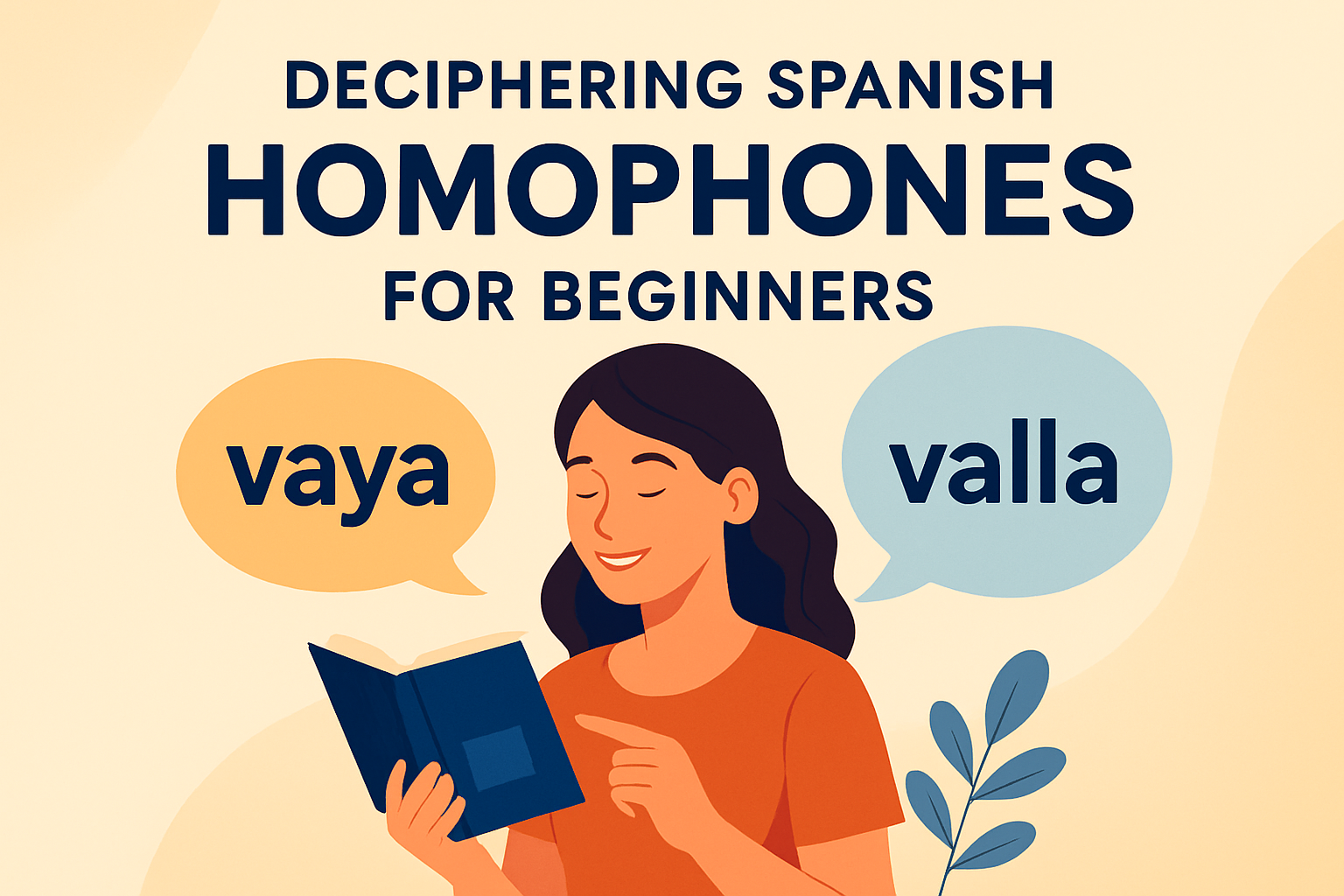
The Spanish language, with its melodious tones and rhythmic flow, can be a delight to learn. However, like every language, it presents its own unique challenges. One such challenge is mastering homophones—words that sound alike but have different meanings or spellings. This phenomenon is not unique to Spanish but is an integral part of its linguistic fabric. Understanding and deciphering Spanish homophones is crucial for learners aiming for fluency and accuracy in both spoken and written communication.
Homophones can easily lead to misunderstandings if not carefully navigated, which is why it’s important for beginners to grasp them. Imagine trying to express a heartfelt sentiment, only to be met with puzzled looks because the word you chose sounds like, and is mistaken for, another word with an entirely different meaning. For instance, mistaking “tubo” (pipe) with “tuvo” (he/she had) might cause confusion in conversations or writings. This article will provide beginners with insightful strategies for identifying and understanding Spanish homophones, enhance their language skills, and help avoid common pitfalls. Let us embark on this linguistic journey to unravel the many homophones that await in the Spanish language.
Understanding the Basics of Spanish Homophones
To effectively tackle Spanish homophones, one must first understand their foundational nuances. Homophones derive from Greek roots: “homo” means “same,” and “phone” refers to “sound.” Thus, homophones are words that sound the same but differ in meaning and potentially spelling. In Spanish, the nuances are subtle yet impactful.
Consider the words “tubo” vs. “tuvo.” They might sound identical when spoken quickly, but “tubo” refers to a tubular item or pipe, and “tuvo” is the past tense of “tener” (to have) for “he” or “she.” Recognizing the different contexts in which these words are used can enhance your comprehension and communication.
The Impact of Regional Accents and Dialects
Regional accents and dialects in Spanish-speaking countries can further complicate the homophone puzzle. For instance, in Spain, the pronunciation of “s” and “z” is distinctly different, aiding in differentiating between words like “casa” (house) and “caza” (hunt). In Latin American countries, these sounds are often indistinguishable, resulting in added intricacies.
Let’s explore another example: In some regions, “b” and “v” in words like “baso” (informal for ‘kiss’) and “vaso” (glass) might be pronounced the same. This illustrates the need for heightened awareness of context and sentence structure when deciphering meaning, especially for beginners who may not yet be familiar with regional nuances.
Common Spanish Homophones Explained
Homophones in Spanish are abundant, and gaining familiarity with them can be extremely beneficial. Let’s examine some common examples:
- ¿Por qué? vs. Porque – “¿Por qué?” means “why?” as a question, while “porque” means “because” as an answer.
- Sí vs. Si – “Sí” means “yes,” but “si” translates to “if.”
- El vs. Él – “El” is the article “the,” whereas “él” means “he.”
- Te vs. Té – “Te” refers to “you,” but “té” is “tea.”
- Masa vs. Maza – “Masa” means “dough” or “mass,” and “maza” refers to a “mace” or club.
By studying the spelling and context in which these words appear, learners can enhance their understanding and prevent miscommunication.
Real-World Application: Communication Clarity
In practical settings, clearly differentiating between homophones is vital. For instance, in a restaurant, the difference between “vino” (wine) and “vino” (he/she came) could be crucial when conveying your order. Imagine saying, “Quiero vino,” and the listener interprets it as “quiero vino” (I want wine) vs. “él vino” (he/she came).
| Word | Meaning 1 | Meaning 2 |
|---|---|---|
| Vino | Wine | He/She came |
| Banco | Bank (financial) | Bench |
| Peso | Weight | Currency (in various countries) |
The table above highlights more examples of potential areas for confusion. Being aware of these can help learners steer clear of misunderstandings.
Strategies for Mastering Spanish Homophones
To effectively learn Spanish homophones, one can employ several strategies. First, it’s essential to contextualize words within sentences. Practice by crafting sentences where homophones might appear, emphasizing their meanings. Recognizing contextual clues is key to discerning the intended word.
Reading aloud is another method that supports mastery. By doing so, you can attune your ear to subtle differences in emphasis or intonation. Encourage yourself to engage in conversations with native speakers who can provide feedback, reinforcing your understanding.
Consider using language apps or flashcards specifically designed for homophones. These tools often provide interactive ways to practice and learn through spaced repetition, ensuring long-term retention.
The Role of Culture in Understanding Homophones
The cultural landscape of a Spanish-speaking country can heavily influence the use and perception of homophones. Certain expressions might incorporate homophones in ways that directly reflect cultural elements or humor. Engaging with cultural content such as music, literature, and television can offer contextual insights into everyday vocabulary.
Take, for example, the difference in tone when a homophone is used humorously in a play in Spain versus a dramatic telenovela in Mexico. Being cognizant of these cultural cues enhances comprehension beyond the textbook definition.
Conclusion: Strengthening Your Spanish Skills
Deciphering Spanish homophones is a critical step for any language learner aiming to become fluent. By understanding the nuances of these words, the contexts in which they appear, and the cultural factors that influence their use, you enhance your communication skills, build confidence, and bridge gaps that might otherwise lead to confusion.
Embrace the journey—practice regularly, listen actively, and immerse yourself in diverse Spanish-speaking environments. This knowledge not only broadens your linguistic repertoire but also enriches your appreciation of the multifaceted Spanish language.
Take the first step today by identifying homophones during your language practice and incorporating them consciously into your daily conversations. Your growing fluency will prove the effort worthwhile.
Frequently Asked Questions
1. What exactly are homophones in the Spanish language, and why are they significant for learners?
Homophones in the Spanish language are words that are pronounced the same way but have different meanings or spellings. These can often trip up learners because, although the words sound identical when spoken, they vary in meaning. A key aspect of mastering Spanish involves understanding these homophones, as they are intrinsic to the language’s structure. For instance, the words “bello” (beautiful) and “vello” (body hair) are pronounced similarly but have distinct meanings. The significance for learners lies in the ability to comprehend context and nuance in conversation and writing. It enhances fluency and comprehension, preventing misunderstandings that could arise from misinterpreting these words. Furthermore, grasping homophones aids in the development of a richer vocabulary and a more nuanced understanding of the language’s rhythm and sounds.
2. Can you provide examples of common Spanish homophones that beginners might encounter?
Of course! There are several frequent Spanish homophones that beginners might come across. One example is the pair “cazar” (to hunt) and “casar” (to marry). Both words sound the same but are used in entirely different contexts. Another example includes “baca” (roof rack of a vehicle) and “vaca” (cow). The homophones “tubo” (tube) and “tuvo” (had, past tense of tener) also illustrate this concept well. Getting familiar with such pairs is not only enjoyable but also essential for effective communication. It involves understanding the context in which these words are used—whether it’s the adventurous pursuit of hunting, the joyous occasion of marriage, or having something in the past. Practicing with sentences and engaging in conversations where these homophones appear can significantly aid beginner learners in distinguishing them.
3. How can learning Spanish homophones improve my overall fluency in the language?
Learning Spanish homophones can significantly enhance your overall fluency by refining both your listening and speaking abilities. The ability to discern words that sound identical yet mean different things allows for more accurate communication and understanding. By recognizing these subtle differences, you become more adept at context-based comprehension, which is an invaluable skill when you’re conversing in real-life situations. This knowledge ensures that you don’t just hear words but you understand what’s being communicated based on the entire conversation. Additionally, mastering homophones enriches your vocabulary and aids in developing a deeper appreciation for the subtleties of the Spanish language. It leads to clearer, more precise communication, reduces misunderstandings, and enhances your confidence in both expressing and interpreting the language. Engaging with language exercises that focus on homophones or immersing yourself in Spanish media can also foster a more intuitive sense of the language’s rhythm and flow.
4. What strategies can I use to effectively learn and remember Spanish homophones?
There are several strategies you can employ to effectively learn and remember Spanish homophones. First, flashcards are a classic and highly effective method. By writing each homophone pair on different sides, it helps reinforce the knowledge through repetition. Using images to associate with each word can also improve memory retention. Another strategy involves creating sentences or short stories with the homophones, enabling you to practice them in context. Additionally, listening to Spanish audio resources such as songs, podcasts, and movies can enhance your ability to distinguish these homophones in natural conversations. This exposure not only aids in recognizing the sound but also helps in understanding the context in which they are used. Engaging with interactive language apps and exercises that target homophones can also be beneficial. Lastly, practicing speaking with native speakers or language partners will give you instant feedback and aid in reinforcing your learning through real-life usage.
5. What are some common challenges beginners face when learning Spanish homophones, and how can they overcome them?
One common challenge beginners face is the initial difficulty of recognizing and differentiating homophones purely by sound, since they’re entitled to the same pronunciation but carry different meanings. This confusion is compounded when similar-sounding words appear in close proximity during conversation or reading. To overcome this, it’s important to focus on expanding both vocabulary and contextual understanding. Regular practice with listening exercises, such as dictations or listening to conversations, can help learners become attuned to contextual cues rather than solely relying on sound. Another challenge is the tendency to mix-up spellings, especially when writing. To combat this, writing exercises and regular practice with spelling drills tailored to homophones are useful. Additionally, engaging with resources like homophone lists and language games can turn a potentially daunting task into a fun and interactive learning experience. Patience, persistence, and steady practice are key to mastering this aspect of the Spanish language.