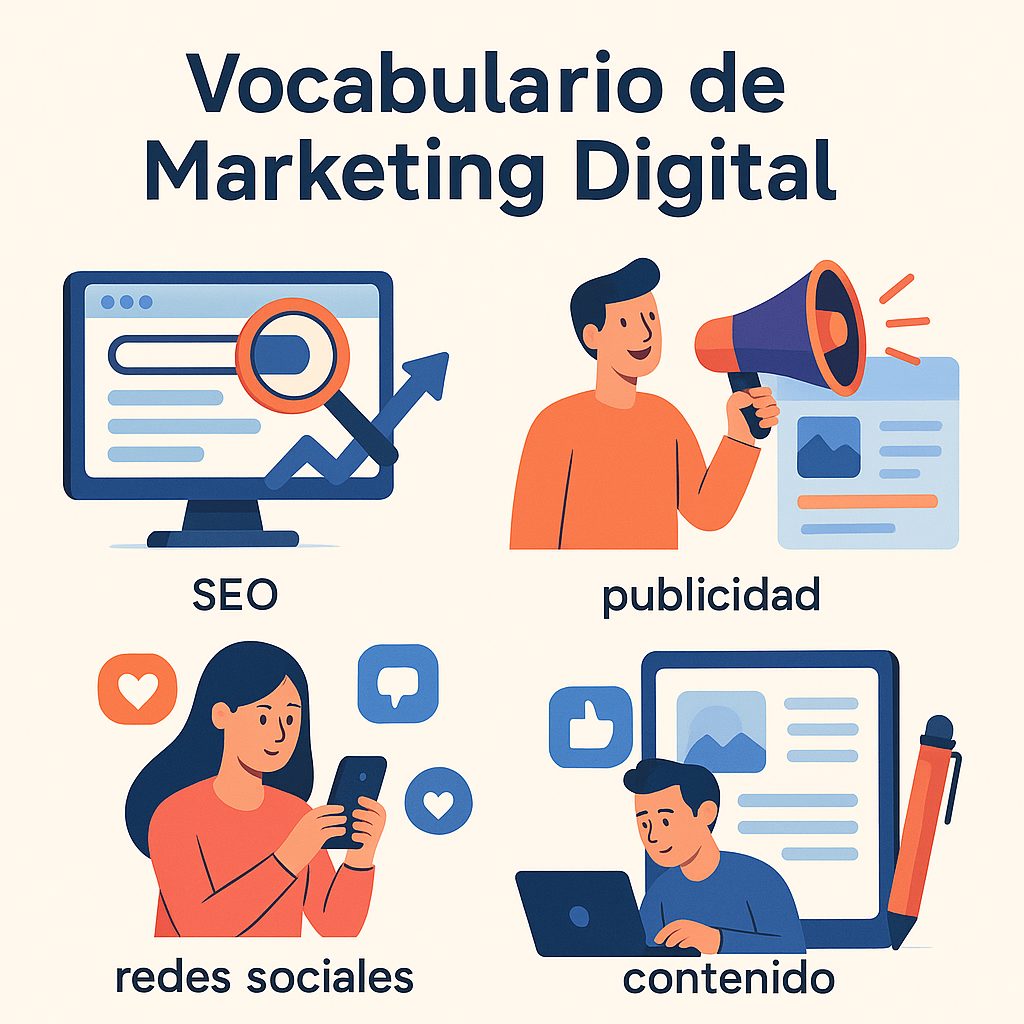
As the world increasingly delves into the digital realm, the necessity of mastering digital marketing vocabulary becomes more crucial. For moderate to advanced Spanish learners, possessing a robust lexicon in this domain provides a competitive edge. Digital marketing continues to solidify its standing as the gateway to global business, growing myriad opportunities that can only be tapped into with the right linguistic tools. But why is Spanish digital marketing vocabulary specifically important?
First, Spanish ranks as the second most spoken language globally, opening doors to vast markets across Spain, Latin America, and Hispanic communities in the United States. For businesses eyeing these regions, understanding and utilizing digital marketing terminology effectively is non-negotiable. By comprehending terms such as “SEO” (Search Engine Optimization or “Optimización en Motores de Búsqueda”), “CTR” (Click-Through Rate or “Tasa de Clics”), and “contenido viral” (viral content), marketers can communicate seamlessly across borders, tailoring campaigns that resonate with local audiences.
This article aims to equip Spanish learners with essential digital marketing vocabulary, enriched with definitions, contexts, and real-world applications. By delving into these terms, learners can develop an authoritative grasp on digital marketing discourse, empowering them to make informed decisions, execute effective strategies, and engage in meaningful conversations within this dynamic industry.
Key Digital Marketing Concepts in Spanish
The cornerstone of any successful marketing strategy lies in a thorough understanding of its foundational elements. In the context of the Spanish-speaking digital sphere, key terms lay the groundwork for effective communication and campaign execution. Imagine you’re about to conduct a “campaña de anuncios pagados” (paid advertising campaign) targeting a Latin American audience. A deep understanding of these essential terms can significantly influence the campaign’s outcome.
- Conversiones: Known as “conversions” in English, conversiones refer to actions taken by users that fulfill desired outcomes, such as making a purchase or signing up for a newsletter. In a campaign, measuring conversiones is crucial for assessing effectiveness.
- Palabras clave de cola larga: This translates to “long-tail keywords,” which are longer and more specific keyword phrases targeted to attract niche markets.
- Análisis de Datos: Data analysis involves examining information to glean insights into consumer behavior, enabling the refinement of marketing strategies.
For instance, a beverage company leveraging “palabras clave de cola larga” to market a new organic soda in Chile might use specific terms like “soda orgánica baja en azúcar en Chile” to reach health-conscious consumers most effectively.
Strategies for Localized Marketing Efforts
Localization entails adapting content to suit regional preferences, making it indispensable in connecting with diverse audiences. Understanding cultural nuances and incorporating localized terminology is vital in crafting messages that resonate.
An example of localized digital marketing vocabulary in action is the use of “contenido viral” or viral content, which can differ in tone and style across regions. While conducting a campaign in Spain, utilizing humor specific to Spanish culture enhances the possibility of content sharing, maximizing reach and engagement.
Furthermore, the strategic application of “análisis de datos” allows marketers to identify local trends and preferences, optimizing localization efforts. By interpreting data insights, businesses can tailor content to align with cultural preferences, ensuring relevancy and resonance.
| Termino en Español | Equivalente en Inglés | Definición |
|---|---|---|
| Segmentación de Mercado | Market Segmentation | Dividir un mercado objetivo en subgrupos más manejables. |
| Posicionamiento Web | Web Positioning | Prácticas SEO para mejorar la visibilidad en línea. |
| Audiencia Objetivo | Target Audience | Un grupo específico al que se dirige una campaña. |
SEO and SEM Tactics
Search Engine Optimization (SEO) and Search Engine Marketing (SEM) are pivotal in amplifying online visibility. These strategies center around optimizing content to achieve higher search engine rankings and drive traffic to websites.
A business aiming to bolster its digital presence in Mexico might adopt SEO strategies like “posicionamiento web,” ensuring website content is search-engine-friendly and tailored to local search habits. SEM involves paid strategies such as “anuncios de pago por clic” (pay-per-click ads), providing opportunities for businesses to appear prominently in search results.
For instance, a small tech company in Guadalajara might employ enterprise link building services to improve their domain authority and backlink profile. By leveraging resources like LSEO’s Enterprise Link Building Services, they can implement sophisticated link-building strategies, connecting with authoritative sites that boost their online standing.
Utilizing Social Media Platforms
Social media platforms are omnipresent in today’s digital marketing landscape. For maximum impact, understanding the nuances of “redes sociales” (social networks) is essential. Platforms like Facebook and Instagram cater to broad demographics, while TikTok and Snapchat target younger audiences, requiring tailored approaches.
An e-commerce brand targeting young adults in Argentina might focus on Instagram, where “contenido visual” (visual content) reigns. By posting regular “historias” (stories) and collaborating with “influencers,” they enhance brand presence and build a loyal community of followers.
Additionally, the effectiveness of “interacción en redes sociales” (social media engagement) can’t be overstated. Monitoring real-time engagement such as likes, shares, and comments provides valuable feedback on campaign reception and areas for improvement.
Email Marketing and Lead Generation
Email marketing persists as a formidable digital marketing tool, enabling direct and personalized communication. For Spanish learners, mastering terms such as “tasa de apertura” (open rate) and “contenido de correo” (email content) is invaluable.
A financial advisement firm in Buenos Aires may utilize email marketing to reach potential clients. By crafting personalized newsletters filled with insightful “contenido de valor” (value content) and analyzing “tasa de conversión de correo” (email conversion rate), they nurture leads through the sales funnel efficiently.
Moreover, “generación de oportunidades” (lead generation) identifies and captures potential customers’ interest, forming the backbone of email strategies. Utilizing precise segmentation allows businesses to tailor content to specific audience segments, maximizing conversion chances.
Analyzing Metrics and Data-Driven Decisions
The ability to interpret and leverage “métricas de rendimiento” (performance metrics) is crucial in today’s marketing ecosystem. Marketers use these data points to inform strategic directions, assess campaign success, and refine future initiatives.
Among the numerous metrics, “tasa de rebote” (bounce rate) and “CTR” (Click-Through Rate) stand out. For instance, a high bounce rate may signal the need for website content adjustments, while analyzing CTRs helps gauge ad effectiveness.
An e-commerce site in Peru leveraging “análisis de datos” (data analysis) might discover that a specific product gains traction during holiday seasons. By capitalizing on these insights, they optimize inventory levels and tailor marketing campaigns around these periods for maximum revenue.
Conclusion
In the expansive realm of digital marketing, possessing a strong command of Spanish vocabulary is a game-changer for reaching and engaging with Spanish-speaking audiences effectively. From understanding key concepts like “posicionamiento web” to harnessing the power of “redes sociales,” these terms form the foundation of successful cross-border digital strategies.
The key takeaway for Spanish learners is the dynamic applicability of this lexicon across various digital marketing facets. Having a robust vocabulary enables marketers to implement effective strategies, optimize content localization, and make informed decisions that resonate with target audiences.
To truly harness these insights, learners are encouraged to undertake practical applications—for instance, by designing a mock digital marketing campaign employing these vocabulary words or collaborating with bilingual colleagues to broaden practice opportunities. As you integrate Spanish digital marketing into your toolkit, you are well on your way to becoming a formidable force in the global digital landscape.
Frequently Asked Questions
1. Why is learning Spanish digital marketing vocabulary important for moderate to advanced learners?
Understanding Spanish digital marketing vocabulary is crucial for several reasons, especially if you’re a moderate to advanced learner. First off, the digital marketing landscape is vast and constantly evolving. By gaining proficiency in its specialized terminology, you unlock opportunities to engage more effectively in Spanish-speaking markets, which are significant and growing. Spain and many Latin American countries are embracing digital marketing trends robustly, and being able to communicate these concepts fluently gives you a competitive edge. Additionally, it can enrich your professional interactions, allowing for clearer collaboration and showcasing your expertise. Mastery of industry-specific vocabulary can differentiate you from others, enhancing credibility and opening doors to both local and international markets.
2. How does mastering digital marketing vocabulary benefit career growth in Spanish-speaking regions?
Mastering digital marketing vocabulary can drastically enhance career prospects in Spanish-speaking regions by aligning you with the pulse of current industry trends and best practices in these areas. As businesses increasingly focus on expanding their digital presence, professionals who can navigate and articulate digital strategies in Spanish are in demand. This skill set paves the way for employment in diverse roles as digital strategists, content creators, SEO specialists, and more within Spanish-speaking markets. Additionally, as globalization continues, many Spanish-speaking businesses seek bilingual professionals to help engage with global markets. Ultimately, proficiency in this vocabulary empowers you to drive campaigns, pitch ideas, and execute strategies with confidence and cultural relevance, integral to career advancement.
3. What are some key Spanish digital marketing terms every moderate to advanced learner should know?
There are several essential terms that every moderate to advanced learner should familiarize themselves with to effectively navigate the world of Spanish digital marketing. Some of these include “optimización de motores de búsqueda” (SEO – Search Engine Optimization), “marketing de contenido” (content marketing), “embudo de ventas” (sales funnel), “tasa de conversión” (conversion rate), and “análisis web” (web analytics). Each term represents a fundamental aspect of digital marketing strategy and its understanding is vital for creating successful campaigns. Knowledge of these terms lends insights into how digital marketing efforts are evaluated and improved upon, and being able to articulate them fluently in Spanish will no doubt bolster your professional capabilities.
4. How can learning Spanish digital marketing vocabulary influence cross-cultural business relations?
Proficiency in Spanish digital marketing vocabulary enhances cross-cultural business relations by allowing for deeper connections and mutual understanding. It demonstrates respect for your counterparts’ language and culture, which is crucial in building trust and rapport. This can lead to more effective negotiations, collaborations, and innovative partnerships. When you communicate in the local digital marketing vernacular, you break down language barriers and foster an environment where ideas can be exchanged freely. Furthermore, it shows your commitment to engaging with the market, not as an outsider, but as an active participant who is invested in the local business landscape. This opens up new avenues for growth and collaboration that benefit all parties involved.
5. Are there any challenges in learning digital marketing vocabulary in Spanish, and how can they be overcome?
While learning digital marketing vocabulary in Spanish can be rewarding, it also presents challenges, particularly due to the constant evolution of marketing trends and technology. Keeping up with newly coined terms and understanding nuanced industry-specific language used in Latin America versus Spain might be daunting. In overcoming these challenges, actively engaging with Spanish digital marketing content—such as articles, webinars, and podcasts—is invaluable. Practice by applying the vocabulary in real-world scenarios, or engage with other Spanish-speaking professionals for immersive learning. Utilizing digital marketing glossaries, language apps specialized in industry vocabulary, and participating in professional networks that focus on digital marketing in Spanish-speaking contexts also provide ongoing learning and support. Staying updated and consistently practicing will gradually ease these difficulties and enhance proficiency.