Language is a fascinating tool that shapes our worldview, and each language comes with its unique set of rules and nuances. Spanish, a widely spoken language across the globe, is no exception. One of the most intriguing aspects of Spanish is its gendered nature, which extends into pronunciation. Gendered pronunciation in Spanish affects not only grammar and vocabulary but also how words are articulated. Understanding these gendered elements and their role in communication can enhance both spoken and written proficiency. This guide aims to demystify gendered pronunciation in Spanish, highlighting its significance and offering practical insights for learners and enthusiasts alike.
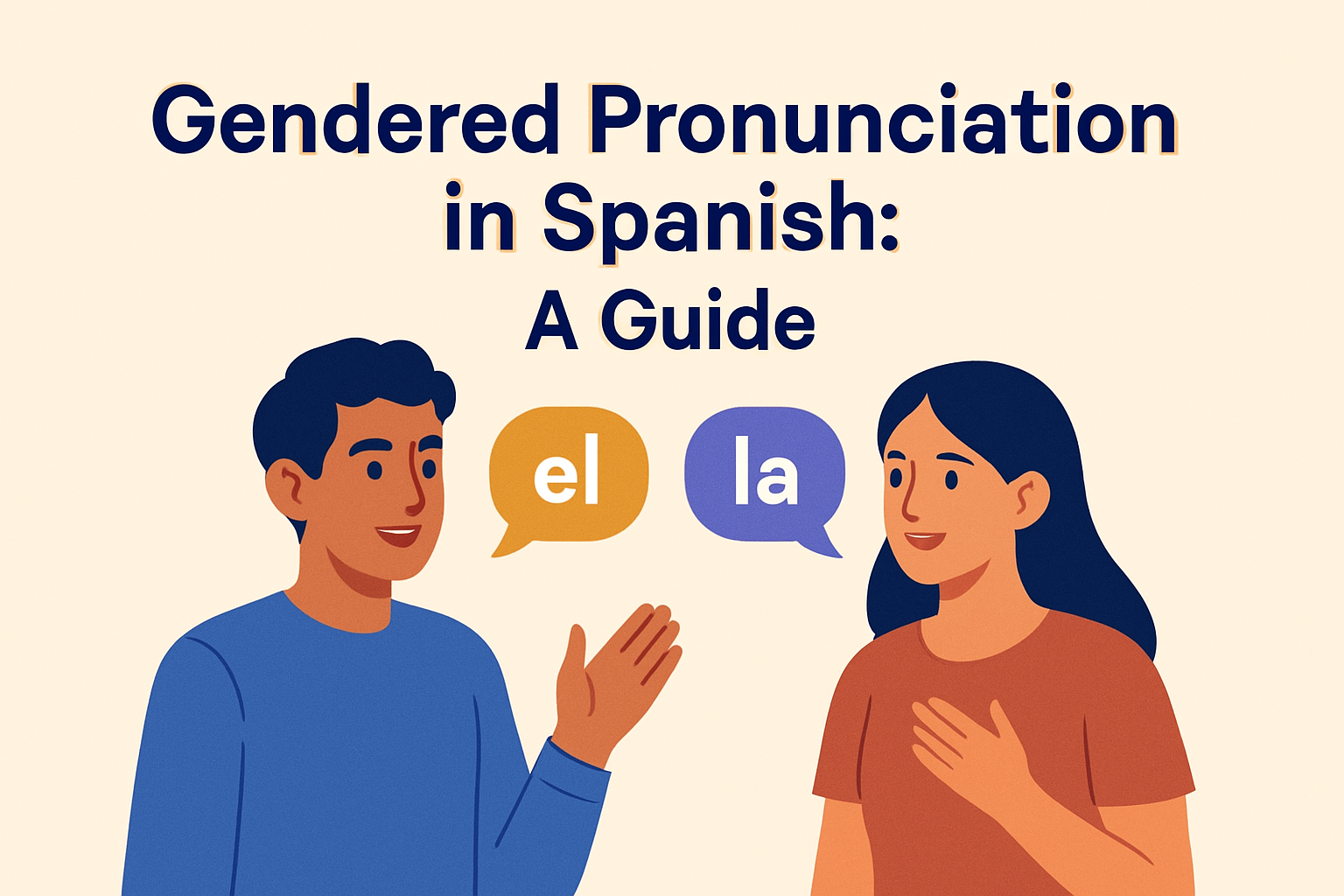
Gender in language refers to the classification of nouns and, by extension, adjectives and articles into male and female categories. In Spanish, this feature significantly influences pronunciation. Unlike English, where gender is mostly tied to biology for nouns like ‘man’ or ‘woman,’ Spanish applies gendered rules to inanimate objects—assigning each noun a masculine or feminine article, usually ‘el’ for masculine and ‘la’ for feminine. These classifications can affect end vowels and agreement patterns, subsequently impacting the rhythm and sound of sentences.
This guide will provide a comprehensive look at the nuances of gendered pronunciation in Spanish, peeling back the layers of these norms by discussing their applications through practical examples. As Spanish learners navigate the intricacies of gendered nouns, adjectives, and articles, they develop a deeper understanding of the language’s structure and flow. This makes communication more precise and immersive, enabling learners to sound more natural and culturally aware. By examining real-world applications and elaborating on this distinct phonological feature, readers stand to benefit from an enriched language skillset that transcends basic vocabulary and grammar.
Understanding Gendered Pronunciation Through Nouns
Nouns form the foundation of gendered pronunciation in Spanish. Each noun is either masculine or feminine, and this gender assignment impacts not only grammar but also pronunciation. Generally, masculine nouns end in the letter ‘-o,’ while feminine nouns end in ‘-a.’ However, there are exceptions, such as feminine nouns like ‘la mano’ (the hand) and masculine nouns like ‘el día’ (the day) that deviate from these norms.
For example, consider the feminine noun ‘amiga’ (female friend). The ‘a’ at the end conveys its gender and affects the adjectives and articles used with it. In contrast, ‘amigo’ (male friend) carries a different sound due to the ‘-o’ ending. These endings guide the melody and emphasis in sentences, significantly affecting how phrases are pronounced.
Pronunciation adjustments also occur in singular-plural shifts. The plural form of a noun can alter the rhythm of speech. For instance, ‘amiga’ becomes ‘amigas,’ and ‘amigo’ morphs into ‘amigos.’ The changes in these terminal sounds can affect the cadence and intonation, which in turn influences how native speakers perceive fluency.
Role of Articles in Gendered Pronunciation
In Spanish, the articles ‘el’ and ‘la’ serve as markers for masculine and feminine nouns, respectively. Similarly, ‘los’ and ‘las’ are their plural counterparts. These articles shape pronunciation by determining the initial sound of noun phrases. Their use not only aligns with gender norms but also aids in clarifying which noun is being referenced in a discourse.
- Masculine: ‘el libro’ (the book) becomes ‘los libros’ (the books), where the article’s vowel helps blend and smooth the transition into the noun’s initial sound.
- Feminine: ‘la casa’ (the house) becomes ‘las casas’ (the houses), demonstrating a similar blending effect.
The application of articles ensures clarity in communication, as they precede every noun. When spoken rapidly, articles and nouns form fluid, musical sequences that characterize Spanish pronunciation as melodic. For Spanish learners, correctly using articles is crucial—not only for grammar but also for achieving a similarly fluid intonation in speech.
The Influence of Adjectives and Agreement
Beyond nouns and articles, adjectives in Spanish require gender agreement, meaning their endings should match the gender of the nouns they describe. Such agreement reinforces gendered pronunciation patterns, impacting sentence structures and their rhythm.
For example, consider the phrase ‘una mujer alta’ (a tall woman) versus ‘un hombre alto’ (a tall man). Despite the descriptive adjective being the same in English, Spanish demands that the adjective agrees with the noun in both gender and number. Consequently, the endings of adjectives change to either ‘-o’ or ‘-a’ based on the noun’s gender, directly influencing pronunciation through sound shifts.
This agreement extends to pluralization as well. ‘Las mujeres altas’ (the tall women) and ‘los hombres altos’ (the tall men) showcase how adjective endings follow plural noun cues. These patterns help native listeners understand the subject’s dynamics before even fully understanding the sentence’s content, making tonal cues important markers in spoken Spanish.
Real-World Example: Conversational Contexts
The rules of gendered pronunciation are more than linguistic constructs; they directly apply to everyday conversation. Picture a Spanish-speaking scenario involving multiple characters, such as ordering food at a restaurant or commenting at a party. Conversational contexts demand that language users accurately use gendered conjugation, contributing to coherent dialogue and avoiding misunderstanding.
Suppose you ask for a menu in a Spanish restaurant: ‘¿Me trae el menú, por favor?’ (Could you bring me the menu, please?). Here, ‘el menú’ is masculine, dictating the sentence’s article choice and shaping its pronunciation. If the menu features a list of drinks, you might observe the gendered roles in beverages: ‘el café’ (the coffee) versus ‘la cerveza’ (the beer), ensuring even casual word exchanges maintain grammatical integrity.
These interactions highlight gendered pronunciation’s importance in conveying precise meanings and preserving clarity. Mispronouncing or misusing gendered elements could disrupt a conversation, hinting at a lack of fluency or misunderstood context. Ultimately, mastering gendered pronunciation in Spanish enhances a speaker’s competency within various social settings, establishing strong communication skills.
Spanish Gendered Pronunciation in the Modern World
In our modern, globalized world, appreciating and understanding linguistic nuances becomes critical. Spanish’s widespread usage means that more individuals are learning the language, aiming to interact smoothly in both personal and professional contexts. Addressing gendered pronunciation not only fosters inclusivity but also honors cultural authenticity in language use.
Language learning platforms and classroom instruction have started emphasizing gendered pronunciation as a crucial component of linguistic education. As society moves towards a broader acceptance of gender diversity, Spanish’s inherently gendered structure has also spurred conversations about neutral language adaptations. Nonetheless, current learning methods retain traditional gendered forms, projecting them as cultural touchstones necessary for effective and authentic communication.
| Masculine Example | Feminine Example |
|---|---|
| El libro (The book) | La mesa (The table) |
| Un hombre alto (A tall man) | Una mujer alta (A tall woman) |
| Los amigos (The male friends) | Las amigas (The female friends) |
Such tables help learners reinforce the distinctions between genders, supporting recalling and applying gendered norms in practical contexts. As ease of communication evolves, highlighting how specific these distinctions operate remains a foundational aspect of effective Spanish language learning.
Final Thoughts: Bringing It All Together
Gendered pronunciation in Spanish serves as a linchpin in understanding and using the language authentically. By dissecting gender’s pronunciation role in nouns, articles, and adjectives, this guide aimed to provide clarity and enhance fluency. Each component contributes to language’s musicality and cultural respect, promising enriched interactions between speakers.
The journey toward mastering gendered pronunciation in Spanish unlocks numerous benefits. It equips learners to express themselves more naturally, ensuring that even in diverse and dynamic linguistic settings, their communication stands out as comprehensible and fluent. The guide offered an approach grounded in real-world applicability, championing knowledge pivotal for navigating quotidian or conversational settings effortlessly.
As you embark on honing your Spanish language skills, embrace gendered pronunciation as a cornerstone. Apply these insights mindfully and observe how they shape both comprehension and expression in exhilarating new ways. Practicing consistently, engaging in immersive experiences, and celebrating the multifaceted nature of Spanish will undoubtedly pave the way for linguistic success. Ready to take that step? Dive deeper into Spanish language resources, connect with native speakers, and witness firsthand the transformative power of mastering these tonal nuances. ¡Buena suerte! (Good luck!)
Frequently Asked Questions
1. What is gendered pronunciation in Spanish?
Gendered pronunciation in Spanish refers to the way men and women might articulate words differently based on the language’s inherent gender distinctions. Spanish, like many other Romance languages, categorizes nouns—and the adjectives, articles, and pronouns that go with them—into two genders: masculine and feminine. This gendered structure affects how sentences and phrases are formed and pronounced. However, the concept of gendered pronunciation is not about different genders speaking entirely differently; it’s more about understanding and properly articulating the subtle nuances that align with the grammatical gender of the words in use. For instance, a word ending might change slightly depending on the gender it is aligned with, which is particularly important in plural forms or when adjusting adjectives to match the noun they are describing.
2. How does the gender of a noun affect pronunciation in Spanish?
In Spanish, the gender of a noun usually influences the ending of both the noun and its accompanying adjectives and articles, all of which can subtly shift pronunciation. Typically, masculine nouns often end in “-o” and feminine nouns in “-a.” This distinction isn’t just for written Spanish; it affects how the word is spoken. The pronunciation changes can be subtle but significant, involving the vowels that signal a word’s gender. For instance, “amigo” (male friend) will have a slightly different sound from “amiga” (female friend), originated by the vowel change at the end of the words. Additionally, when adjectives or articles are involved, their endings must also agree with the noun they modify, such as “el amigo feliz” (the happy male friend) versus “la amiga feliz” (the happy female friend). These alignment rules influence pronunciation at a more profound phonetic level, hinting at the importance of accent and intonation based on gender agreements.
3. Is there a difference in how men and women use or pronounce Spanish?
While the grammatical structure of Spanish remains consistent regardless of the speaker’s gender, social and cultural aspects can influence how men and women might prioritize certain elements of pronunciation. In some regional dialects or traditional settings, men and women might adopt slightly different speech patterns influenced by cultural expectations, emphasizing different syllables or intonation patterns. For example, in particular Latin American cultures, women might use more diminutive forms as a softer or more polite way of speaking, which can affect pronunciation through the use of specific suffixes like “-ita” or “-ito.” While these differences aren’t rigidly defined by the language itself, they can be influenced by societal factors and may vary widely depending on context, region, and personal style. Therefore, understanding these nuances can allow speakers to engage more effectively and sensitively in diverse Spanish-speaking communities.
4. How does understanding gendered pronunciation improve Spanish communication skills?
Understanding and mastering gendered pronunciation in Spanish can dramatically enhance communication skills by ensuring that speakers are using the language accurately and respectfully. Mastery of grammatical gender rules ensures that sentences are both grammatically correct and natural-sounding to native speakers. This involves knowing when to apply gender agreements with articles, adjectives, and verbs relating to nouns. Accurate gendered pronunciation can prevent misunderstandings, as incorrect usage may unintentionally alter meaning or imply something unintended. An appreciation for these nuances also demonstrates cultural competence and respect when communicating in diverse Spanish-speaking regions. By speaking with accurate gender distinction, learners can build a more authentic and effective connection with Spanish speakers, fostering richer, more authentic interactions in both personal and professional scenarios.
5. Are there any exceptions or complexities in Spanish gendered pronunciation?
Yes, Spanish, like any complex language, has exceptions and intricacies regarding gendered pronunciation. While most masculine nouns end in “-o” and most feminine nouns end in “-a,” there are numerous exceptions. Some feminine nouns might end in “-o,” and some masculine nouns in “-a,” such as “el día” (the day, which is masculine) and “la mano” (the hand, which is feminine). Also, certain nouns are gender-ambiguous and have the same form for both genders, relying on the context or accompanying articles to determine gender. Moreover, pronunciation complexities can arise with nouns that change meaning with gender, such as “el capital” (money) and “la capital” (the city of a capital). Grasping these exceptions involves experiencing the language in context and familiarizing oneself with regional dialects and cultural norms that may influence their application. Exploring these nuances in depth fosters a deeper understanding of the language, appreciating its fluidity and variabilities that add to its richness and expressive capability.