Community and family shape daily life in Spain in ways that visitors notice immediately and residents often take for granted. The Spanish approach to community and family is not a single rigid model, but a living set of habits, expectations, and values that influence how people eat, celebrate, work, raise children, support elders, and relate to neighbors. Understanding those patterns matters because they explain much more than social etiquette. They help decode housing choices, school routines, public festivals, friendship circles, caregiving, and the pace of everyday interaction across cities, towns, and villages.
In practice, Spanish community life rests on proximity, repetition, and shared public space. People see the same relatives, shopkeepers, parents at school gates, and neighbors in plazas and cafés week after week, which creates dense networks of familiarity. Family, in this context, usually extends beyond the nuclear household. Grandparents, adult siblings, cousins, godparents, and in-laws often play active roles in childcare, meals, celebrations, and decision-making. Community refers both to formal local structures, such as municipalities, parish groups, associations, and neighborhood organizations, and to the informal social fabric built through regular contact. These bonds are not merely sentimental. They function as practical systems of mutual aid, identity, and belonging.
I have seen this most clearly in ordinary routines rather than dramatic moments. A child is picked up from school by a grandparent because both parents are working. A local bar owner knows which customer’s mother is unwell and asks about her recovery. Entire apartment buildings adjust to the sound and schedule of communal festivals. A town square becomes an intergenerational meeting place every evening. These scenes show why the subject deserves a close look. Spain is a modern European country with high urbanization, digital connectivity, and changing gender roles, yet strong family and community ties still organize daily life. To understand Spain well, you need to understand the social systems behind those interactions.
This hub article explains the core features of Spanish family and community culture, including kinship patterns, hospitality, neighborhood life, celebrations, caregiving, religion, migration, and regional variation. It also addresses common questions directly: Why are family ties so strong in Spain? How important are grandparents? What role do local festivals play? How do modern pressures affect traditional community life? By covering these themes together, the article serves as a foundation for deeper reading across the broader Spanish Community and Interaction topic.
Family as the central social unit
Family remains the primary reference point in Spanish social life. Even when individuals live independently, family obligations and family participation continue to shape choices about housing, finances, childcare, holidays, and elder support. This pattern is reinforced by both cultural expectation and economic reality. Spain has historically had high rates of home-centered socializing, and during periods of youth unemployment or expensive housing, many young adults stay longer in the parental home than in northern Europe. According to Eurostat trends over recent years, the average age of leaving the family home in Spain has remained above the European Union average, reflecting both material constraints and social acceptance of close intergenerational living.
That closeness should not be mistaken for uniform conservatism. Spanish families vary widely in structure. Married couples with children, cohabiting partners, divorced and blended families, same-sex parents, single-parent households, and transnational families all form part of today’s reality. What persists is not one ideal household type, but a strong expectation that family members stay involved in one another’s lives. Sunday meals, birthday lunches, long phone calls with parents, and regular cousin gatherings still anchor many calendars. In my experience, even highly independent Spaniards often define reliability through family presence: who shows up, who helps, who stays in contact, and who participates in milestones.
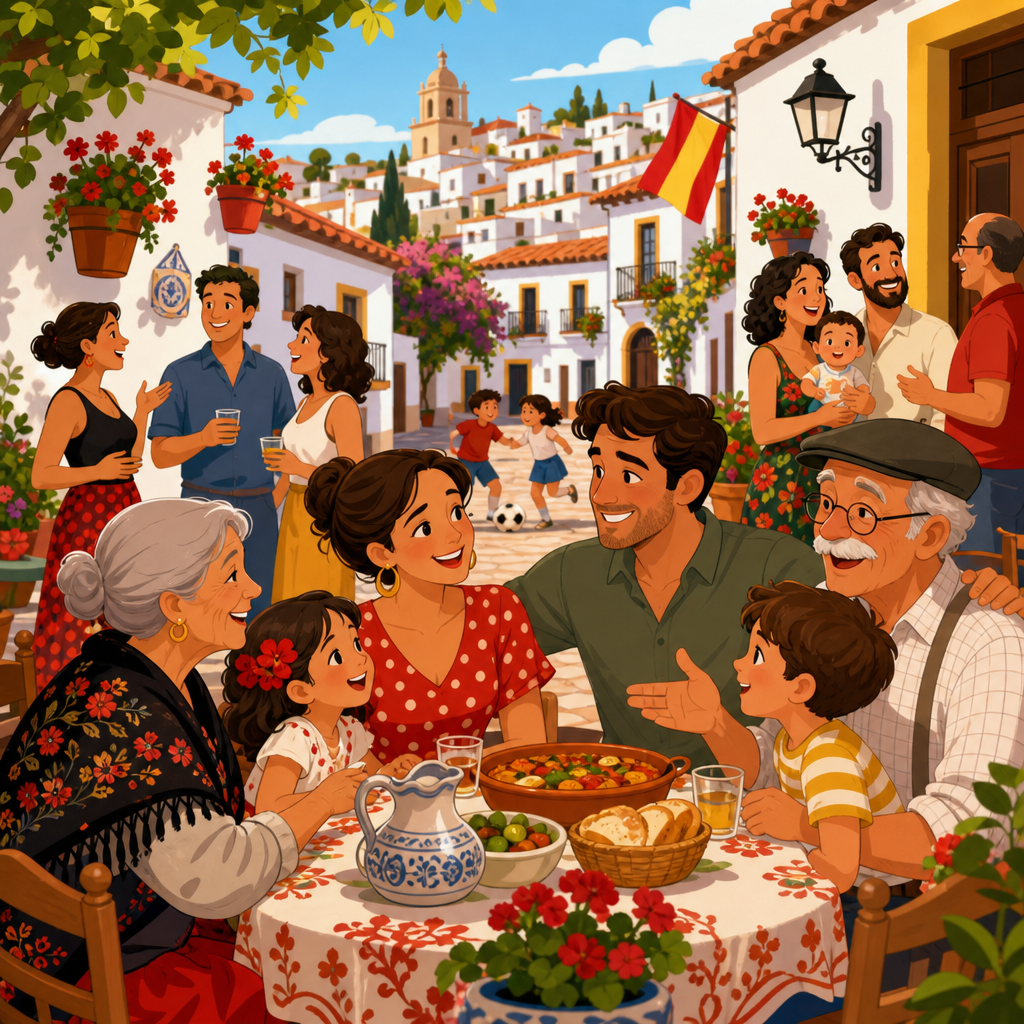
This helps explain why family events in Spain often feel collective rather than private. Baptisms, communions, weddings, funerals, saint’s days, village feasts, and even casual summer dinners can draw a broad network of relatives. The event itself matters, but so does reaffirming the family unit in public. Children learn early that belonging includes obligations. Adults are expected to attend, contribute, and maintain ties, not only when convenient but especially when support is needed.
Community life in streets, plazas, and local institutions
Spanish community life is deeply tied to place. The built environment supports interaction: walkable streets, central plazas, mixed-use neighborhoods, local markets, bars, bakeries, pharmacies, and schools create repeated points of contact. In many municipalities, especially small and medium-sized ones, people do not schedule every interaction in advance. They encounter one another naturally during the paseo, the evening stroll, while shopping or sitting outdoors. This rhythm turns public space into social infrastructure.
Local institutions strengthen those ties. Town halls, neighborhood associations, sports clubs, parent associations, parish groups, cultural centers, and peñas linked to festivals all provide structured ways to participate. In cities, these networks can be more segmented, but they remain important. Madrid and Barcelona may feel fast-paced, yet district identity is still meaningful, and local markets or community centers often serve as social anchors. In smaller towns, the social web is denser, and reputations travel quickly. That can create warmth and accountability, though it can also produce social pressure and reduced privacy.
The Spanish concept of convivencia, living together in a workable social balance, is central here. It does not mean the absence of conflict. Rather, it reflects the expectation that people share space repeatedly and must manage relationships over time. Noise in apartment blocks, use of common areas, festival disruptions, and neighborhood disagreements all test this principle. Successful communities rely on negotiation, tolerance, and familiarity more than strict individual isolation.
| Area of life | Common Spanish pattern | Practical effect on community |
|---|---|---|
| Public space | Frequent use of plazas, terraces, parks, and promenades | Creates regular informal contact across generations |
| Meals | Long family lunches and group dining | Reinforces kinship and friendship networks |
| Childcare | Grandparent involvement is common | Shares labor across the family system |
| Festivals | Strong participation in local fiestas | Builds civic identity and neighborhood cohesion |
| Housing | Close family proximity is often preferred | Makes support and frequent visits easier |
Meals, hospitality, and the social meaning of time
To understand the Spanish approach to community and family, look closely at meals. Eating together is not a side activity. It is one of the main ways relationships are maintained. Lunch has traditionally been the principal meal, especially on weekends, and family gatherings around the table can last for hours. Shared dishes, multiple courses, sobremesa, the conversation that continues after the meal, and a relaxed approach to lingering all communicate that time spent together has value in itself.
Hospitality often appears informal rather than ceremonial. Guests may be invited with little notice, relatives may drop in, and children are commonly integrated into adult social settings rather than separated early. A home, village bar, or family restaurant can all become extensions of communal life. This does not mean every host performs elaborate rituals. The key point is accessibility. People are expected to make room for others, literally and socially.
Time also works differently in social contexts. Spanish schedules can seem flexible to outsiders, but the pattern is coherent. Late dinners, evening socializing, and weekend family lunches reflect climate, work rhythms, and long-established habits. The result is that community often becomes most visible after formal work hours, when streets fill and social interaction intensifies. For anyone trying to build relationships in Spain, showing up consistently matters more than appearing efficient.
Grandparents, caregiving, and intergenerational reciprocity
Grandparents occupy a pivotal position in many Spanish families. They provide emotional continuity, practical childcare, historical memory, and often financial support. During the years following the 2008 financial crisis, many households relied on pensions from older relatives to stabilize family budgets. That period revealed how intergenerational solidarity functions in Spain not as an abstract virtue but as an economic safety net. Even today, grandparents commonly collect children from school, supervise afternoon routines, and host extended family meals.
The exchange is reciprocal, at least in principle. Adult children are widely expected to support aging parents, visit regularly, help with appointments, and organize care when independence declines. Spain’s long-term care system includes public services, but family remains the first line of responsibility. This creates strengths and strains. Strong kin networks reduce isolation and can improve continuity of care. At the same time, caregiving burdens often fall unevenly, historically on women, although that is changing gradually as roles shift.
When I have spoken with families managing elder care, the same tension appears repeatedly: affection and duty are inseparable. Many people feel proud to care for parents at home, yet they also confront burnout, housing limitations, and complex medical needs. A balanced view of Spanish family culture must acknowledge both the warmth of intergenerational support and the pressure it can create.
Festivals, religion, and collective identity
Local festivals are among the clearest expressions of Spanish community culture. From Semana Santa processions in Andalusia to Fallas in Valencia, San Fermín in Pamplona, and countless patron saint festivals in villages across the country, these events mobilize families, associations, volunteers, musicians, and local authorities. Participation often begins in childhood and continues across generations, which turns festivals into living archives of community identity.
Religion still matters in this landscape, though unevenly. Spain has secularized significantly in recent decades, and regular church attendance has declined. Yet Catholic traditions continue to shape rites of passage, calendars, symbolism, and public celebrations. Many families that are not strongly observant still baptize children, attend First Communions, or participate in Holy Week events because these occasions connect them to family history and local belonging. In other words, religious practice may be weaker than before, but cultural Catholicism remains socially influential.
Festivals also demonstrate how Spanish communities merge private and public life. Families prepare food, gather relatives, dress children for processions, and spend hours outdoors together. Neighbors collaborate on decorations, music, logistics, and fundraising. The social payoff is substantial: collective memory is renewed, newcomers can integrate, and residents feel attached to a shared place rather than merely occupying it.
Change, diversity, and the future of Spanish family networks
No serious account of Spanish community and family life can ignore change. Urbanization, tourism, migration, remote work, rising housing costs, delayed parenthood, lower birth rates, and shifting gender expectations are reshaping the social fabric. Spain’s fertility rate has been among the lowest in Europe for years, and smaller family sizes affect how care and support can be distributed. At the same time, immigration from Latin America, North Africa, Eastern Europe, and elsewhere has expanded the meaning of Spanish community, adding new languages, religions, and family patterns to local life.
Regional variation also matters. Family customs in Galicia, Catalonia, the Basque Country, Andalusia, Castile, the Balearic Islands, or the Canary Islands can differ in tone, schedule, language, and local tradition. Rural areas usually sustain denser interdependence, while large cities may encourage more elective, friend-based networks. Still, the broader pattern persists: relationships are expected to be maintained actively, not left to chance.
Digital communication has altered how those ties are managed. Family WhatsApp groups coordinate meals, school pickups, holiday plans, and elder check-ins with constant efficiency. Yet technology has mostly extended existing bonds rather than replaced face-to-face contact. In Spain, presence still carries special weight. Being there for lunch, for the festival, for the hospital visit, or for the evening walk remains the measure of commitment.
The strongest insight is simple: the Spanish approach to community and family is built on repeated participation. People belong by showing up, sharing time, and remaining available across generations. That approach gives social life resilience, especially in moments of crisis, because support is distributed through relationships people have already practiced for years. It also explains why Spanish neighborhoods and families often feel tightly woven even when modern life is changing their structure.
For readers exploring Spanish Community and Interaction more broadly, this hub offers the core framework. Family is the primary support system, community is reinforced through public space and local institutions, meals and festivals sustain belonging, and intergenerational ties carry both comfort and responsibility. The details vary by region, class, age, and household type, but the underlying pattern is consistent: social connection is treated as part of ordinary life, not an optional extra.
If you want to understand Spain more accurately, pay attention to the everyday mechanics of closeness. Notice who gathers at lunch, who watches the children, who checks on older relatives, who organizes the fiesta, and who lingers in the plaza. Those habits reveal the values beneath the surface. Use this article as your starting point, then continue through the related pages in this subtopic to explore hospitality, local customs, social etiquette, neighborhood interaction, and intergenerational life in greater detail.
Frequently Asked Questions
1. How does family life typically influence everyday routines in Spain?
Family life plays a central role in everyday routines across Spain, and that influence often shows up in practical, visible ways. Meals are a clear example. Lunch is traditionally the main meal of the day, and although modern work schedules have changed this pattern in some urban settings, the idea that eating together matters remains deeply rooted. Family gatherings around the table are not only about food, but also about conversation, checking in on one another, and maintaining close ties across generations. Dinner is often later than in many other countries, which can surprise visitors, but it reflects broader social rhythms rather than simple preference.
Family also shapes how time is organized. Parents, grandparents, siblings, aunts, uncles, and cousins often remain actively involved in one another’s lives well into adulthood. It is common for adult children to maintain frequent contact with parents and to rely on family networks for help with childcare, transportation, housing transitions, and elder support. In many households, grandparents play an especially important role in day-to-day family life, including picking children up from school, preparing meals, or helping during busy workweeks. This does not mean every family follows the same pattern, but interdependence is generally viewed as normal and positive rather than as a lack of independence.
Another key point is that Spanish family culture often places high value on presence. Showing up for birthdays, baptisms, weddings, local festivals, Sunday meals, and other family events is part of how relationships are maintained. Emotional closeness is reinforced through regular contact, shared routines, and mutual obligation. Even when younger generations embrace more individual lifestyles, the expectation of staying connected to family usually remains strong. That is one reason housing choices, work decisions, and even where people choose to live are often influenced by proximity to relatives and the desire to remain part of a close support network.
2. What role does the wider community play in Spanish social life?
Community in Spain is often experienced as something immediate and local. It is built through neighborhoods, plazas, schools, cafés, markets, apartment buildings, sports clubs, and recurring public events. In many places, daily life still has a strong street-level social dimension. People walk, stop to talk, recognize familiar faces, and participate in shared routines that make the neighborhood feel like a social environment rather than just a place to sleep. This local connection helps explain why everyday interactions can feel warm, informal, and socially dense to outsiders.
The concept of community is reinforced by frequent face-to-face contact. Parents may know other families from school drop-offs, older residents may have long-standing relationships with nearby shopkeepers, and neighbors may interact regularly in communal buildings or public spaces. Festivals and religious or civic celebrations also strengthen these bonds. Whether the event is a local saint’s day, a town fair, a neighborhood dinner, or a seasonal procession, collective participation helps create a sense of belonging that goes beyond the individual household. These traditions are not just entertainment; they are mechanisms for social continuity.
Importantly, community life in Spain often carries an implicit expectation of mutual awareness and informal support. People may look out for elderly neighbors, help relatives and friends navigate bureaucratic challenges, or step in during family emergencies. That support system can be highly resilient because it is rooted in repeated personal contact rather than in formal structures alone. At the same time, this community-oriented style can also mean that privacy functions differently than in more individualistic societies. People may ask personal questions more readily, express opinions more directly, or assume a higher degree of familiarity. In context, that behavior is often meant as engagement and care rather than intrusion.
3. Why are grandparents and extended family so important in Spain?
Grandparents and extended family are often essential to the practical and emotional functioning of Spanish family life. One reason is historical continuity. Spain has long maintained strong intergenerational ties, and even as the country has modernized, these relationships remain deeply valued. Grandparents are not always seen as peripheral relatives who visit occasionally; in many families, they are active participants in childrearing, household support, and family decision-making. Their presence can shape the rhythm of the week, school logistics, holiday planning, and everyday care.
Economic and social realities also reinforce the importance of extended family. In periods of unemployment, rising housing costs, or limited childcare options, family networks often provide stability. Adult children may live with parents longer than is common in some other countries, especially while studying, saving money, or searching for stable employment. Likewise, older parents may rely on adult children and grandchildren as they age. This arrangement is often understood less as dependence and more as reciprocity across generations. Each age group contributes in different ways at different moments of life.
There is also a cultural dimension that goes beyond practical help. Extended family gatherings preserve traditions, regional customs, recipes, stories, and family identity. Children often grow up with regular contact not only with grandparents but also with cousins, godparents, and family friends who occupy quasi-family roles. These networks create a broad sense of belonging and continuity. While family structures in Spain are increasingly diverse, including single-parent households, blended families, and more geographically dispersed relatives, the broader cultural ideal still emphasizes connection, shared responsibility, and sustained intergenerational contact.
4. How do Spanish values around community and family affect children and parenting?
Parenting in Spain is often shaped by the belief that children are integrated into family and social life rather than separated from it. Children commonly accompany adults to restaurants, family visits, public celebrations, and evening gatherings, which can surprise visitors from places where children’s schedules are more strictly segmented from adult social life. This does not mean there are no boundaries, but it does reflect a broader assumption that children learn social behavior by participating in communal spaces and shared routines. They are expected to be present, included, and gradually socialized through experience.
Family support networks strongly influence how children are raised. Grandparents frequently help with school pickups, meals, and after-school care, especially when both parents work. This wider caregiving circle can provide children with a strong sense of security and continuity, while also easing pressure on parents. In many households, parenting is not understood as an isolated task carried solely by the nuclear family. Instead, it often unfolds within a web of kinship and trusted relationships that share responsibility in informal but meaningful ways.
Spanish parenting culture also tends to emphasize emotional closeness, sociability, and adaptability to group life. Children often grow up accustomed to spending time with relatives of different ages and participating in collective events, which can strengthen communication skills and a sense of belonging. School routines, extracurricular activities, and local traditions often connect families to one another, further reinforcing the idea that raising children is embedded in community life. Of course, parenting styles vary by region, class, and personal philosophy, and contemporary Spanish families are as diverse as any others. Still, the enduring pattern is one in which children are raised not only within a household, but within an interconnected social world.
5. What should visitors understand to better appreciate Spanish family and community culture?
Visitors should understand first that Spanish family and community culture is built around relationships, time spent together, and ongoing social presence. What may look from the outside like a casual coffee, a long lunch, a crowded family gathering, or a late evening stroll is often part of a much deeper social structure. These shared moments help maintain trust, reinforce belonging, and carry obligations that are taken seriously even when they are expressed informally. To appreciate Spanish social life, it helps to see these habits not as inefficiencies or mere customs, but as ways of organizing care, identity, and mutual support.
It is also useful to recognize that Spain is not culturally uniform. Regional identities, urban-rural differences, class dynamics, migration patterns, and generational change all shape how community and family are lived. Family routines in Madrid may differ from those in Seville, Bilbao, Valencia, or a small Galician town. Some households are highly traditional, while others are more individualistic or internationally influenced. Yet across this diversity, a few themes remain common: close family ties, strong intergenerational contact, social value placed on gathering in person, and a neighborhood culture that can still be more relational than many visitors expect.
Finally, visitors will understand Spain better if they pay attention to the social meaning behind everyday behavior. Greeting people warmly, making time for conversation, showing up for shared occasions, and maintaining contact with relatives are not minor gestures. They are part of the cultural framework that supports both family life and community cohesion. Appreciating that framework can make daily interactions easier to interpret and more rewarding to experience. It also offers a deeper insight into why so many aspects of Spanish life, from meal schedules to childcare arrangements to public celebrations, revolve around the enduring importance of being together.