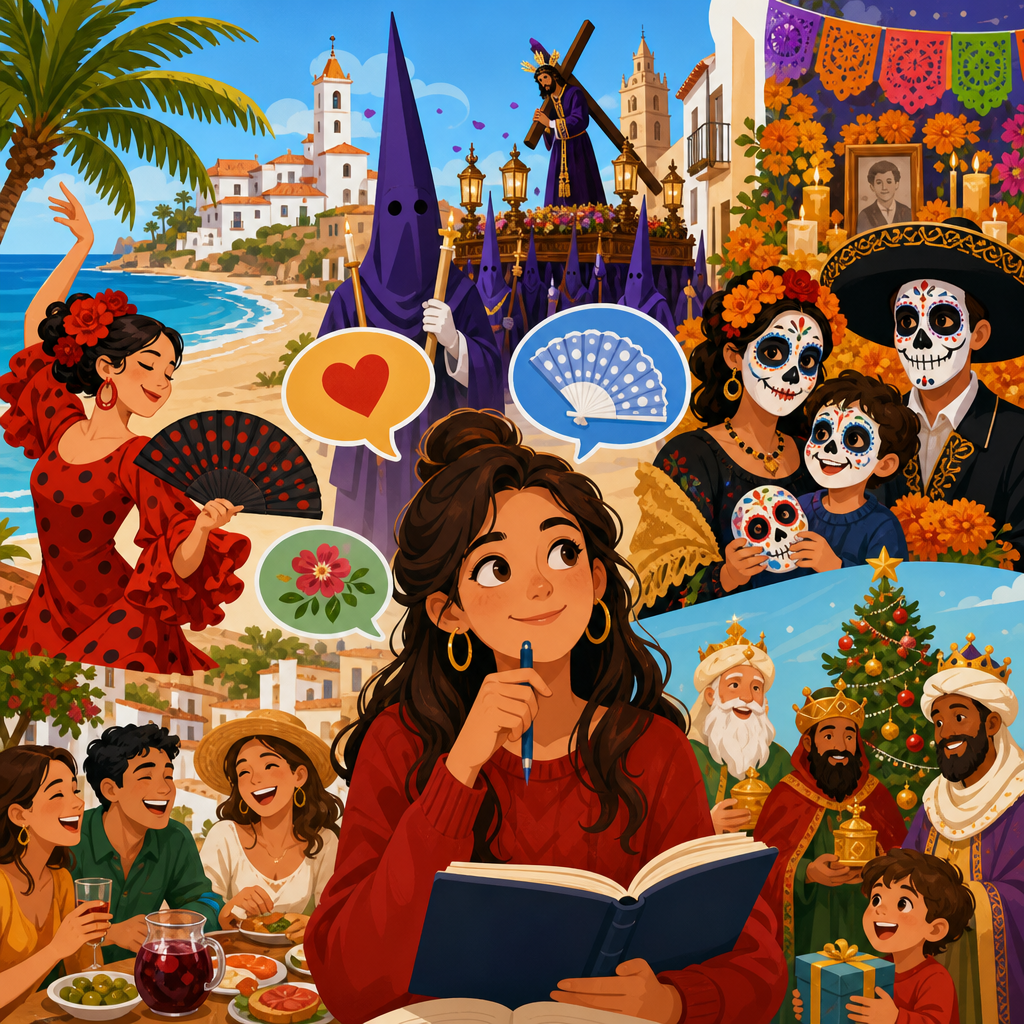
Spanish holidays do far more than mark days off on a calendar; they shape vocabulary, greetings, regional identity, storytelling, and the everyday rhythm of communication across the Spanish-speaking world. When people talk about las fiestas, they are not referring only to celebrations in the abstract. They are describing a social system of shared meals, public rituals, religious observance, music, humor, and neighborhood customs that leave a clear imprint on the language people use at home, in schools, in the media, and in the street. For anyone studying Spanish community and interaction, holidays are one of the most practical windows into how language actually lives.
In this context, “Spanish holidays” includes both celebrations in Spain and traditions across Latin America and other Spanish-speaking communities. Some are religious, such as Semana Santa, Navidad, and Día de Reyes. Others are civic, historical, or local, such as the Feria de Abril in Seville, Las Fallas in Valencia, Día de la Independencia in Mexico, or Carnival in the Caribbean. A holiday can be national, regional, municipal, or even neighborhood-based. That distinction matters because Spanish changes with place, and holiday language often preserves local words that standard textbooks barely mention.
The connection between holidays and language works in several ways. First, celebrations generate specialized vocabulary: processions, costumes, foods, songs, and rituals all need names. Second, they reinforce forms of address and social formulas, from formal congratulations to affectionate holiday greetings. Third, they keep older expressions alive. I have seen learners understand grammar much faster once they hear how real families repeat phrases every December, every Holy Week, or every patron saint festival. Fixed expressions stick because they are tied to memory, emotion, and repetition.
Holidays also matter because they reveal how Spanish handles politeness, identity, and cultural nuance. Saying Felices fiestas, Feliz Navidad, Próspero año nuevo, or Que la pases bien is never just a literal translation exercise. The choice signals region, relationship, and context. In Spain, a person may refer broadly to las fiestas when talking about a town celebration. In Mexico or much of Central America, references to a patron saint’s day, a posada, or a civic commemoration carry different social expectations. To understand the language well, you need to know what the holiday asks people to do and say.
Why Holidays Leave a Lasting Mark on Spanish
Holiday language becomes durable because it is repeated across generations and anchored in highly visible public events. In sociolinguistic terms, holidays create predictable speech situations: greetings, invitations, blessings, announcements, songs, prayers, and toasts. Those repeated situations stabilize expressions. That is why learners quickly encounter phrases like ¡Feliz cumpleaños!, ¡Feliz Año Nuevo!, Que cumplas muchos más, buen provecho, and salud. They are tied to ceremonial moments, and ceremony preserves language.
Another reason is register. During holidays, people move between formal and informal Spanish more often than usual. A city hall poster may announce Fiestas patronales, while friends message each other ¿Vas a la verbena? or Nos vemos en la cabalgata. A grandmother may use religious language, children may use playful diminutives, and journalists may rely on inherited formulas. This coexistence of registers gives Spanish learners a clear map of how context shapes word choice. It also explains why holiday vocabulary is an efficient entry point into real social Spanish.
Regionalism is just as important. A single celebration can produce different words depending on location. Christmas gatherings may involve turrón in Spain, ponche in Mexico, hallacas in Venezuela, or panetón in Peru. The language of the holiday reflects local history, migration, and food culture. In practice, holidays function as lexical archives. They store indigenous influences, Arabic legacies in Iberia, Catholic terminology, Afro-Caribbean musical vocabulary, and modern media phrases all in one place. That mixture is one reason holiday speech is so revealing.
Key Holiday Vocabulary and the Social Situations Behind It
The most useful way to learn holiday Spanish is by pairing terms with the situations where people actually use them. Broad nouns include fiesta (party or festival), feria (fair or festival), romería (pilgrimage festival), procesión (procession), verbena (outdoor festivity), and cabalgata (parade, often with riders or holiday pageantry). Food terms such as roscón, buñuelos, tamales, and uva often appear in seasonal conversation. Music and performance bring words like villancico, comparsa, chirigota, and banda.
Greeting formulas deserve special attention because they are among the most repeated holiday expressions. Felices fiestas is broad and inclusive. Feliz Navidad and Próspero Año Nuevo are explicit seasonal wishes. On birthdays, Feliz cumpleaños is standard, but many countries add regional patterns such as Que Dios te bendiga, Que cumplas muchos más, or a local birthday song variation. During saint days or local festivals, a simple ¿Vas a salir? can imply participation in public celebration, not merely going outdoors. Meaning expands with cultural context.
| Holiday or Event | Common Spanish Terms | How the Language Functions |
|---|---|---|
| Navidad | Nochebuena, villancicos, belén, aguinaldo | Creates greetings, family invitations, and vocabulary around food, gifts, and religious scenes. |
| Semana Santa | cofradía, paso, nazareno, saeta | Preserves formal, religious, and highly regional terminology in public speech. |
| Día de Reyes | cabalgata, roscón, Reyes Magos | Shapes childhood vocabulary, gift language, and family routines in early January. |
| Carnaval | disfraz, comparsa, desfile, murgas | Encourages playful language, satire, costume terms, and public performance speech. |
| Día de los Muertos | ofrenda, calavera, altar, cempasúchil | Combines family memory, indigenous terminology, and poetic expressions about death. |
Religious Celebrations and Their Linguistic Influence
Many of the most enduring holiday expressions in Spanish come from religious calendars. In Spain, Semana Santa has a dense vocabulary that outsiders often underestimate. Words such as cofradía, hermandad, costalero, trono, and saeta are not decorative synonyms; they refer to specific institutions, roles, and art forms. In Seville or Málaga, these words enter ordinary conversation every spring. Local media, school schedules, family planning, and tourism language all adapt to the season. That annual repetition keeps highly specific terminology current.
Christmas is equally influential but broader in geographic spread. In Spain, Nochebuena, Nochevieja, and Día de Reyes structure the end-of-year calendar. The custom of eating twelve grapes at midnight popularizes las doce uvas as a fixed phrase. In Mexico, las posadas introduces vocabulary around reenactment, hospitality, songs, and candles. In Puerto Rico, extended Christmas seasons have helped preserve greetings and musical terms tied to parrandas. Religious holidays are therefore not only theological references; they are engines of repeated speech.
These celebrations also influence metaphor. Terms first learned in ritual settings often become figurative in ordinary language. Procesión can refer jokingly to any slow group movement. Milagro is used for an unlikely success. Pasión, rooted in sacred narrative, becomes a common word for intense enthusiasm. Even where religiosity has declined, the linguistic residue remains strong. This is common in Spanish-speaking societies where Catholic calendars historically organized school breaks, markets, and municipal life, leaving lexical traces long after practice becomes more secular.
National, Civic, and Regional Festivals as Language Carriers
Not every influential holiday is religious. Civic and regional festivals often shape language just as strongly because they localize identity. In Spain, San Fermín immediately evokes terms like encierro, peña, and chupinazo. Las Fallas brings ninot, mascletà, and cremà, words that are difficult to translate cleanly because they describe specific Valencian practices. These terms do not survive merely in tourist brochures. Residents use them naturally, and local newspapers treat them as shared knowledge.
Across Latin America, independence days produce another layer of language. In Mexico, September celebrations activate patriotic formulas, references to el Grito, and vocabulary around national symbols and food. In Colombia, local fairs generate terms associated with parades, queens, horse culture, or music depending on the region. In the Dominican Republic and Cuba, carnival and patron saint festivities overlap with words shaped by African, Indigenous, and European influences. Holiday language is therefore one of the clearest places to observe how Spanish absorbs historical contact and makes it ordinary.
Regional festivals also demonstrate how language can index belonging. If someone understands the difference between a feria and a romería, or knows why a town says sus fiestas mayores, that person sounds socially informed, not just grammatically correct. I have watched advanced learners gain trust quickly in conversation once they can ask specific questions about a local celebration instead of speaking in generic terms. Holiday vocabulary shows cultural listening, and that changes interaction.
Food, Music, and Family Rituals in Everyday Speech
Some of the strongest holiday language comes from what people eat, sing, and do together. Food words often become season markers. Mentioning torrijas can suggest Holy Week in Spain. Rosca de Reyes points to Epiphany traditions in Mexico and beyond. Buñuelos, tamales, lechón, and ponche carry family associations that go beyond ingredients. In speech, these foods trigger invitations, nostalgia, and regional pride. Holiday meals therefore function as practical vocabulary lessons embedded in lived experience.
Music works similarly. Villancicos are not simply Christmas carols; they are part of childhood memory and community performance. Carnival traditions keep terms like murga and comparsa active. In Andalusia, people discussing a saeta are referring to a highly specific devotional song form. Because music is participatory, it strengthens pronunciation, rhythm, and formulaic language. Refrains, chants, and repeated choruses help preserve older words and regional accents with unusual force.
Family ritual adds another layer: commands, blessings, and routines. During celebrations, children hear dale las gracias, saluda a tu tía, pide la bendición, or trae la bandeja. Those phrases teach interactional Spanish, not textbook Spanish. They explain how community etiquette is transmitted in ordinary households.
How Learners Can Use Holidays to Understand Real Spanish
If your goal is stronger Spanish community and interaction skills, holidays are one of the most efficient study frameworks. Start with a calendar approach. Choose major celebrations for Spain and several Latin American countries, then learn the vocabulary, greeting formulas, foods, and public rituals tied to each one. Build mini word sets around events rather than isolated nouns. For example, connect cabalgata, roscón, and Reyes Magos instead of memorizing them separately. Thematic clustering improves recall because it mirrors how native speakers store cultural knowledge.
Next, compare regional usage. The Royal Spanish Academy documents standard forms, but local newspapers, tourism boards, municipal event pages, and radio clips show how people really speak during festivals. A learner who reads a Semana Santa schedule from Seville, a Día de Muertos article from Mexico, and a Navidad recipe post from Puerto Rico will notice differences in tone, vocabulary, and assumptions. That comparison is where cultural fluency develops. It teaches not only what a word means, but who uses it, when, and why.
Finally, practice with purpose. Write holiday greetings, listen to songs, watch parade coverage, and ask native speakers about one celebration from their hometown. Most people respond warmly because holidays invite storytelling. That storytelling is the real reward. Spanish holidays shape the language by attaching words to memory, identity, and recurring human interaction. Learn the celebrations, and you learn how communities speak when the moment matters most. Use this hub as your starting point, then explore each holiday in depth and bring those phrases into your own Spanish conversations.
Frequently Asked Questions
How do Spanish holidays influence everyday vocabulary and expressions?
Spanish holidays shape language by giving people a shared set of words, phrases, and references that go far beyond the holiday itself. Terms like fiesta, feria, romería, procesión, verbena, and puente all carry specific cultural meanings, and native speakers understand them not just as dictionary terms but as part of lived social experience. A puente, for example, is more than a long weekend; it reflects the way people organize work, travel, and family time around feast days and public holidays. Likewise, saying someone is in a ambiente festivo or that a town is de fiesta signals a whole mood of collective celebration, noise, food, music, and public life.
Holiday language also enters idioms, greetings, and seasonal routines. During Christmas, Easter, local patron saint festivals, and national celebrations, people use formulas that may sound simple but carry social warmth and cultural continuity, such as ¡Felices fiestas!, ¡Feliz Navidad!, ¡Feliz Día de Reyes!, or ¡Que disfrutes la feria! In many places, these expressions come with expected conversations about meals, travel plans, religious observance, or family visits. Over time, repeated holiday speech becomes part of everyday communication, helping preserve tradition while also introducing younger speakers to culturally loaded vocabulary they might not learn from grammar books alone.
Why do holiday greetings and seasonal phrases matter so much in Spanish-speaking cultures?
Holiday greetings matter because in Spanish-speaking cultures language is often used to reinforce closeness, courtesy, and participation in communal life. A greeting tied to a holiday does more than acknowledge the date; it signals belonging. When someone says ¡Feliz Semana Santa!, ¡Felices Pascuas!, or ¡Que pases unas buenas fiestas!, the phrase functions as a social bridge. It recognizes shared customs and shows attentiveness to another person’s family, beliefs, and local traditions. Even in more secular settings, these greetings remain important because they connect individuals to the rhythm of the calendar and to the expectations of community life.
These phrases also reveal how language adapts to region, generation, and context. In one country, people may emphasize religious wording; in another, they may prefer broader seasonal wishes. Some expressions are formal and suitable for workplaces or public announcements, while others are intimate and used among relatives and friends. This flexibility is part of what makes holiday language so powerful. It teaches learners that Spanish is not only about grammar and vocabulary but also about choosing the right tone for the right moment. In practical terms, understanding these greetings helps speakers sound more natural, more respectful, and more culturally aware.
How do regional festivals and local traditions affect the Spanish language?
Regional festivals have a major influence on Spanish because they preserve local vocabulary, pronunciation habits, and cultural references that may not be equally visible across the entire Spanish-speaking world. A festival in Andalusia, a patron saint celebration in Mexico, a carnival in the Caribbean, or a harvest event in the Andes may all generate distinct words, songs, jokes, chants, and nicknames. These local traditions often introduce terms tied to costumes, foods, dances, musical instruments, religious images, and neighborhood roles. As a result, holiday language becomes one of the clearest ways regional identity is expressed and maintained.
These celebrations also keep older forms of speech alive. Announcements, prayers, public songs, and ceremonial language can preserve expressions that might sound formal or old-fashioned in ordinary conversation but remain meaningful during festive occasions. At the same time, festivals encourage linguistic creativity. Communities invent slogans, humorous sayings, and recurring phrases that become recognizable markers of local pride. This means holidays do not merely reflect regional Spanish; they actively help produce and sustain it. For language learners and readers, this is an important reminder that Spanish is not a single uniform system. It is a living language deeply shaped by place, and holidays are one of the most visible stages where that diversity comes to life.
What role do holidays play in storytelling, memory, and cultural identity in Spanish?
Holidays are central to storytelling in Spanish because they provide a shared backdrop for family memory, neighborhood history, and national identity. People often organize personal stories around festive dates: who came home for Christmas, what happened during a town fair, how a procession was experienced as a child, or which songs were sung during a local celebration. Because these events are repeated year after year, they create a common narrative structure that makes stories easy to tell and easy to understand. A simple mention of Nochebuena, Semana Santa, or la feria del pueblo can immediately evoke scenes, emotions, and social expectations without requiring much explanation.
This storytelling function matters because it helps transmit language together with culture. Children learn not only the names of holidays but also the phrases, jokes, descriptions, and emotional tones attached to them. Grandparents may repeat traditional sayings, parents may explain rituals, and communities may retell local legends or memorable incidents connected to annual festivities. In that process, vocabulary becomes inseparable from identity. Holidays give people a way to speak about who they are, where they come from, and what they value. That is why festive language often feels especially rich: it carries memory, belonging, and a sense of continuity between generations.
Can learning about Spanish holidays help someone communicate more naturally in Spanish?
Yes, learning about Spanish holidays can dramatically improve natural communication because it gives context to words and expressions that native speakers use all the time. Without cultural knowledge, a learner may understand the literal meaning of a phrase but miss its emotional weight or social purpose. Knowing what Reyes, Semana Santa, Todos los Santos, or a local fiesta patronal represents helps a speaker understand why certain greetings are used, why travel patterns change, why people refer to family meals or public celebrations, and why some conversations become more formal, affectionate, or nostalgic at certain times of year.
This knowledge also helps with listening comprehension, tone, and relationship-building. Native speakers often refer to holidays indirectly, assuming cultural familiarity. They may mention plans for a puente, talk about preparing traditional food, recall a procession, or compare a current event to the mood of a festival. A learner who understands these references can follow conversations more easily and respond in a way that feels appropriate and engaged. Just as importantly, holiday knowledge makes language feel more human. It connects words to routines, emotions, and social practices, which is exactly how real communication works. For anyone studying Spanish seriously, holidays are not an optional cultural extra; they are a practical key to sounding informed, respectful, and genuinely connected.