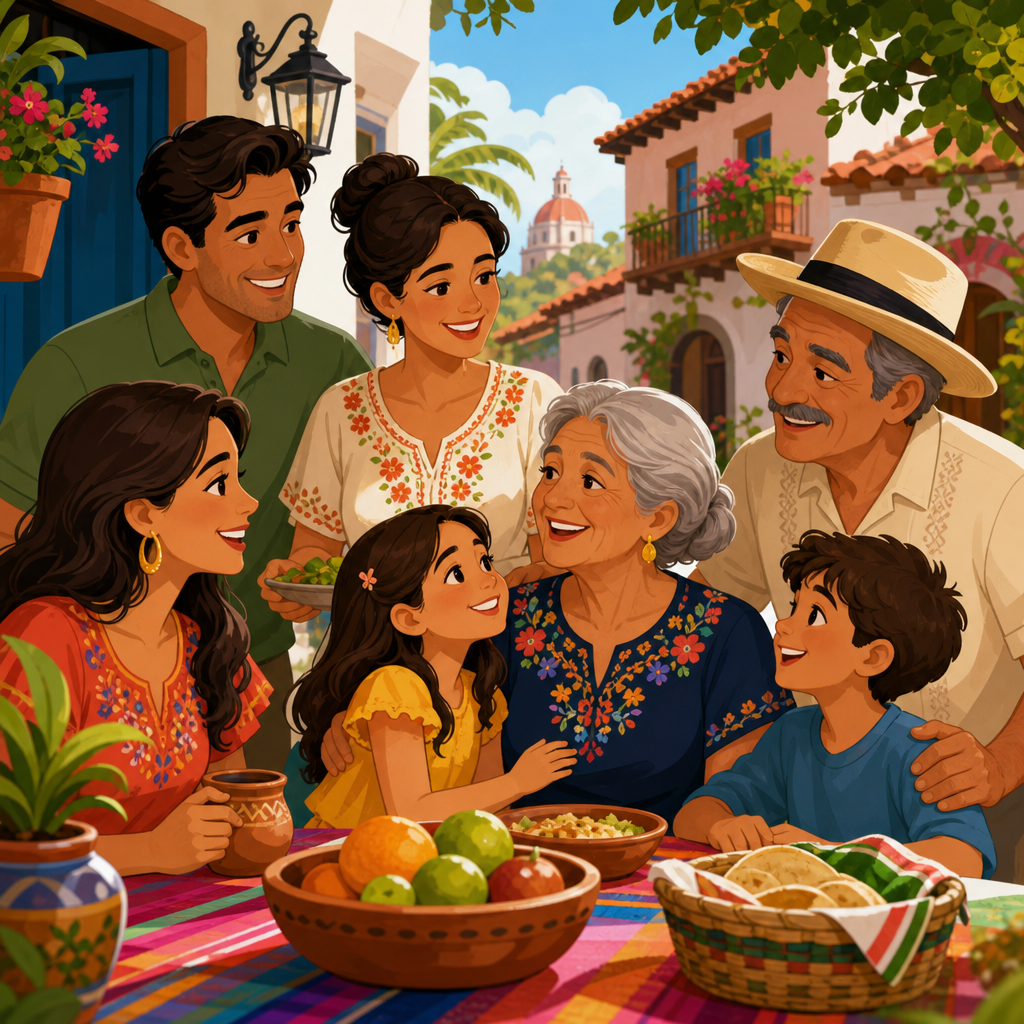
Family is the central organizing force in many Spanish-speaking societies, shaping identity, daily routines, social obligations, and the way communities preserve tradition across generations. In this context, family means more than parents and children living in one home. It usually includes grandparents, aunts, uncles, cousins, godparents, in-laws, and even close family friends who are treated as relatives. Across Spain, Mexico, the Caribbean, Central America, and South America, local customs differ, yet the basic pattern is consistent: family remains a primary source of emotional support, practical help, moral guidance, and social belonging.
Understanding the role of family in Spanish-speaking societies matters for anyone studying language, traveling, doing business, teaching, marrying into a Spanish-speaking household, or trying to communicate with cultural sensitivity. In my work with bilingual teams and community programs, I have seen that misunderstandings often happen when outsiders interpret family involvement as interference, obligation as lack of independence, or frequent contact as unusual dependence. In reality, many Spanish-speaking communities treat family closeness as a sign of responsibility, respect, and stability. Decisions about work, education, migration, caregiving, finances, and celebrations are often made with family impact in mind rather than individual preference alone.
This hub article explores the miscellaneous dimensions that make family life such a powerful cultural force. It defines core values such as respeto, solidaridad, confianza, and familismo, then explains how these values appear in everyday life, rites of passage, household structure, intergenerational care, migration patterns, and modern social change. It also serves as a starting point for deeper reading within the broader Spanish Community and Interaction topic, because family intersects with communication style, hospitality, religion, social networks, gender expectations, and community leadership. To understand family in Spanish-speaking societies is to understand how many people build trust, maintain continuity, and navigate change.
Core Values That Shape Family Life
Several recurring values help explain why family occupies such a prominent place in Spanish-speaking societies. One of the most important is familismo, a concept widely used in social science to describe strong identification with and attachment to family. Familismo includes loyalty, reciprocity, shared responsibility, and the expectation that relatives will support one another materially and emotionally. It does not mean every family is harmonious or traditional. It means family usually carries moral weight. People may disagree intensely, yet still show up for illness, funerals, child care, paperwork, housing, or financial emergencies.
Respeto is another key principle. It refers to respect expressed through language, behavior, and recognition of roles, especially toward elders and authority figures. Children are often taught to greet older relatives properly, listen when adults speak, and use polite forms of address when appropriate. Confianza, or trust developed over time, also matters deeply. In many communities, family is the first place where trust is earned, tested, and extended. This influences how people build friendships, business relationships, and neighborhood alliances. Solidaridad reinforces the idea that one person’s problem belongs to the group. If a cousin loses a job or a grandparent needs care, support is frequently organized collectively rather than left to the individual alone.
Religion has historically reinforced these values, especially in Catholic-majority contexts, though secularization has changed practice levels in places such as Spain, Uruguay, Argentina, and urban Mexico. Even where formal religious observance declines, family-centered rituals remain strong. Baptisms, quinceañeras, weddings, Christmas gatherings, Holy Week traditions, and funeral observances continue to bind relatives through shared obligations and memory. These values are not static. Younger generations often reinterpret them, balancing personal autonomy with family duty, but the vocabulary of respect, care, and belonging remains influential.
Extended Family and Everyday Social Structure
In many Spanish-speaking societies, the household and the family network are not identical. A person may live in a nuclear household while relying daily on an extended network nearby or in constant contact through messaging apps, calls, and visits. Grandparents often provide school pickups, meals, and child care. Aunts and uncles may help with tuition, apprenticeships, housing transitions, or introductions to employers. Cousins can function like siblings. Godparents, or padrinos and madrinas, frequently have roles that extend beyond ceremonial events, especially in Latin America, where compadrazgo creates durable social bonds between families.
Multigenerational living is common in many places, though its prevalence varies by country, income level, housing market, and migration history. In Spain, high housing costs and youth unemployment have prolonged co-residence between adult children and parents in many regions. In Mexico, Peru, Colombia, and the Dominican Republic, multigenerational homes often combine economic practicality with cultural preference. The arrangement can reduce costs, increase child supervision, and allow elder care within the home. It can also create tension over privacy, authority, and household labor, especially when gender expectations remain uneven.
Social life is frequently organized through family calendars. Weekends may revolve around shared lunches, saint’s day gatherings, football matches watched together, visits to grandparents, or neighborhood festivals attended as a group. A person’s reputation is also often linked to family reputation. This can create strong accountability, but it can also place pressure on younger members who want unconventional careers, relationships, or lifestyles. Family connection provides security; it can also produce expectations that feel heavy. Both realities are part of the cultural picture.
Family Roles Across Life Stages
Family influence appears clearly at major turning points. Childhood is usually highly relational, with children socialized to participate in family routines rather than treated as fully separate units. Older siblings may help care for younger ones, and grandparents often transmit stories, recipes, sayings, and religious or moral instruction. Adolescence can bring negotiation between independence and obedience. In many households, teens are granted freedom gradually, and parental oversight may remain stronger for daughters than for sons, although this pattern is changing in urban and middle-class settings.
Young adulthood often involves family consultation on education, work, and relationships. I have repeatedly seen students choose majors, cities, or jobs not only by salary but by whether they can stay near relatives or contribute to the household. Migration decisions are especially family-centered. One member may move abroad first, send remittances, and later assist siblings or parents. According to the World Bank, remittances are economically significant in countries such as Mexico, Guatemala, Honduras, El Salvador, and the Dominican Republic, and these transfers are rarely just financial transactions. They are expressions of obligation, sacrifice, and ongoing membership in the family unit.
Older age usually increases family visibility rather than diminishing it. Elders are often seen as sources of authority, memory, and practical wisdom, even when health declines. Families commonly prefer home-based elder care for as long as possible, though this depends on income, available caregivers, and health system capacity. In Spain and parts of Latin America, demographic aging, lower fertility, and women’s labor force participation are changing care patterns. Professional elder services are growing, but many families still judge care quality through presence and personal attention, not only through institutional standards.
Celebrations, Rituals, and Emotional Bonds
Family solidarity becomes especially visible during celebrations and crises. Birthdays, baptisms, first communions, quinceañeras, weddings, Christmas Eve dinners, New Year gatherings, Mother’s Day, and patron saint festivals are not merely social events. They reaffirm roles, alliances, and continuity. Attendance matters. Cooking for large groups matters. Traveling home matters. In many communities, the effort invested in showing up is interpreted as proof of commitment. Food often carries symbolic importance as well, whether it is tamales at Christmas in parts of Mexico and Central America, lechón in Caribbean celebrations, or paella at major family occasions in Spain.
Funerals and mourning customs reveal the same deep ties. Velorios, rosaries, condolence visits, and anniversary masses or memorial meals create structured ways for relatives and neighbors to accompany grief. The emphasis is not only on individual loss but on collective remembrance. This communal response can be one of the strongest forms of social support available, particularly in working-class communities where formal counseling may be limited. At the same time, these rituals can be expensive, and families sometimes incur debt to meet social expectations around hospitality, burial, and travel.
| Family practice | How it functions socially | Common real-world example |
|---|---|---|
| Weekly shared meals | Maintains routine contact and informal problem solving | Sunday lunch at grandparents’ home |
| Godparent relationships | Extends support beyond the immediate household | Padrinos helping with school costs or ceremonies |
| Remittance sending | Links migration to family duty and status | Adult child abroad paying rent or medicine for parents |
| Collective celebrations | Reinforces identity, memory, and reciprocity | Large quinceañera organized by extended relatives |
| Elder caregiving | Shows respect and preserves intergenerational ties | Grandmother rotating between adult children’s homes |
These practices are not universal in exactly the same form, and class, geography, race, religion, and migration shape them differently. Still, the pattern is broad enough to be culturally significant: family life is enacted through repeated, visible acts of care, attendance, and exchange.
Regional Differences and Social Change
It is a mistake to describe all Spanish-speaking societies as culturally identical. Spain differs from Latin America in history, welfare systems, secularization, and labor patterns. Within Latin America, indigenous traditions, Afro-descendant heritage, rural life, urbanization, and national policy create major variation. For example, family networks in rural Guatemala may operate differently from those in Madrid, Buenos Aires, or San Juan. Yet even where lifestyles diverge, kinship still tends to hold social importance beyond what is common in more individualistic settings.
Urbanization has changed family interaction without eliminating it. Smaller apartments, longer commutes, dual-earner households, and migration to major cities have reduced some forms of daily contact. Digital communication has compensated in part. Family WhatsApp groups now coordinate birthdays, medical updates, school news, religious holidays, and emergency fundraising across countries and time zones. Migration has also internationalized family life. Transnational families maintain closeness through video calls, remittances, visits, and shared decisions, even when members live in Barcelona, Miami, Bogotá, or Madrid.
Gender roles are also evolving. Traditional expectations often positioned women as primary caregivers and men as providers, but this model no longer describes many households accurately. Women’s education and employment have expanded dramatically, and men in younger generations are taking more visible roles in child care and domestic tasks, though unevenly. Legal recognition of divorce, civil marriage changes, and same-sex marriage in Spain and several Latin American countries have broadened what family can look like. Blended families, single-parent homes, child-free couples, and chosen families are now part of the social landscape. The enduring point is not one fixed structure but the continuing power of kinship obligations and emotional interdependence.
How to Navigate Family-Centered Cultures Respectfully
If you are interacting with Spanish-speaking families as a student, teacher, manager, neighbor, health professional, or in-law, the best approach is respectful curiosity. Ask about family members. Learn names and relationships. Do not assume that a decision is purely individual, especially when it involves relocation, caregiving, money, or celebrations. In professional settings, understand that family emergencies may include obligations to extended relatives, not only spouses or children. In educational contexts, a grandparent or aunt may be as influential as a parent. In community work, trust usually grows faster when you recognize the wider family network rather than addressing one person in isolation.
It also helps to avoid stereotypes. Strong family ties do not mean everyone is conservative, dependent, or resistant to change. Nor do they guarantee closeness. Estrangement, conflict, abuse, and inequality exist in Spanish-speaking societies just as they do elsewhere. A balanced view recognizes both the strengths and the pressures of family centrality. The strength lies in durable support systems, resilience in crisis, and rich intergenerational connection. The pressure appears in limited privacy, expectations of sacrifice, and social judgment when someone chooses a different path. Cultural competence begins when you can hold both truths at once.
Family remains one of the most reliable keys to understanding Spanish-speaking societies because it connects personal identity with community life, tradition with modern change, and private emotion with public obligation. Across regions and social classes, family often provides the first safety net, the first classroom, the first moral framework, and the strongest sense of belonging. Its influence can be seen in daily routines, migration decisions, care for children and elders, holiday calendars, language use, and the way trust is built over time.
The most important takeaway is simple: in many Spanish-speaking contexts, family is not a background detail. It is a living social system that shapes how people interpret loyalty, responsibility, respect, and love. Whether the family is multigenerational, transnational, blended, religious, secular, traditional, or highly modern, kinship usually matters in practical ways. If you understand that, you will communicate more effectively, read social situations more accurately, and appreciate why personal decisions are often evaluated through their impact on the wider group.
Use this hub as your starting point for exploring the broader Spanish Community and Interaction topic, then continue into related articles on communication style, celebrations, hospitality, migration, and community traditions. The more closely you study family life, the more clearly Spanish-speaking cultures come into focus.
Frequently Asked Questions
1. Why is family considered so central in many Spanish-speaking societies?
Family is often the primary social unit in many Spanish-speaking societies because it shapes identity, belonging, responsibility, and everyday life from an early age. In these cultures, family usually extends well beyond the nuclear household to include grandparents, aunts, uncles, cousins, godparents, in-laws, and longtime family friends who are treated like relatives. This broader network provides emotional support, practical help, childcare, guidance, and a sense of continuity across generations. People often learn values such as respect, loyalty, hospitality, and mutual obligation through family relationships before they encounter them in wider society.
Family also serves as an important source of stability during major life transitions, including marriage, migration, financial hardship, education, and aging. Decisions are frequently made with the family’s well-being in mind, not just individual preference. In many communities across Spain, Mexico, the Caribbean, Central America, and South America, family gatherings, religious observances, holiday rituals, and weekly meals reinforce these bonds and keep traditions alive. While modern life, urbanization, and globalization have changed family structures in many places, the underlying idea remains strong: family is not just a private relationship but a living support system that connects personal life to cultural identity and community belonging.
2. What does “family” typically include in Spanish-speaking cultures?
In many Spanish-speaking cultures, the idea of family is expansive and relational rather than strictly limited to parents and children. It commonly includes grandparents, aunts, uncles, cousins, nieces, nephews, in-laws, and godparents, all of whom may play active roles in daily life. In some communities, close neighbors or family friends are also embraced with kin-like closeness, especially when they have longstanding ties or regularly participate in important family events. This wider understanding of family reflects a cultural emphasis on interconnectedness, shared responsibility, and lasting personal bonds.
One important feature is the role of multiple generations. Grandparents may help raise children, preserve family stories, and pass on language, religious traditions, recipes, and social expectations. Aunts and uncles may act as secondary caregivers or mentors, while older cousins often bridge the gap between generations. Godparents, or padrinos and madrinas, can hold both spiritual and practical importance, particularly in religious or ceremonial contexts. This means that support is often distributed across many people rather than resting on just one household. Although family structures differ by country, class, region, and personal circumstance, the broader pattern is clear: kinship is often understood as a durable network of care, loyalty, memory, and obligation that extends beyond the walls of a single home.
3. How does family influence daily routines and major life decisions?
Family influence often appears in both ordinary routines and life-changing decisions. On a daily level, family may shape meal schedules, caregiving arrangements, holiday plans, transportation, and social priorities. It is common in many Spanish-speaking societies for relatives to stay closely involved in one another’s lives through frequent visits, phone calls, shared meals, and regular celebrations. Children may spend significant time with grandparents or extended relatives, and adults often balance work and personal commitments with obligations to parents, siblings, or other kin. These routines help reinforce the idea that family life is a collective experience rather than an entirely private matter.
When it comes to major decisions, family input can carry considerable weight. Choices about education, marriage, where to live, career changes, migration, property, and elder care are often discussed with relatives and evaluated in terms of how they affect the family as a whole. This does not mean every family operates the same way or that individual goals are unimportant. Rather, there is often an expectation that personal decisions exist within a web of mutual responsibility. In many cases, family members provide financial help, advice, housing, or childcare, which naturally gives them a meaningful voice in important matters. This dynamic can be deeply supportive, though it can also create pressure when individual preferences differ from family expectations. Still, the broader cultural pattern reflects the enduring belief that life is best navigated with the involvement and support of family.
4. How do families help preserve tradition across generations?
Families are one of the main ways traditions are transmitted in Spanish-speaking societies because they turn culture into lived experience. Traditions are not preserved only through formal institutions or public celebrations; they are taught at the dinner table, during holidays, in everyday language, through music, storytelling, religious observances, and repeated family rituals. Grandparents and elders often play a particularly important role by passing down memories, regional customs, prayers, sayings, recipes, and family histories. These practices give younger generations a sense of where they come from and how they fit into a larger story.
This preservation happens in both visible and subtle ways. A family might gather for a saint’s day, observe Christmas or Three Kings traditions, prepare foods associated with a particular region, or maintain customs tied to weddings, baptisms, funerals, and community festivals. Children learn not only what the tradition is, but also why it matters, who practiced it before them, and what emotional meaning it carries. In migrant families or diaspora communities, these traditions can become even more significant because they help maintain a connection to heritage across distance and time. Even as customs evolve and younger generations reinterpret them, family remains the bridge between past and present. Through repeated acts of care, remembrance, and participation, families keep culture active rather than merely symbolic.
5. Are family roles and expectations the same across all Spanish-speaking societies?
No, family roles and expectations are not identical across all Spanish-speaking societies, and it is important to avoid treating such a large and diverse cultural world as if it were uniform. Spain, Mexico, the Caribbean, Central America, and South America each contain enormous regional, ethnic, economic, and historical diversity. Rural and urban communities may organize family life differently. Social class, religion, migration history, Indigenous heritage, Afro-descendant traditions, education levels, and generational change all influence how families function. Some families are highly traditional and hierarchical, while others are more egalitarian, flexible, or individualistic in their decision-making.
That said, many Spanish-speaking societies share a strong cultural respect for family connection, intergenerational ties, and mutual support. What varies is how those values are expressed. In one household, grandparents may live under the same roof; in another, they may live separately but remain deeply involved. In some families, expectations around caregiving, marriage, or respect for elders may be very formal, while in others they are negotiated more casually. Contemporary realities such as women’s changing work roles, international migration, blended families, and digital communication have also transformed how family bonds are maintained. The most accurate view is that family remains highly important across many Spanish-speaking contexts, but the form it takes is shaped by local customs and modern social change.