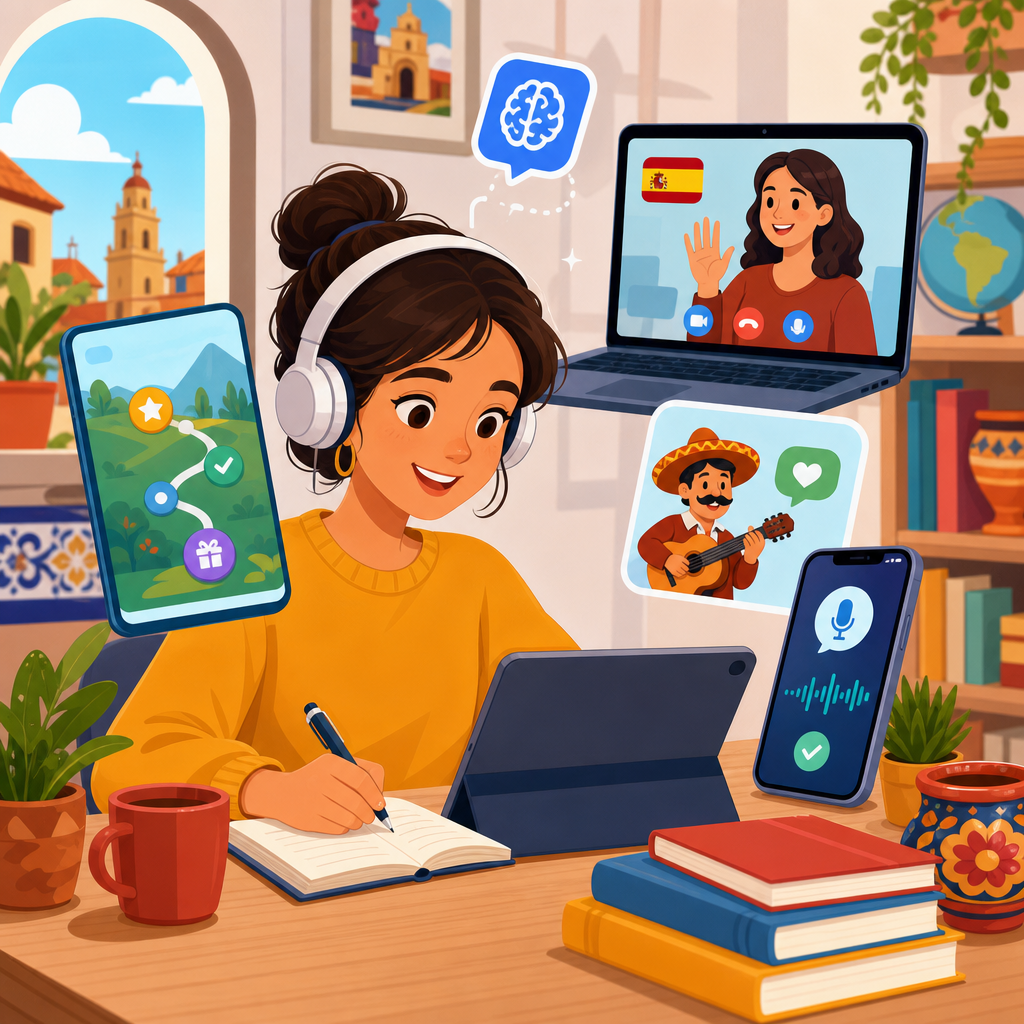
Technology has changed how people learn Spanish by making input constant, feedback immediate, and practice social rather than isolated. A decade ago, most learners relied on textbooks, weekly classes, and occasional audio CDs. Today they move between apps, video platforms, AI tutors, online communities, streaming media, and digital flashcards in a single study session. For anyone exploring Spanish community and interaction, this shift matters because language learning no longer happens only in classrooms. It happens in group chats, gaming servers, comment sections, tutoring marketplaces, and voice notes exchanged across borders.
When I first worked with adult Spanish learners, the biggest constraint was exposure. Students could memorize verb charts but still freeze when hearing fast speech from Mexico, Spain, Colombia, or Argentina. Technology changed that equation. Learners now access dialect variety, native content, pronunciation tools, and live conversation on demand. In practical terms, technology in Spanish learning means any digital system that improves comprehension, speaking, reading, writing, memory, or interaction. That includes structured tools such as Duolingo, Babbel, Quizlet, Anki, italki, and Busuu, but also less obvious resources like YouTube channels, WhatsApp groups, Netflix subtitles, Discord communities, and transcription software.
This matters because Spanish is a global language with more than 500 million native speakers and strong regional variation. A learner who wants to use Spanish at work, travel confidently, pass an exam, or build friendships needs more than grammar knowledge. They need repeated contact with real voices, real contexts, and real cultural signals. Digital tools make that possible at scale. They also lower cost, personalize pacing, and create new forms of accountability. The challenge is not access anymore. The challenge is choosing the right mix of tools and using them well.
Why digital learning works especially well for Spanish
Spanish benefits from technology because it is widely spoken, richly represented online, and supported by mature learning platforms. Compared with less commonly taught languages, Spanish learners can find abundant graded readers, podcasts, subtitles, bilingual captions, speech-recognition exercises, and native social content. That density of material matters. Language acquisition improves when learners receive large amounts of comprehensible input, then notice recurring patterns, and finally use those patterns in speech and writing. Digital environments accelerate all three steps.
Spanish also has sound-letter correspondence that is more consistent than English. That makes audio plus text combinations particularly effective. Learners can hear a word like necesito, see it written, and map pronunciation quickly. Technology reinforces this through captioned video, click-to-define reading tools, and text-to-speech. In my experience, beginners who combine visual text, native audio, and spaced repetition progress faster than learners who study grammar alone. They build recognition before production, which reduces anxiety when speaking.
Another reason technology works is flexibility. Some learners need ten-minute mobile lessons before work. Others want hour-long tutoring sessions or multiplayer conversation events. Digital study supports both. A parent can review flashcards during a commute, then join a live class at night. A university student can watch a grammar explanation, read a news article from El País, and send voice messages to a language partner in one evening. That modular structure fits modern schedules while keeping Spanish present every day, which is essential for retention.
The biggest tools reshaping Spanish learning
Not all technology does the same job. The best results come from matching the tool to the learning task. Apps such as Duolingo and Babbel are useful for habit formation, core vocabulary, and beginner sentence patterns. Spaced repetition platforms like Anki and Quizlet are stronger for long-term recall because they schedule review before memory fades, a method supported by cognitive science. Tutoring platforms such as italki and Preply add corrective feedback and real interaction. Video platforms like YouTube expose learners to accents, gestures, and authentic pacing. Streaming services train listening through repeated contact with natural dialogue.
AI tools have added a new layer. Learners can now ask for sentence corrections, role-play situations, simplify readings, or generate vocabulary lists by topic. Used correctly, AI is an efficient practice partner. It is especially helpful for controlled output: writing short dialogues, rehearsing job interview answers, or checking whether a phrase sounds too literal from English. Still, AI should not be treated as a perfect authority on idiomatic Spanish. Regional usage, politeness, and natural phrasing often require confirmation from native speakers or trusted educators.
The most effective setup is usually blended. I recommend one structured course for sequence, one flashcard system for memory, one source of native input for listening, and one human interaction channel for communication. Learners who rely only on gamified apps often plateau because recognition outpaces real usage. Learners who jump straight into conversation without vocabulary support become frustrated. Technology works best when each tool has a clear role in a broader Spanish learning system.
| Tool type | Best use | Example platforms | Main limitation |
|---|---|---|---|
| Structured learning apps | Beginner foundations, habit building | Duolingo, Babbel, Busuu | Limited spontaneous conversation |
| Spaced repetition | Vocabulary retention, verb forms | Anki, Quizlet | Can feel decontextualized |
| Live tutoring | Speaking, correction, accountability | italki, Preply | Ongoing cost |
| Video and streaming | Listening, cultural context, accents | YouTube, Netflix, RTVE | Content may be too fast for beginners |
| AI language tools | Writing practice, role-play, explanations | Chat-based assistants, grammar tools | May produce unnatural regional phrasing |
How online communities turn study into real interaction
Spanish community and interaction thrive online because technology removes the old geographic barrier. Learners no longer need a local meetup to find conversation partners. They can join Discord servers for Spanish learners, participate in Reddit discussions, enter Facebook groups for expats or exam candidates, or exchange messages with native speakers through tandem platforms. This is not just convenient. It changes motivation. People persist longer when Spanish is tied to belonging, humor, shared interests, and regular social contact.
I have seen learners make major progress after joining topic-based communities rather than generic study groups. A football fan who follows Spanish-language match commentary gets repeated exposure to emotional, fast-paced language. A gamer in a bilingual server learns commands, negotiation, and slang. A professional in a Latin American industry group learns workplace vocabulary that textbooks rarely prioritize. Because the interaction is meaningful, the language sticks. Vocabulary learned in context is easier to retrieve than vocabulary memorized from isolated lists.
These spaces also teach register and culture. Learners notice when tú feels natural, when usted is safer, how greetings differ by country, and which jokes do not translate well. They start recognizing voice-note etiquette, emoji usage, and the rhythm of everyday exchange. That knowledge matters as much as grammar if the goal is participation. The caution is that online communities can expose learners to slang, abbreviations, and regionalisms before they are ready. A balanced approach includes both authentic interaction and reliable reference materials.
What AI, speech tools, and analytics now do better than traditional materials
One of the clearest advances is immediate feedback. Traditional workbooks can show an answer key, but they cannot explain why a learner keeps confusing por and para, dropping object pronouns, or misplacing stress. New systems can detect patterns across many responses, then surface targeted review. Speech technology can flag pronunciation issues like weak trill production, vowel reduction influenced by English, or incorrect syllable stress in words such as médico and difícil. The feedback is not perfect, but it is far faster than waiting a week for a teacher to mark homework.
Analytics also improve planning. Serious learners can track review intervals, listening hours, speaking frequency, and error categories. That matters because progress in Spanish is uneven. Listening may improve before speaking. Reading may surge while pronunciation lags. With data, learners stop guessing. They can see that they know travel vocabulary but not connectors, or that they understand podcasts at 0.8x speed but not native conversation at full speed. Good instruction has always used diagnosis; technology simply makes diagnosis easier to scale.
Another strength is simulation. AI role-play lets learners rehearse restaurant orders, customer service calls, first meetings, apartment searches, and medical appointments. In live teaching, I have used these simulations to lower speaking anxiety before real conversations. The learner practices opening lines, repair strategies, and clarification phrases such as ¿Puede repetir? or Quise decir…. By the time they talk to a native speaker, they are not inventing language from nothing. They are adapting patterns they have already tested. That bridge between practice and reality is one of technology’s most practical benefits.
Where technology falls short and how smart learners avoid common mistakes
Technology helps, but it also creates illusions of progress. Many learners feel productive because they maintain long app streaks, collect points, or finish lessons quickly. Yet when asked to describe their weekend in Spanish, they struggle. That gap appears because recognition is easier than retrieval. Tapping the right option in a multiple-choice activity is not the same as producing a sentence under pressure. To avoid this trap, every digital routine should include output: speaking aloud, writing short summaries, or responding to prompts without cues.
Another limitation is quality control. Not all online explanations are accurate, and not every correction from AI or peer forums reflects standard usage. Spanish varies by region, and many “wrong” forms are actually informal, dialectal, or context-specific. For example, learners may hear vos in Argentina, different past-tense preferences in Spain and Latin America, or local vocabulary for everyday items. The solution is not to avoid variation. It is to anchor learning in a target variety when needed and verify uncertain points with reputable sources such as the RAE, Instituto Cervantes materials, established textbooks, or experienced tutors.
Distraction is the final obstacle. A phone can deliver a lesson, but it can also interrupt concentration every two minutes. Deep learning still requires focused attention. I advise learners to separate active study from passive exposure. Active study means deliberate tasks: shadowing audio, reviewing flashcards, correcting writing, or attending class. Passive exposure means listening to music, watching shows, or following creators. Both help, but they serve different purposes. Learners who know the difference build stronger habits and waste less time.
How to build an effective Spanish learning system with modern tools
A strong system begins with a clear goal. Someone preparing for travel needs high-frequency phrases, listening tolerance, and repair strategies. Someone seeking friendships in Spanish-speaking communities needs conversational range and cultural awareness. Someone studying for DELE or SIELE needs exam-specific reading, writing, and timing practice. Once the goal is defined, technology choices become easier. Pick tools that solve the next real problem, not the tools with the best marketing.
For most learners, a practical weekly system looks like this: daily spaced repetition for vocabulary, three or four short listening sessions with transcripts, one or two focused grammar reviews, one writing task corrected by a tutor or language tool, and at least one live conversation. Add one community-based activity tied to personal interest, such as joining a Spanish book club, following a cooking channel, or participating in a hobby forum. This mix works because it covers the five core needs: input, memory, feedback, output, and social relevance.
Consistency matters more than intensity. Thirty well-designed minutes a day usually beat a single four-hour cram session each week. I have seen busy professionals progress steadily with morning flashcards, lunchtime podcast listening, and one evening lesson. What made the difference was not heroic effort. It was continuity and interaction. Technology is changing the way we learn Spanish because it makes that continuity realistic. It puts structure, community, and authentic language within reach of almost anyone with an internet connection.
The core lesson is simple: technology does not replace the fundamentals of learning Spanish, but it dramatically improves access to them. Learners still need repeated exposure, meaningful practice, correction, and patience. What has changed is how easily those elements can be combined. A learner can study verbs in an app, hear them in a podcast, notice them in subtitles, test them in an AI role-play, and use them in a live chat the same day. That tight loop speeds progress and makes Spanish feel useful sooner.
For a subtopic hub under Spanish community and interaction, the main takeaway is that modern learning is no longer a solo academic exercise. It is participatory. Digital tools connect learners to native speakers, niche communities, cultural content, and tailored feedback in ways older methods could not. The best results come from using technology intentionally: build around goals, choose a few complementary tools, verify important language points, and prioritize real interaction over passive tapping.
If you want to learn Spanish more effectively, audit your current routine this week. Keep the tools that improve comprehension, retention, and conversation, and drop the ones that only create the feeling of progress. Then add one live interaction channel and one source of authentic Spanish content. That small change is often the turning point from studying Spanish to actually using it.
Frequently Asked Questions
How has technology changed the way people learn Spanish compared with traditional methods?
Technology has transformed Spanish learning from a scheduled, limited activity into something continuous, flexible, and highly interactive. In the past, many learners depended on a textbook, a weekly class, and perhaps a set of audio recordings. That approach could work, but it often meant slow feedback, limited listening variety, and very little real-world interaction between lessons. Today, learners can combine language apps, video lessons, podcasts, online tutors, AI conversation tools, digital flashcards, and streaming media in one study routine. This creates far more exposure to Spanish throughout the day rather than confining practice to a single classroom session.
Another major change is speed of feedback. Instead of waiting days for a teacher to correct a worksheet, learners can now get immediate responses on pronunciation, vocabulary, grammar, and listening comprehension. That instant correction helps people notice mistakes early and adjust before bad habits become fixed. Technology also supports different learning styles. Some learners improve fastest through short app-based drills, others through subtitled videos, guided conversation, voice recognition, or live group sessions. As a result, Spanish learning has become more personalized, more social, and much easier to fit into everyday life.
What are the biggest benefits of using apps, AI tools, and online platforms to learn Spanish?
The biggest benefit is access. Technology gives learners immediate entry to Spanish at almost any level, from complete beginner to advanced speaker. Instead of searching for a local class that fits a schedule, people can practice on demand whenever they have ten minutes free. Apps and online platforms also break learning into manageable pieces, which helps with consistency. Short daily sessions in vocabulary, listening, reading, and speaking often produce better long-term results than irregular, longer study sessions.
AI tools and digital platforms also make practice more responsive. They can adapt to a learner’s level, repeat weak areas, suggest new vocabulary based on past mistakes, and provide conversation prompts that feel more natural than memorizing isolated phrases. Online platforms also expand exposure to authentic Spanish, including different accents, speeds, and cultural contexts. That matters because real Spanish is not limited to textbook dialogues. Learners hear how people actually speak in interviews, shows, livestreams, and community spaces. Perhaps most importantly, technology reduces isolation. Learners can join discussion groups, language exchanges, virtual communities, and tutoring platforms, which makes Spanish feel like a living language used with real people rather than a subject studied alone.
Can technology really help with speaking and listening skills, or does it mostly support vocabulary and grammar?
Technology can absolutely support speaking and listening, and in many cases it does so better than older study methods. Vocabulary and grammar apps are useful, but modern tools go much further. Learners can listen to native or near-native speech through podcasts, YouTube channels, streaming series, social media clips, online lessons, and live conversations. This constant exposure builds familiarity with rhythm, pronunciation, common expressions, and regional variation. Listening improves faster when learners hear Spanish in different settings rather than only in slow, scripted classroom audio.
Speaking has also become much more accessible through technology. Video tutoring, language exchange platforms, voice messaging, speech recognition tools, and AI conversation partners give learners more chances to speak out loud without waiting for a formal class. This matters because speaking improves through repetition, confidence-building, and immediate use. Many learners are more willing to practice when the environment feels low pressure and available at any time. Technology is especially helpful for overcoming the old problem of “I understand more than I can say.” With regular digital speaking practice, learners can turn passive knowledge into active communication. That said, the best results usually come from combining tools: guided speaking, real listening, review systems, and meaningful interaction with other people.
What role do online communities and digital interaction play in learning Spanish effectively?
Online communities play a powerful role because language grows through connection, not just memorization. Learning Spanish becomes much more effective when people use it to ask questions, respond to others, share ideas, and participate in real conversations. Digital interaction creates opportunities that many learners did not have before, especially if they live in areas without easy access to Spanish speakers. Through forums, live chats, group classes, social platforms, language exchange communities, and interest-based communities, learners can engage with Spanish in a social and practical way.
This kind of interaction also increases motivation. People are more likely to stay consistent when Spanish is tied to friendship, curiosity, culture, entertainment, or community participation. Instead of studying only for a test, they begin using the language to understand others and be understood themselves. Online spaces also expose learners to informal phrasing, cultural references, regional vocabulary, and the natural back-and-forth of conversation. That experience is difficult to reproduce with worksheets alone. For anyone interested in Spanish community and interaction, technology matters because it shifts learning from isolated study into active participation. In other words, learners are no longer just preparing to use Spanish someday; they can start using it right now.
What is the best way to use technology without becoming overwhelmed or distracted while learning Spanish?
The most effective approach is to use technology with structure rather than trying every tool at once. One of the biggest advantages of modern learning is variety, but too much variety can lead to distraction and shallow progress. A smart routine usually includes a few core elements: one system for vocabulary review, one source of listening input, one speaking practice option, and one place for grammar support when needed. For example, a learner might use digital flashcards for retention, short videos or podcasts for listening, an AI or tutor session for speaking, and a grammar platform for clarification. That is often far more effective than downloading ten apps and using none consistently.
It also helps to focus on regular exposure instead of perfection. Technology works best when it creates frequent contact with Spanish throughout the day. Even brief sessions can be powerful if they are intentional and repeated. Learners should choose tools that match their goals. Someone preparing for travel may need conversation practice and listening comprehension, while someone interested in reading may prioritize vocabulary and sentence structure. Progress improves when learners review what they study, track weak areas, and gradually increase contact with authentic Spanish content. The key is to make technology serve a plan. When used thoughtfully, it becomes a bridge to fluency, confidence, and real communication rather than just another source of digital noise.