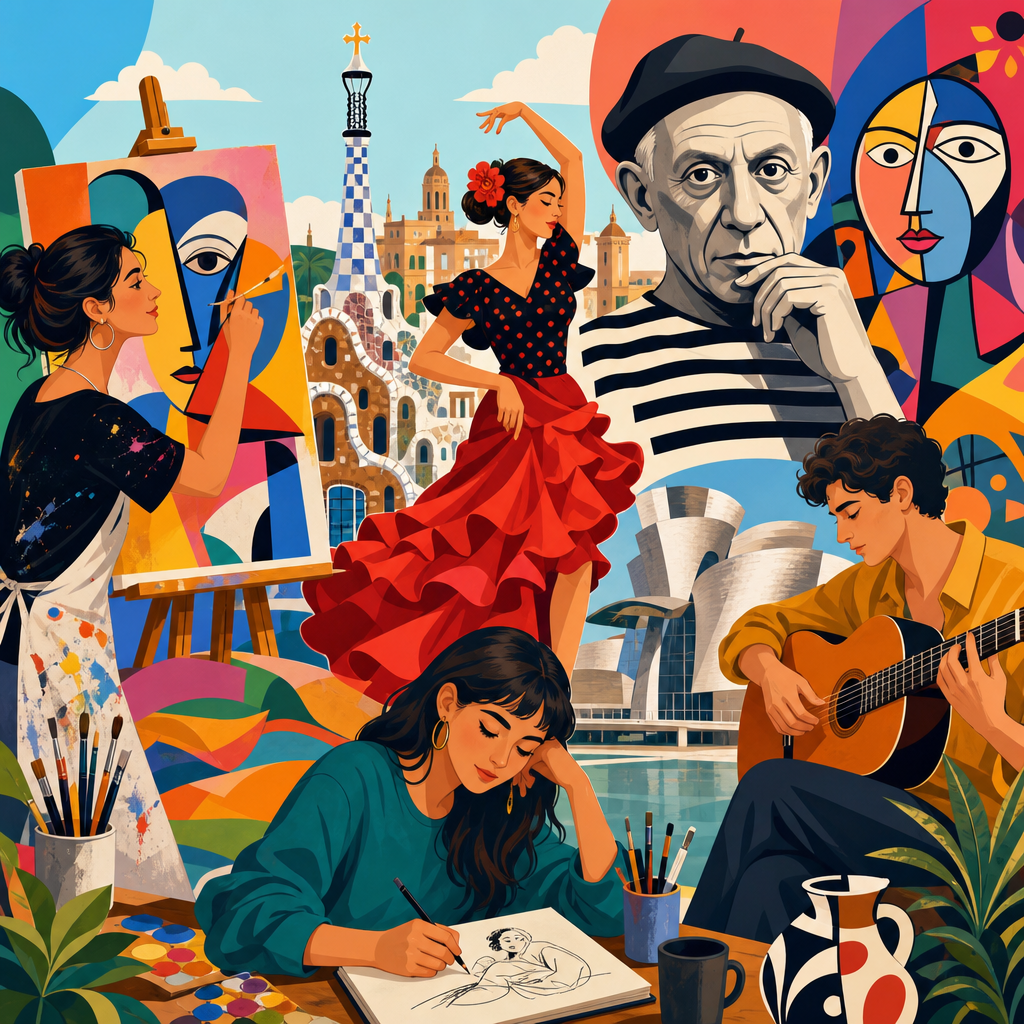
Spanish in the arts is not a narrow category tied only to Spain or to a single literary canon; it is a living cultural force that shapes music, film, visual art, theater, dance, publishing, digital media, and community practice across multiple continents. In this hub on contemporary movements and influences, “Spanish” refers both to the language and to the cultural ecosystems built around it, from Madrid and Mexico City to Miami, Bogotá, Buenos Aires, San Juan, Los Angeles, and increasingly online spaces where creators collaborate across borders. “Contemporary” matters here because today’s artistic production is defined by migration, bilingual identity, streaming platforms, activist networks, and constant exchange between local traditions and global audiences.
I have worked with Spanish-language arts organizations, festival programmers, and bilingual education teams long enough to see a clear pattern: when institutions treat Spanish-language creativity as a niche, they miss where innovation is actually happening. Spanish-speaking artists are not merely preserving heritage. They are setting aesthetic trends, reshaping public conversations, and influencing how communities understand identity, memory, race, gender, and belonging. This matters for readers interested in Spanish community and interaction because the arts are one of the most visible ways language becomes social life. They create gathering points, intergenerational ties, public narratives, and pathways into participation for people who may not enter through formal education or policy debates.
This article serves as a hub for the broader miscellaneous branch of Spanish community and interaction by mapping the major artistic arenas where Spanish has contemporary power. It explains what is changing, why certain movements have momentum, and how to think about influence without flattening regional differences. It also points toward the kinds of connected topics a hub should support: bilingual performance, Latin music industries, Spanish-language publishing, museum inclusion, diaspora storytelling, digital creators, cultural policy, and arts education. If you want to understand how Spanish functions in public culture today, the arts are one of the most practical and revealing places to start.
Music, sound, and the global reach of Spanish-language creativity
Spanish-language music is the clearest example of contemporary artistic influence moving from community scenes to worldwide dominance. The rise of reggaetón, Latin trap, regional Mexican crossover, urbano, flamenco fusion, and Afro-Latin pop has changed the mainstream music economy. This shift did not happen because artists translated themselves into English. It happened because audiences, platforms, and labels finally adjusted to the reality that Spanish-language songs could lead global charts on their own terms. Streaming data from Spotify, YouTube, and Apple Music repeatedly shows Spanish-language tracks reaching listeners far beyond their countries of origin, and major award circuits now treat Latin categories as trendsetting rather than peripheral.
What matters artistically is not just market scale but formal innovation. Artists such as Rosalía, Bad Bunny, C. Tangana, Karol G, Natalia Lafourcade, Jorge Drexler, and Residente work from different traditions, yet all demonstrate how Spanish can carry local rhythm, slang, poetic compression, and social critique without losing broad appeal. In practice, Spanish-language music scenes often blend distinct lineages: Caribbean percussion, Andalusian vocal techniques, corrido storytelling, hip-hop production, jazz harmony, electronic textures, and folk instrumentation. That hybridity reflects community interaction in real time. Migration routes, neighborhood clubs, TikTok trends, and festival circuits now influence composition as much as radio once did.
I have seen programmers make a mistake by grouping all Spanish-language music into a single “Latin” block. Contemporary audiences are more informed than that. They notice whether an event understands the difference between bachata and banda, between nuevo flamenco and urbano, between Argentine indie pop and Colombian champeta. The lesson for any arts institution is simple: specificity builds trust. When organizations present Spanish-language music with regional context, artist biographies, and accurate genre framing, attendance and engagement improve because communities feel recognized rather than packaged.
Film, television, and streaming as engines of Spanish cultural influence
Spanish-language film and television have become central to global storytelling because streaming lowered distribution barriers while preserving linguistic identity. Directors from Spain and Latin America now circulate alongside Hollywood rather than beneath it. Pedro Almodóvar remains a defining figure in queer aesthetics, melodrama, and color-driven visual storytelling, but the contemporary field is much wider. Alfonso Cuarón, Alejandro G. Iñárritu, Guillermo del Toro, Lucrecia Martel, Pablo Larraín, Isabel Coixet, J. A. Bayona, and Carla Simón represent different national traditions and production models, yet all show how Spanish-speaking creators influence narrative structure, realism, memory, horror, and political cinema.
Streaming series accelerated this influence. Productions such as La casa de papel, Élite, and Club de Cuervos proved that viewers will follow Spanish-language characters, humor, and social codes at scale. More importantly, they normalized subtitles for mainstream audiences. That change has practical consequences for the arts ecosystem. Once audiences accept multilingual viewing habits, independent cinema, documentary work, and regional television become easier to program, market, and discuss. In community settings, screenings also create entry points for conversations about dictatorship, migration, class, urban transformation, and family structures, topics Spanish-language cinema often treats with unusual directness.
For a hub page, it is useful to remember that influence runs in both directions. Spanish-language creators borrow from global genre conventions, but they also reshape them. Horror from Spain and Latin America regularly ties fear to religious imagery, historical trauma, and domestic space. Political drama often approaches institutions through intimate family conflict rather than abstract ideology. Even commercial comedy relies heavily on code-switching, accent, and regional expression. Those features make Spanish in film more than a translation medium; it is a storytelling framework.
Visual art, museums, and public space
In visual art, Spanish operates as a language of interpretation, community memory, and institutional critique. Contemporary Spanish-speaking artists work across painting, installation, video, photography, performance, and public art, often engaging questions of colonial history, Indigenous presence, migration, labor, surveillance, and ecological damage. The field includes artists from Spain and from every major Latin American tradition, but also many U.S.-based creators whose work emerges from bilingual and diasporic life. Museums that once treated Spanish only as a translation service increasingly recognize that Spanish-language interpretation changes who feels addressed by an exhibition.
That distinction is important. A wall label translated into Spanish is useful, but it is not the same as curating from Spanish-speaking perspectives. I have worked on exhibition interpretation where the most effective change was not linguistic conversion but narrative redesign. Instead of presenting an artist solely through academic terminology, we added oral-history excerpts, neighborhood context, and glossary notes for terms rooted in Caribbean, Mexican, or Andean experience. Visitors stayed longer and asked better questions because the exhibition no longer assumed one cultural starting point. In public art, the same principle applies. Murals, memorials, and socially engaged projects often use Spanish text, local idioms, and collective authorship to signal who the work is for.
Contemporary museums are also being pushed by artists and educators to address provenance, representation, and access. Spanish-language tours, bilingual catalogues, and community co-curation are no longer optional extras in many cities with large Hispanic populations. They are basic infrastructure. Institutions that ignore this reality lose relevance, while those that invest in authentic engagement gain stronger partnerships with schools, families, and neighborhood organizations.
Literature, publishing, and digital writing communities
Spanish-language literature remains one of the deepest reservoirs of artistic influence, but the contemporary story is no longer limited to prestige novels. Independent presses, spoken word scenes, hybrid memoir, graphic narrative, newsletters, podcasts, and social platforms have expanded who publishes and who gets read. Traditional publishing in Spanish still matters, especially through major groups such as Penguin Random House Grupo Editorial and Planeta, yet much of the current energy comes from smaller editorial projects, literary festivals, book fairs, and online communities that connect readers across borders. The Guadalajara International Book Fair is a major example of how Spanish-language publishing operates as a transnational network rather than a set of isolated national markets.
Current literary movements often center voice, mobility, and genre blending. Writers move between Spanish and English, between essay and poetry, between testimony and fiction. This has made contemporary Spanish literary culture especially responsive to questions of migration, Afro-Latinidad, feminism, queer identity, and historical repair. Readers looking for interaction rather than passive consumption are also finding it in book clubs, live readings, Instagram poetry circles, and independent bookstores that function as civic spaces. In my experience, bilingual literary events succeed when organizers respect both languages equally instead of framing Spanish as supplementary. Audiences can tell the difference immediately.
| Art area | Contemporary movement | How Spanish shapes influence | Community effect |
|---|---|---|---|
| Music | Streaming-driven crossover | Preserves slang, rhythm, and regional identity at scale | Builds transnational fan communities |
| Film and TV | Subtitle-normalized global distribution | Centers Spanish as original narrative language | Expands access to shared cultural discussion |
| Visual art | Bilingual and community-led curation | Changes interpretation, not just translation | Improves museum trust and participation |
| Literature | Independent and hybrid publishing | Supports multilingual, diasporic storytelling | Creates active reading communities |
| Performance | Collaborative and activist practice | Uses accent, code-switching, and oral tradition as form | Strengthens local identity and dialogue |
Performance, dance, theater, and community storytelling
Live performance shows especially clearly how Spanish creates interaction. In theater, language is never just script; it is timing, breath, social class, geography, humor, and power. Contemporary Spanish-language and bilingual theater companies often use code-switching to represent real speech patterns rather than to provide novelty. On stage, that choice can reveal generational tension, immigration status, educational pressure, or emotional intimacy in ways a single-language script cannot. Companies across the United States, Spain, Mexico, Chile, and Argentina are using devised theater, documentary performance, and community workshops to make Spanish-language performance more participatory and less dependent on traditional gatekeepers.
Dance follows a parallel path. Flamenco continues to evolve through collaboration with jazz, contemporary dance, and digital scenography, while salsa, tango, folklórico, bomba, and urban forms move between social dance floors and formal stages. The strongest contemporary work does not freeze tradition as folklore for outsiders. It shows tradition as technique under pressure, changing through migration, race politics, and youth culture. I have seen audiences respond most powerfully when choreographers explain lineage clearly: where a rhythm comes from, what a movement signifies, why a costume choice matters. Context deepens appreciation and prevents cultural flattening.
Performance also remains one of the most effective vehicles for local storytelling. Community-based ensembles can address housing, labor, language loss, anti-immigrant rhetoric, and neighborhood memory with immediacy that static media often lacks. For Spanish community and interaction, this is crucial. A play, concert, or dance event is not only an artwork. It is a meeting place, language space, and public forum.
How institutions, educators, and audiences can engage Spanish arts well
Effective engagement with Spanish in the arts requires more than booking one heritage-month event. Institutions need sustained practice. First, treat regional specificity as essential information. Spanish is shared, but cultural references are not interchangeable. Second, invest in bilingual communications that are written natively, not mechanically translated. Third, pay artists and cultural workers fairly; too many organizations expect Spanish-speaking creatives to supply outreach labor for free. Fourth, build partnerships with schools, libraries, community centers, and independent cultural venues, because trust often sits outside major institutions. Fifth, archive and document work carefully so local projects are not lost after a single season.
Educators should connect artistic material to language learning, history, and civic life. A song can open discussion about poetry, race, and migration. A film can support vocabulary development while introducing social context. A mural can become an entry point into neighborhood research and oral history. Audiences, meanwhile, can participate more thoughtfully by following artists directly, attending small venues, buying books from independent presses, and choosing institutions that program Spanish-language work year-round. These actions matter because contemporary influence is not produced only by stars. It depends on durable ecosystems.
Spanish in the arts matters because it shows language doing what communities need most: carrying memory, inventing new forms, and making public life more representative of the people who live it. Across music, film, visual art, literature, and performance, Spanish is not a side channel to mainstream culture. It is one of the main engines shaping contemporary aesthetics and cultural conversation. The most important takeaway from this hub is that influence grows where artistic excellence meets community relevance. When creators keep regional texture, institutions provide real access, and audiences engage with curiosity rather than stereotype, Spanish-language arts become a powerful site of connection.
As a hub for miscellaneous topics under Spanish community and interaction, this page should guide deeper exploration into bilingual creativity, diaspora identity, arts education, publishing networks, museum practice, local festivals, and digital culture. Those subtopics are connected by one core fact: Spanish is not only spoken in communities; it is performed, filmed, painted, sung, staged, and published into shared experience. If you want to understand where Spanish culture is moving now, follow the artists, study the contexts, and support the spaces where that work can be seen and heard.
Frequently Asked Questions
What does “Spanish in the arts” mean in a contemporary context?
In a contemporary context, “Spanish in the arts” refers to far more than creative work produced in Spain or to a fixed body of canonical literature. It describes a broad, evolving artistic ecosystem shaped by the Spanish language and by the many communities that use it across Europe, Latin America, the Caribbean, the United States, and digital spaces worldwide. That means the term includes not only novels, poetry, and theater, but also film, music, dance, visual art, performance, publishing, streaming culture, and online creative expression.
What makes this idea especially important today is that Spanish-language creativity is deeply transnational. Artists often move between cities such as Madrid, Mexico City, Bogotá, Buenos Aires, Miami, San Juan, and Los Angeles, carrying influences with them and collaborating across borders. A musician may blend Caribbean rhythms with urban production from New York and lyrics shaped by Mexican or Colombian slang. A filmmaker may tell a local story using an international visual language. A visual artist may reference migration, colonial memory, identity, and digital life all at once. In this sense, Spanish is both a language and a cultural network.
It is also important to understand that contemporary Spanish-language art is not culturally uniform. It contains Indigenous, African, European, Arab, Asian, and diasporic influences, and it reflects differences in class, race, geography, gender, politics, and generation. The result is a living field of artistic production that is dynamic, hybrid, and constantly reinventing itself. Rather than pointing to a single tradition, “Spanish in the arts” points to a conversation happening across multiple continents and media.
How has Spanish influenced contemporary music, film, and visual art globally?
Spanish has become a major force in global culture because it serves as both a medium of expression and a bridge between regional scenes and international audiences. In music, Spanish-language artists have expanded the reach of genres such as reggaetón, Latin trap, pop, indie rock, regional Mexican music, flamenco fusion, and Afro-Latin styles. What matters here is not only commercial success, but also aesthetic influence. Spanish-language music has changed production trends, reshaped collaborations, and normalized multilingual listening habits across the world. Listeners who may not speak fluent Spanish still engage with the emotional rhythm, vocal texture, and cultural identity embedded in the language.
In film, Spanish has helped create a rich space for storytelling that moves between local specificity and global relevance. Contemporary Spanish-language cinema often addresses migration, memory, violence, urban life, family dynamics, gender politics, and historical trauma with striking formal innovation. Directors and screenwriters working in Spanish frequently draw from national traditions while also participating in global festival circuits and streaming platforms. This has increased visibility for stories rooted in cities and regions that were once marginalized in mainstream media distribution.
In visual art, the influence of Spanish appears through text, symbolism, political context, and public engagement. Artists use Spanish in installations, murals, conceptual works, photography, and social practice projects to speak directly to communities while also challenging institutions. Themes such as colonial aftermath, border identity, language politics, neighborhood memory, and resistance often emerge strongly in Spanish-language or bilingual artwork. Globally, this influence is visible not just in museums and galleries, but also in street art, community spaces, design culture, and digital exhibitions. Together, music, film, and visual art show how Spanish functions as a powerful cultural language with worldwide impact.
Which contemporary movements are shaping Spanish-language arts today?
Several major movements are shaping Spanish-language arts today, and many of them overlap rather than exist as separate categories. One of the most visible is transnational hybridity, where artists combine influences from multiple countries, genres, and traditions to create work that resists simple labels. This can be seen in music that mixes flamenco, dembow, electronic production, and folk elements, or in literature that blends memoir, criticism, fiction, and migration narrative. Hybridity reflects the reality of contemporary Spanish-speaking communities, many of which are shaped by mobility, diaspora, and constant cultural exchange.
Another important movement is the rise of diasporic and bilingual expression, especially in the United States and other multilingual spaces. Many artists move fluidly between Spanish and English, or between Spanish and Indigenous or regional languages, using code-switching as an artistic device rather than treating language boundaries as fixed. This has influenced spoken word, theater, film scripts, song lyrics, podcasts, and digital content. It reflects the lived experience of communities whose identities are layered and whose artistic voices do not fit neatly into monolingual traditions.
Decolonial and memory-centered practices are also central. Across visual art, literature, performance, and curatorial work, artists are revisiting archives, confronting colonial histories, questioning official narratives, and highlighting Indigenous and Afro-descendant perspectives. At the same time, feminist and queer interventions have transformed Spanish-language arts by opening new forms of storytelling, representation, and critique. These movements have challenged older power structures in publishing, film, museums, and theater, making room for voices that were long excluded or underrepresented.
Finally, digital-native creativity has become a defining force. Artists are no longer dependent solely on traditional institutions to reach audiences. Social platforms, streaming services, independent newsletters, online magazines, virtual exhibitions, and creator-driven communities have changed how work is made, circulated, and discussed. This has allowed Spanish-language artists from different regions to influence one another more quickly and to build audiences beyond their immediate local markets. The contemporary moment is therefore shaped by hybridity, diaspora, decolonial critique, expanded representation, and digital circulation all at once.
Why are cities like Madrid, Mexico City, Bogotá, Buenos Aires, San Juan, Miami, and Los Angeles so important to Spanish-language arts?
These cities matter because they function as cultural crossroads where artistic production, audience development, education, publishing, performance, and media infrastructure come together. Each city has its own history and artistic identity, but all of them play a major role in shaping how Spanish-language art is created and shared. Madrid remains influential through publishing, museums, theater, film institutions, and its role as a gateway between European and Latin American cultural circuits. Mexico City is one of the most important creative centers in the Spanish-speaking world, with major strength in literature, independent art spaces, cinema, design, music, and intellectual life.
Bogotá and Buenos Aires are especially important for their vibrant literary, theatrical, musical, and visual art scenes, as well as for their deep traditions of public culture and artistic debate. San Juan holds a unique place through Caribbean creativity, performance, music, and its role in conversations about colonialism, identity, and language. Miami and Los Angeles, meanwhile, are crucial because they show how Spanish-language arts thrive in diasporic and multilingual environments. These cities bring together creators from across Latin America, the Caribbean, and Spain, while also connecting to U.S. media industries, digital audiences, and global markets.
What makes these urban centers so influential is not simply population size or institutional prestige. It is their ability to act as meeting points for collaboration, experimentation, and circulation. Festivals, galleries, small presses, performance venues, universities, neighborhood arts organizations, and online creator networks all interact in these places. Artists often move among them physically or digitally, creating shared trends and new aesthetics. In practical terms, these cities help determine which voices gain visibility, which genres evolve, and how Spanish-language culture reaches broader audiences. They are not the only important centers, but they are key nodes in a much larger artistic network.
How is digital media changing the future of Spanish in the arts?
Digital media is transforming Spanish-language arts by making creation, distribution, and audience engagement faster, more accessible, and more decentralized. In the past, many artists depended heavily on publishers, labels, galleries, television networks, or film distributors to gain recognition. Today, creators can launch projects through streaming platforms, social video, podcasts, digital magazines, virtual exhibitions, newsletters, crowdfunding, and direct community channels. This has lowered some barriers to entry and allowed more regional, experimental, and independent voices to find audiences.
One of the biggest changes is that digital media strengthens transnational exchange. A poet in Buenos Aires, a curator in Bogotá, a filmmaker in Madrid, and a musician in Los Angeles can now collaborate in real time, share work instantly, and build communities that are not limited by geography. Spanish-language audiences are also more connected than ever. People discover new artists through recommendation algorithms, fan communities, subtitled clips, short-form video, and online criticism. This creates faster trend cycles, but it also encourages cross-pollination between genres and regions.
Digital space has also expanded what counts as artistic practice. Memes, video essays, digital storytelling, online performance, hybrid documentary forms, interactive installations, and community-based media projects all play a role in contemporary Spanish-language expression. At the same time, the shift to digital raises important questions about platform dependency, cultural visibility, monetization, archiving, and language politics. Not every artist benefits equally, and algorithms do not always reward nuance or regional specificity. Even so, the broader trend is clear: digital media is not simply a tool for distributing Spanish-language art; it is actively reshaping its forms, audiences, and future directions.