The Spanish language, known for its melodic tones and poetic charm, stretches far beyond the borders of Spain. It weaves its intricate web across the diverse cultures and landscapes of Latin America and even touches pockets of the United States. Among the bustling streets of Madrid, the vibrant festivals of Mexico City, and the tranquil beaches of the Caribbean, Spanish is spoken with varying flavors and nuances. One of the key elements that shape these linguistic differences is the variation in vowel pronunciation. Understanding these vowel variations is essential for anyone aspiring to master the Spanish language or simply wishing to communicate effectively across different Spanish-speaking regions.
Key to comprehending the nuances of Spanish vowels is recognizing the distinct pronunciation attributes aligned with each region. Vowels serve as the skeleton of any language’s sound structure, and in Spanish, they are historically treated as pure and short—unlike the lengthy diphthongs typical in English. Vowel pronunciation can affect intelligibility and communication effectiveness, making it an important consideration for learners at all levels. This article dives deep into the nuanced world of Spanish vowel variations across regions, highlighting the unique characteristics, influences, and practical examples from different Spanish-speaking areas.
The Five Pure Spanish Vowels
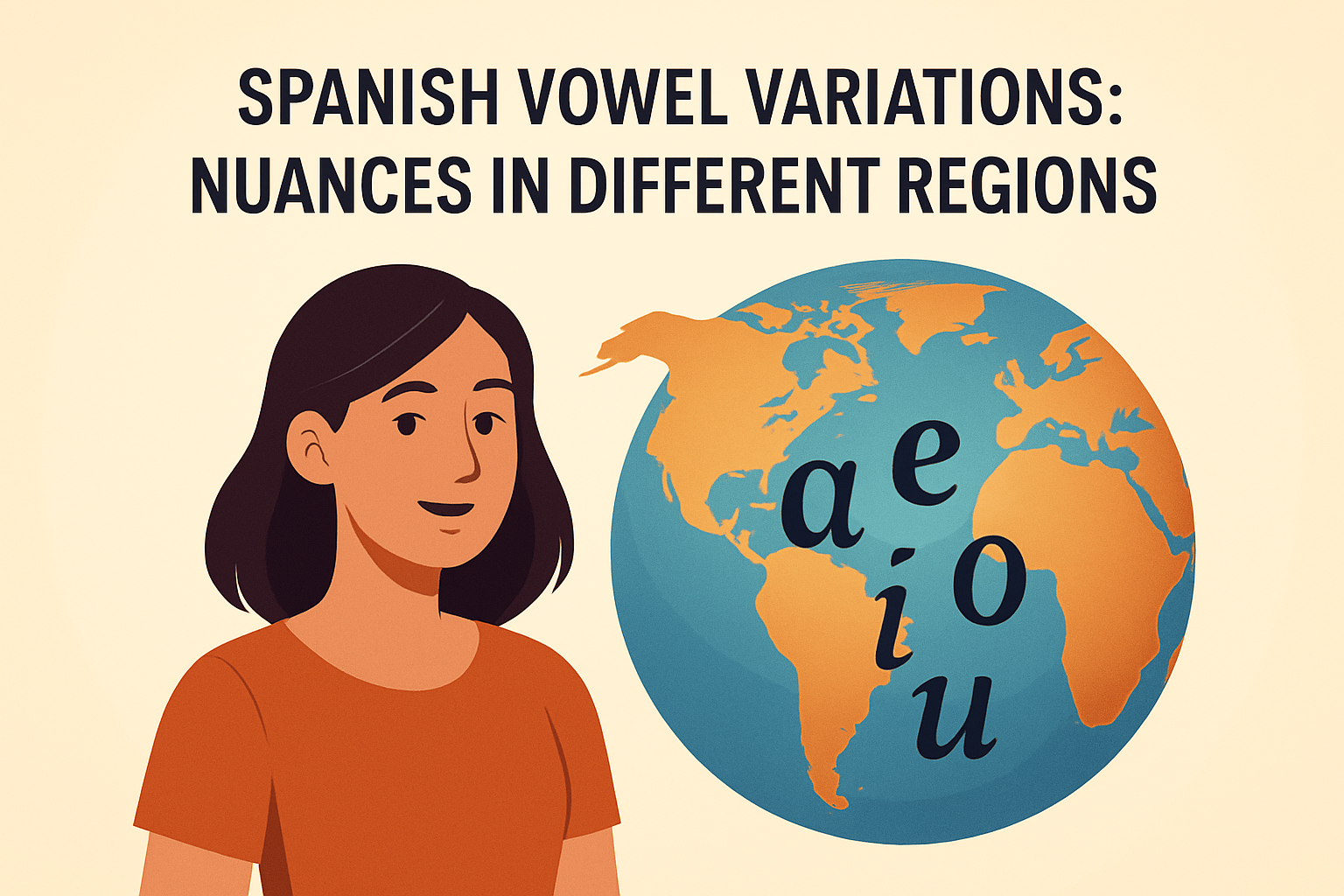
In standard Spanish, there are five distinctive vowel sounds: ‘a’, ‘e’, ‘i’, ‘o’, and ‘u’. They are short, crisp, and always pronounced the same way regardless of their position in a word, which can be quite different from how English vowels behave. For instance, the word ‘casa’ (house) consistently sounds like /ˈkasa/, with the vowels ‘a’ being uniformly articulated.
Consider the following table to illustrate these vowel sounds:
| Vowel | Example Word | Pronunciation |
|---|---|---|
| A | Amigo | /aˈmiɣo/ |
| E | Estrella | /esˈtɾeʝa/ |
| I | Mira | /ˈmiɾa/ |
| O | Ojo | /ˈoxo/ |
| U | Uno | /ˈuno/ |
Spanish Vowel Variations in Spain
Geographical distinctions play a significant role in the vowel variations found within Spain itself. The phonetic landscape of Spain varies greatly from region to region, yet the Castilian accent, often associated with the central region of the country, is considered the standard form of Spanish pronunciation in Europe. Castilian Spanish maintains the pure vowel sounds across the board, but in certain southern regions like Andalusia, an intriguing phenomenon known as “Seseo” and “Ceceo” can occur, affecting the vowel context as well. Seseo refers to the pronunciation of the sound /θ/ as /s/, while ceceo signifies the opposite, /s/ becoming more like a /θ/. Though this primarily alters consonant sounds, it influences the perception of vowels in fluent speech, adding a soft, delicate touch to the enunciation of words.
An example can be found in the word ‘casa’ being pronounced in Andalusian Spanish not as /ˈkasa/ but potentially influenced by softer consonantal transitions, leading to a more nuanced vowel state compared to Castilian Spanish.
Latin American Spanish: A Symphony of Variations
Venturing across the Atlantic to Latin America, the variation reaches new heights, with every country contributing its unique melodic twist to the Spanish language. For instance, in Mexican Spanish, vowels are typically more open. Think of the vowel ‘e’ in words such as ‘mesa’ (table), often sounding more like [me’sa] than [mes’a], adding a distinctive regional color.
In contrast, Argentine Spanish, particularly in the Buenos Aires region, is distinguished by an Italian-influenced rhythm and articulation pattern. Here, the vowel ‘a’ is frequently pronounced in a longer, more drawn-out manner, giving a musical quality to their speech. An illustrative case would be the word ‘calle’ (street), which is often pronounced as [ˈkaʎe] instead of the standard [ˈkaʝe].
The Caribbean offers another fascinating variation. Countries like Puerto Rico and the Dominican Republic feature rapid, rhythm-centered speech. In these regions, vowels sometimes experience elision, particularly in unstressed syllables, affecting even the clarity of vowels. For example, ‘pescado’ (fish) might be pronounced more like [pes’kaðo] in rapid speech, with the vowels blending into the surrounding consonants.
Cultural and Social Influences on Vowel Variations
The vowels in Spanish are not isolated from the larger social and cultural contexts in which they exist. Historical interactions, such as colonization and immigration, have played crucial roles in shaping speech patterns. The influence of indigenous languages is particularly pronounced in countries like Peru and Bolivia, where Quechua inflections lend unique sounds to otherwise standard Spanish words.
In these Andean countries, vowels might not only sound different but sometimes include sounds not typically found in other varieties of Spanish. This is observable in everyday terms such as ‘agüita’ (diminutive of water), where regional influences might lead to an unusual aspiration of vowels due to native influence.
Practical Implications for Learners and Speakers
Understanding vowel variations is essential for those learning Spanish, whether for travel, business, or communication. Each regional nuance offers a lens into the culture and history that have shaped the language. An adept speaker or learner can adjust pronunciation to suit different regions, thereby improving understanding and acceptance into diverse communities.
Practical examples can include recognizing a speaker’s country of origin or adapting accents and pronunciation to better integrate with Spanish-speaking communities when traveling or working abroad. This awareness not only aids in comprehension but also enriches cultural connections, fostering mutual respect and understanding.
Conclusion: Embracing the Diversity of Spanish Vowels
Spanish vowel variations are more than mere phonetic quirks; they are crucial threads woven into the linguistic fabric of the Spanish-speaking world. These nuances provide insights into regional identities and historical contexts while shaping communication styles and effectiveness. As Spanish continues to grow as a global language, understanding these vowel variations becomes increasingly vital.
Readers are encouraged to delve deeper into the linguistic idiosyncrasies of Spanish vowels, not just as students of the language but as explorers of diverse cultural narratives. Whether through travel, education, or conversational practice, embracing these differences enhances both linguistic proficiency and cultural appreciation. Therefore, take the next step to actively listen to conversations, immerse in regional dialects, and perfect your own pronunciation with an open mind and a forward-thinking approach.
Frequently Asked Questions
What are the main regions where Spanish vowel variations are noticeable?
Spanish vowel variations are prominently noticeable across several regions, particularly in Spain and Latin America. In Spain, differences can be observed between the central regions, such as Madrid, and other areas like Andalusia and the Canary Islands. In Latin America, countries like Mexico, Argentina, Puerto Rico, and Chile exhibit distinctive vowel pronunciations that set them apart from each other. Additionally, Spanish-speaking communities in the United States also display unique vowel characteristics influenced by their surrounding linguistic environments. These regional differences contribute to the rich tapestry of the Spanish language, offering a fascinating insight into its evolution and adaptation through geography and culture.
How do vowel sounds differ between Spanish spoken in Spain and Latin America?
In Spain, particularly in regions like Castile, vowels tend to be pronounced with a more clipped and clear sound, often considered more “standard” or “neutral” in European Spanish. The vowel ‘e’ is distinctly enunciated, whereas the ‘a’, ‘i’, ‘o’, and ‘u’ sounds maintain a crisp texture. In contrast, Latin American Spanish showcases a more varied approach. For instance, in Caribbean Spanish, vowels may be softened or merged, giving them a more fluid and flowing quality. In Mexico, vowel sounds might be broader and more expressive, while in Argentina, you can observe the phenomenon of intonation and rhythm affecting vowel pronunciation, lending a unique musicality to the speech. These subtle yet significant differences are a testament to the dynamic nature of Spanish as it adapts to different regions and cultures.
What causes the variations in Spanish vowels across different regions?
Several factors contribute to vowel variations in Spanish across different regions. Historically, the Spanish language has been influenced by the various indigenous languages of Latin America, as well as by other European languages due to colonization and migration. This has led to a blending of linguistic traits that emphasize different vowel sounds. Cultural influences, such as music, media, and literature, also play a significant role in shaping how vowels are pronounced. Additionally, geographical factors, like isolation or proximity to other cultures, can accelerate the development of regional variations. The interaction between language and identity drives speakers to adopt and adapt vowel sounds that resonate with their unique cultural heritage and community identity.
Are there specific vowels that have more noticeable variations in pronunciation?
Yes, certain vowels undergo more noticeable variations in pronunciation across Spanish-speaking regions. The vowel ‘o’ is often subject to change; in some areas, it may be pronounced with a closed sound, while in others, it retains a more open quality. The ‘e’ vowel often exhibits regional differences, particularly in terms of clarity and enunciation. In some Latin American regions, the ‘e’ and ‘i’ vowels can shift slightly, influenced by the rhythm and stress patterns of local speech. Furthermore, the umlauted ‘ü’, rare in Castillian Spanish, emerges in some dialects, notably in howling Spanish songs and is more prevalent in indigenous-influenced regions, reflecting a legacy of linguistic convergence. These vowels, among others, help to differentiate regional accents and contribute to the rich diversity of spoken Spanish.
How do cultural influences affect vowel variations in Spanish dialects?
Cultural influences have a profound impact on vowel variations in Spanish dialects. Each region’s history, lifestyle, and traditions imprint a unique linguistic signature on the Spanish spoken there. In regions like the Caribbean, African rhythms and intonations have melded with Spanish to produce a distinctive sound, reshaping the vowels to reflect musical cadences in everyday speech. Similarly, in Mexico, the rich tapestry of indigenous cultures has influenced the phonetic attributes of vowels, often creating smoother transitions between sounds. Argentine Spanish, heavily influenced by Italian immigration, features a melodic cadence that elongates vowels, adding a sing-song quality to speech. The cultural identity of a region shapes its language evolution, with vowels often serving as audible markers of historical and social transformation. These influences collectively demonstrate how language acts as a living, breathing element of culture, constantly evolving and adapting.