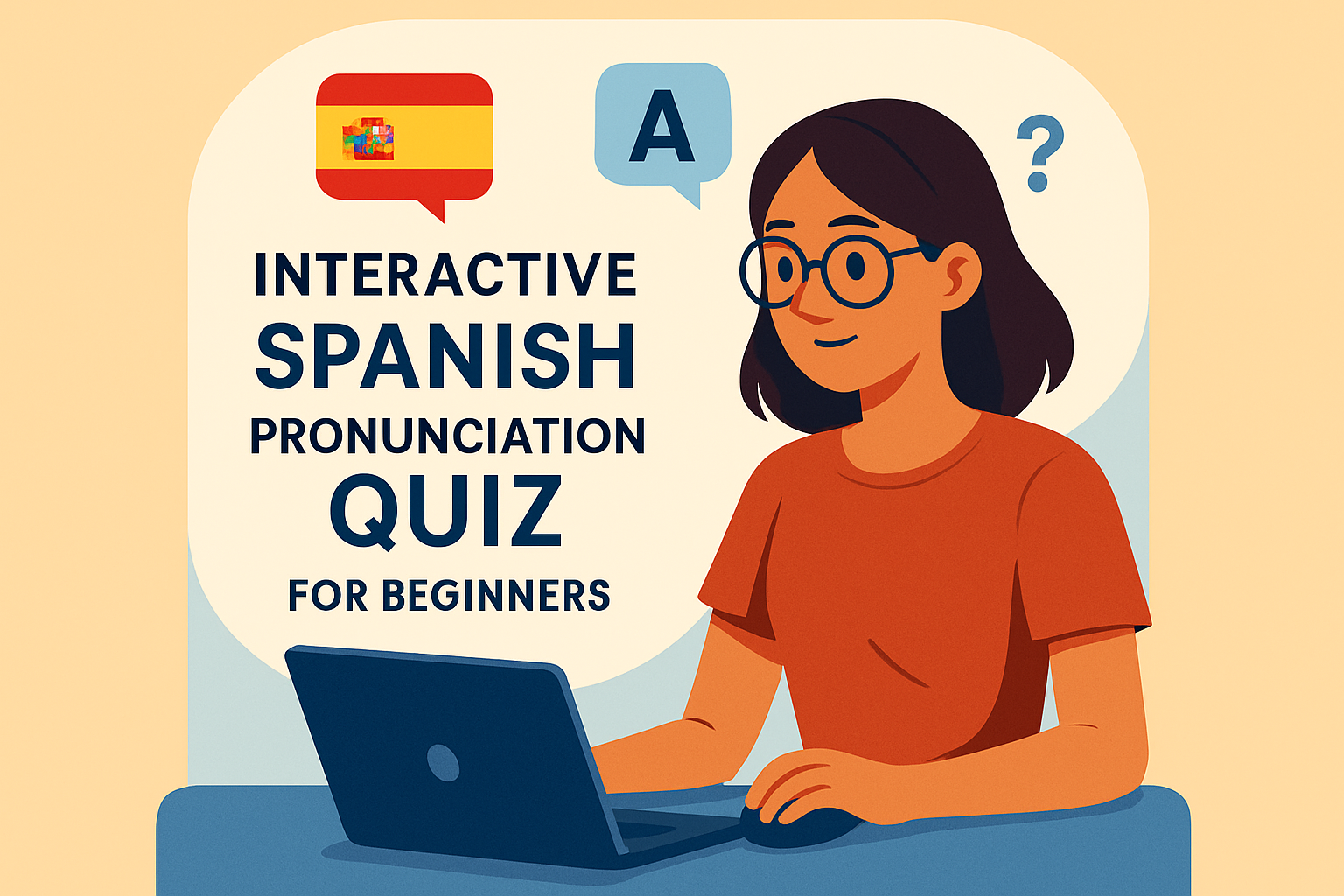
Learning a new language can be an exciting yet challenging journey, and Spanish, with its rich culture and vibrant community, offers an engaging linguistic experience for beginners worldwide. However, one of the critical elements of mastering Spanish, or any language, is acquiring a clear pronunciation skills. Good pronunciation not only allows you to be understood but also enhances your confidence to speak fluently. For beginners, interactive learning tools such as quizzes can be a valuable resource. In this article, we introduce the concept of an interactive Spanish pronunciation quiz specifically designed for beginners. We’ll explore why pronunciation is crucial, how quizzes can aid in learning, and the potential benefits of this approach.
Understanding Spanish Pronunciation Basics
Spanish pronunciation involves understanding the sounds of its vowels and consonants, stress rules, and the syllabic patterns that form words. Unlike English, many Spanish letters are pronounced consistently, which simplifies the learning process for beginners. For instance, the letter ‘a’ in Spanish is always pronounced as /a/ as in ‘car’. Getting these basics right is essential for clear pronunciation.
Real-world example: Consider the commonly mispronounced word ‘gracias.’ Beginners often say /ˈgrɑːsɪjəs/ instead of the correct /ˈɡɾasjas/. This distinction is crucial for clear communication.
Learning the basic pronunciation rules aids beginners in forming the building blocks for more advanced language skills. Mastering these basics allows learners to tackle more complex words and sentences confidently, ensuring better comprehension and interaction with native speakers.
How Interactive Quizzes Enhance Learning
Interactive quizzes have proven to be quite effective in educational settings, mainly due to their engaging nature. For Spanish pronunciation, quizzes that offer immediate feedback help learners quickly correct mistakes and reinforce correct pronunciation patterns. These quizzes can be structured sequentially to cover sounds incrementally, thereby allowing learners to build their knowledge systematically.
Real-world example: A beginner might take a quiz featuring audio clips of words like “casa,” “jardín,” and “elefante.” The learner listens to the clip, says the word aloud, and receives immediate feedback on their pronunciation accuracy.
Such interactive tools make the learning process dynamic and enjoyable, keeping learners motivated by showing tangible progress and clear areas for improvement. This interactivity also fosters a more active learning environment, which aids in better retention of pronunciation skills.
Pronunciation Challenges for Beginners
One of the significant challenges for beginners in learning Spanish pronunciation is distinguishing between similar sounds that do not exist in their native language. For instance, the trilled ‘r’ (as in ‘perro’) can be difficult for English speakers. Additionally, the subtle differences in vowel sounds, such as ‘e’ and ‘i’, require careful practice and attention.
Real-world example: Words like “caro” (expensive) and “carro” (car) can sound similar to beginners but have different meanings, making correct pronunciation crucial.
Recognizing and practicing these challenges through a structured quiz can greatly aid beginners in overcoming phonetic obstacles. By repeatedly encountering these pronunciation hurdles in a non-threatening and supportive environment, learners gain confidence and technical accuracy over time.
Real-World Application Through Quizzes
The ultimate goal of mastering Spanish pronunciation is to be able to use the language effectively in real-world settings. Interactive quizzes can simulate real-life scenarios, preparing learners for practical communication. A pronunciation quiz might include phrases commonly used in everyday conversations, such as ordering food, asking for directions, or making new friends.
- Ordering in a restaurant: “¿Puedo pedir una tortilla española, por favor?”
- Asking for directions: “¿Cómo llego a la estación de tren desde aquí?”
- Making new friends: “¿De dónde eres? Me llamo [Your Name].”
These quizzes serve as a bridge between theoretical learning and practical use, helping learners apply their skills in real-life situations. The use of contextualization in quizzes encourages situational learning, ensuring that the pronunciation practice is both relevant and useful to the learner.
Steps to Implement an Effective Pronunciation Quiz
Designing an interactive Spanish pronunciation quiz involves several steps to ensure effectiveness for beginners. Firstly, it’s vital to define clear learning objectives that specify which pronunciation skills the quiz will address. Following that, curate audio resources that exemplify correct pronunciation and structure the quiz in levels to cater to varying learner progressions.
Real-world example: A five-level quiz could start with vowel sounds, progress to consonant blends, incorporate stress patterns, and eventually handle complex sentences.
| Level | Subject | Objective |
|---|---|---|
| 1 | Vowels | Differentiate Spanish vowels from English vowels |
| 2 | Consonants | Master basic consonant sounds and blends |
| 3 | Stress | Understand stress and intonation patterns in sentences |
| 4 | Common Words | Pronounce frequently used words accurately |
| 5 | Complex Sentences | Apply pronunciation skills in sentence formation |
Interactive quizzes need to be engaging and should provide immediate feedback to correct mistakes. Regular assessments and adaptable difficulty levels help maintain learner interest and cater to different paces. Furthermore, reinforcement through repetition is key in cementing these pronunciation skills.
Tools and Resources for Spanish Pronunciation Quizzes
The availability of digital tools and resources makes the creation of interactive Spanish pronunciation quizzes more accessible. Platforms like Quizlet, Kahoot, and tailored learning management systems offer features to create custom quizzes with multimedia content for an enriched learning experience. Additionally, language learning apps such as Duolingo and Babbel provide integrated pronunciation exercises as part of their curriculum.
Real-world example: A teacher designing a quiz might use Quizlet to incorporate flashcards with audio examples, providing learners immediate exposure to correct pronunciations and robust practice routines.
These tools offer various options for replaying audio samples, tracking progress, and reviewing mistakes through digital means, enhancing the learner’s ability to adaptively learn at their own pace. By using these resources, learners can have a more comprehensive and self-directed learning journey.
Summary and Next Steps
Incorporating an interactive Spanish pronunciation quiz into your learning routine can significantly enhance your ability to speak confidently and clearly in Spanish. Understanding the importance of correct pronunciation, utilizing interactive quizzes, and tackling pronunciation challenges are critical steps in achieving fluency. Through consistent practice and real-world application of learned skills, learners soon find themselves navigating Spanish conversations with ease and clarity. Improvement in pronunciation not only facilitates communication but also deepens the learner’s connection to the Spanish culture and community.
As your next step, consider exploring various digital platforms that offer collaborative and interactive tools to create or participate in these quizzes. Engaging with these resources consistently will enhance your pronunciation journey, making it fulfilling and effective. Embark on this interactive learning pathway and see how it transforms your approach to mastering the beautiful Spanish language.
Frequently Asked Questions
1. What exactly is an Interactive Spanish Pronunciation Quiz for Beginners?
An Interactive Spanish Pronunciation Quiz for Beginners is a dynamic learning tool designed to help new Spanish learners develop their pronunciation skills. These quizzes typically consist of audiovisual content like recordings, videos, and exercises aimed at simulating real-world conversation and pronunciation challenges. They’re called “interactive” because they allow the learner to participate actively, often by providing real-time feedback. This engagement helps reinforce the correct pronunciation through practice and repetition, making the learning process more enjoyable and efficient.
Such quizzes may cover basic pronunciation elements, such as vowel sounds, common consonant sounds, stress and intonation patterns, and frequent pronunciation pitfalls for English speakers. Integrating various learning methods, these quizzes can provide an all-rounded approach so beginners can hear, imitate, and practice sounds to eventually improve their speaking ability. The goal is not just accuracy but also confidence in speaking Spanish.
2. How can an Interactive Pronunciation Quiz enhance my Spanish learning experience?
An Interactive Pronunciation Quiz can significantly enhance your Spanish learning experience by offering an engaging and practical approach to mastering pronunciation. Whereas traditional learning might focus on rote memorization of vocabulary and grammar rules, interactive quizzes put emphasis on the active application of language skills. They provide immediate feedback, which is crucial for correcting mistakes and understanding nuances in pronunciation that may not be evident otherwise.
Additionally, these quizzes can be tailored to suit your specific needs and learning pace. This personalization can help in targeting problem areas more effectively. By breaking down complex pronunciation rules into manageable exercises, these quizzes build your confidence to speak Spanish fluently. The sense of accomplishment as you complete different levels and receive positive reinforcement from the quiz can be incredibly motivating, helping you progress faster and with more enthusiasm.
3. I struggle with understanding spoken Spanish. How does practicing pronunciation help with this?
Struggling to understand spoken Spanish is a common challenge for beginners, and practicing pronunciation can indirectly yet profoundly help improve comprehension. When you focus on pronunciation, you are training your ear alongside your tongue. By learning how sounds form and change within words and sentences, you improve your auditory discrimination skills, which are vital for understanding spoken language.
As you practice saying words and phrases, you’re also training your brain to anticipate the kinds of sounds that native speakers use in rapid speech. This anticipation can bridge the gap between listening and comprehension. Moreover, as you become familiar with the distinct sounds of Spanish, you’ll better recognize them when they occur naturally, thereby enhancing your understanding during conversations, listening exercises, or even authentic Spanish media like songs and movies.
4. Can I use an Interactive Spanish Pronunciation Quiz on my own, or do I need a teacher?
You can definitely use an Interactive Spanish Pronunciation Quiz on your own. These quizzes are designed to be self-guided and are perfect for independent learners who wish to supplement their study with focused pronunciation practice. The interactive component simulates a learning environment that offers feedback and corrections, akin to having a personal tutor by your side.
However, pairing these quizzes with guidance from a teacher can also be beneficial. A teacher can provide personalized feedback, clarify doubts about particular pronunciation difficulties, and guide you through any specific issues you’re facing. Combining self-study with professional instruction can create a balanced learning approach where interactive quizzes consolidate classroom lessons and provide additional practice outside of class.
5. Is it necessary to have access to a digital device for Interactive Spanish Pronunciation Quizzes?
Yes, having access to a digital device such as a smartphone, tablet, or computer is essential for participating in Interactive Spanish Pronunciation Quizzes. These tools are typically delivered through digital platforms, be it dedicated learning apps, websites, or even downloadable content that requires digital interfaces to function properly.
Digital devices not only allow you to access these quizzes from virtually anywhere but also help in seamlessly integrating various multimedia components such as audio recordings, video demonstrations, and interactive feedback mechanisms. Having a reliable internet connection further enhances this experience by providing access to additional resources and updates to the quizzes, ensuring that you are continually challenged and engaged in your learning journey.