
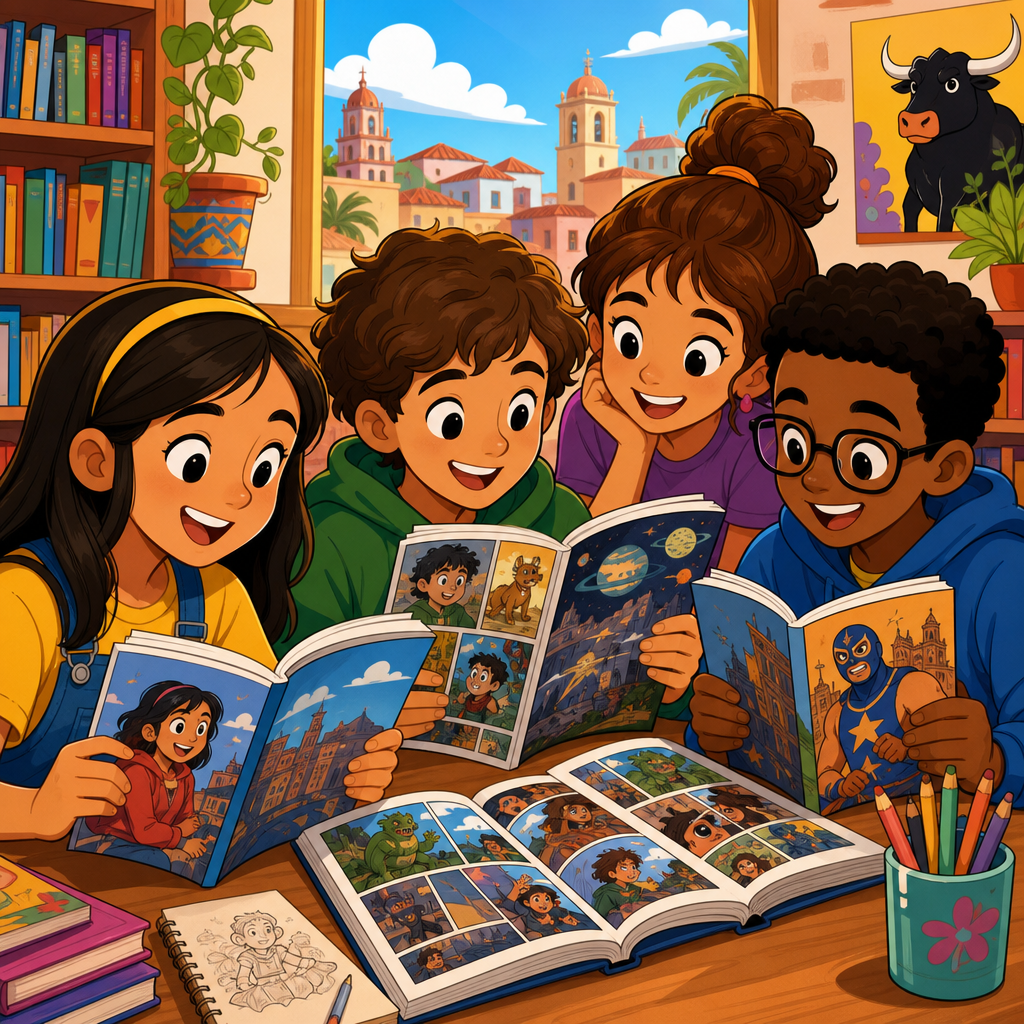
Spanish comics and graphic novels turn language study into sustained, enjoyable reading practice by combining visual context, everyday dialogue, and cultural detail in a format that feels less intimidating than dense prose. In Spanish learning, comics usually refer to shorter serialized stories, humor strips, superhero issues, or manga translations, while graphic novels tend to be longer, self-contained narratives with more developed plots and themes. Both formats help learners connect words to actions, emotions, and settings, which improves comprehension and recall. I have used comics with beginners who struggled through textbook dialogues but suddenly understood jokes, commands, and conversational turns when they saw the scene unfold in panels. That matters because motivation is often the difference between quitting and building a daily reading habit. As a hub within Spanish Community and Interaction, this topic also supports conversation practice, cultural participation, and shared recommendations, making comics not just reading material but a gateway into real Spanish-speaking communities online and offline.
Why Spanish comics work so well for language learning
Spanish comics are effective because they reduce cognitive load without reducing authenticity. A learner reading a page of prose must decode vocabulary, grammar, tone, and scene changes from text alone. In a comic, the artwork supplies part of that information. If a character says, “¡Apúrate!” while running toward a departing bus, the image clarifies the meaning immediately. This supports what language teachers call comprehensible input: material that is slightly above your level but still understandable through context. Over time, that repeated context builds vocabulary depth. You do not just learn that “enfadado” means angry; you see different faces, settings, and reactions that give the word emotional texture.
Dialogue density is another advantage. Comics contain a high concentration of speech acts learners actually need: greetings, interruptions, jokes, warnings, apologies, and informal reactions. In one issue, you may encounter tú and usted, slang, exclamations, and question forms repeatedly in natural use. Sound effects also help. Words like “¡Pum!”, “zas”, or “toc toc” expose learners to expressive language that textbooks often ignore but native speakers recognize instantly. For pronunciation and speaking practice, speech bubbles model short, repeatable phrases. I often advise learners to read one page aloud twice: once for comprehension and once for rhythm. That simple routine improves fluency more than passively highlighting unknown words.
Comics also support stamina. Many learners abandon Spanish reading because early success with graded readers does not always transfer to novels. Graphic storytelling bridges that gap. A twenty-page comic issue or a seventy-page graphic chapter feels finishable, and finishing matters psychologically. It creates momentum, reinforces identity as a reader in Spanish, and gives learners something concrete to discuss with conversation partners. That social dimension is especially valuable in community-based language learning, where reading becomes fuel for interaction instead of an isolated exercise.
Choosing the right comics and graphic novels by level and goal
The best Spanish comics for beginners are not automatically the simplest stories; they are the ones with clear visuals, strong narrative continuity, and manageable text density. Humor strips, slice-of-life comics, and young reader graphic novels often work well because they repeat familiar situations. For absolute beginners, translated editions of stories you already know can lower difficulty because plot knowledge fills in gaps. A learner who has seen a superhero film, for example, can often follow the Spanish comic adaptation far more easily than an unfamiliar literary narrative. Early on, choose books with larger panels, fewer narration boxes, and modern conversational Spanish rather than heavily stylized historical language.
Intermediate learners can expand into mystery, fantasy, memoir, and journalistic graphic nonfiction. At this stage, the goal shifts from basic comprehension to range. You want exposure to different registers, regional vocabulary, and more complex sentence patterns. This is where Spanish-language originals become especially useful because they reflect local culture rather than translated conventions. Advanced learners should deliberately mix genres: satire for wordplay, crime for colloquial dialogue, literary graphic novels for narration, and newspaper strips for concise social commentary. That variety prepares you for real interaction with native speakers, who rarely stay within one register.
Selection should also match your purpose. If your main goal is speaking, choose dialogue-heavy works and practice retelling scenes. If vocabulary growth matters most, use nonfiction comics about history, science, or biography, where topic-specific terms recur. If cultural understanding is the priority, seek creators from different Spanish-speaking countries and compare how they handle humor, politics, family life, and identity. A good hub page on Spanish comics should point learners toward all three paths because “fun learning” works best when enjoyment aligns with a concrete outcome.
| Learner goal | Best comic type | Why it helps | Practical example |
|---|---|---|---|
| Build confidence | Short humor strips | Fast payoff, repeated everyday phrases | Read one strip daily and summarize the joke aloud |
| Improve speaking | Dialogue-heavy graphic novels | Natural turn-taking and emotional expression | Shadow speech bubbles and role-play scenes with a tutor |
| Expand vocabulary | Nonfiction comics | Topic terms repeat with visual support | Create flashcards from recurring words in one chapter |
| Learn culture | Original works from Spanish-speaking creators | Shows local references, humor, and social norms | Discuss regional slang in a language exchange |
How to read comics actively instead of passively
Reading comics for fun learning does not mean reading carelessly. The most productive method is a three-pass approach. On the first pass, read for story only and avoid stopping for every unknown word. On the second, note high-frequency vocabulary, repeated grammar patterns, and expressions that seem useful in conversation. On the third, read selected panels aloud. This sequence protects enjoyment while still creating measurable learning. When learners interrupt every page to check a dictionary, they often destroy narrative flow and remember less. By contrast, postponing lookups helps you infer meaning, which is a core reading skill.
Annotation should be light and purposeful. I recommend tracking only three categories: phrases you would personally use, words repeated at least three times, and cultural references worth exploring later. If a character constantly says “venga ya,” that belongs in your notes because it is a living expression, not just isolated vocabulary. If a political reference appears once and is central to the plot, add it to a separate culture list rather than cluttering your main study notes. Digital reading tools like Kindle dictionaries, Readlang, LingQ, and browser translation extensions can help, but they are best used selectively. Too much instant translation trains dependency.
Comics are also ideal for output activities. Retell a page in your own words, describe a character’s mood from the art, or rewrite one panel in more formal Spanish. In group classes, I have had learners cover the text bubbles and invent dialogue before revealing the original. The gap between their version and the published line produces useful discussion about register, grammar, and tone. Another strong technique is panel dictation: one person describes a panel in Spanish, while another sketches or identifies it. This turns reading into interactive listening and speaking practice, which fits the broader goal of Spanish community and interaction.
Using comics to connect with Spanish-speaking communities
Comics become much more powerful when they lead to shared conversation. A learner who reads a graphic novel alone may improve comprehension, but a learner who discusses it in Spanish gains vocabulary retention, pragmatic awareness, and confidence expressing opinions. Book clubs, Discord servers, subreddit threads, local library groups, and online classes can all serve this purpose. The key is to choose discussion prompts that go beyond plot summary. Ask whether a character sounds natural, which expressions would be rude in another context, or how a setting reflects a specific city or generation. These questions force learners to notice language in use rather than simply consume a story.
Spanish-speaking fandom spaces are especially useful because they generate authentic interaction around a shared interest. Readers comment on art style, speculate about future installments, compare editions, and quote favorite lines. That creates repeated exposure to informal writing and community norms. However, learners should expect regional variation. A comment thread from Mexico will not sound identical to one from Spain or Argentina, and that is a benefit, not a problem. Comics make these differences visible in manageable pieces. You may see “ordenador” in one edition and “computadora” in another, or encounter voseo in Argentine dialogue. Instead of chasing one “correct” Spanish, learners can build flexible understanding.
For teachers, tutors, and meetup organizers, comics are practical community materials because they invite low-pressure participation. Even shy learners can point to a panel and say what they notice. A short excerpt can anchor an entire session on emotions, slang, narrative sequencing, or cultural comparison. In mixed-level groups, stronger learners can handle interpretation while newer learners focus on concrete description. That inclusive design is why comics deserve a hub position within Spanish Community and Interaction: they naturally produce conversation, recommendations, collaborative meaning-making, and cultural curiosity.
Finding quality Spanish comics, avoiding common mistakes, and building a reading path
The easiest places to find Spanish comics are public libraries with digital apps, major ebook stores, specialty comic shops, publisher catalogs, and secondhand marketplaces. Many libraries now offer graphic titles through Libby or Hoopla, though availability varies by region. For print readers, publishers often group titles by age range or genre, which helps with level selection. If you are buying imported editions, check whether the book is an original Spanish-language work or a translation, and note the country of publication. That detail affects vocabulary and spelling preferences. Reviews from bilingual teachers, language learners, and comics critics are more useful than generic star ratings because they explain text density, register, and cultural references.
Several mistakes slow progress. The first is choosing material purely by prestige. An award-winning graphic novel may be excellent literature yet frustrating for a learner if it relies on dense metaphor or fragmented narration. The second is overusing dictionaries. If you stop at every line, you are studying fragments rather than reading Spanish. The third is ignoring repetition. Real progress comes from rereading creators, genres, and series long enough for patterns to sink in. The fourth is staying only with translations. Translated manga or superheroes can be a helpful starting point, but original Spanish comics often teach more about rhythm, humor, and social context. Balance both.
A strong reading path starts narrow and then expands. Begin with one accessible series, one reading routine, and one discussion outlet. For example, read ten pages three times a week, record five useful expressions, and post one reaction in Spanish to a reading partner or community. After four to six weeks, add a second genre or a creator from another country. Keep a simple log of finished titles, recurring vocabulary, and cultural notes. That record shows progress better than vague impressions. If you want to go deeper into this Miscellaneous hub area, use comics as a bridge to related topics such as Spanish slang, language exchange, online communities, fan culture, and collaborative storytelling. The format is fun, but the learning gains are real, cumulative, and sustainable.
Spanish comics and graphic novels make language learning more approachable because they combine meaningful input, memorable visuals, and authentic community touchpoints in one format. They help beginners understand more with less frustration, give intermediate learners range across registers and regions, and offer advanced learners rich material for discussion, nuance, and cultural analysis. The strongest results come from choosing texts that match your level, reading actively instead of translating every line, and using each story as a starting point for speaking and interaction. When learners do that consistently, comics stop being a side hobby and become a practical reading system.
This Miscellaneous hub matters because it connects many parts of Spanish Community and Interaction at once. A single comic can lead to vocabulary study, pronunciation practice, online discussion, cultural comparison, and real conversations with other readers. That multiplies the value of every page you read. It also makes consistency easier, since people return to material they enjoy. If you want a sustainable way to learn Spanish that feels engaging rather than mechanical, start with one comic or graphic novel this week, read it in short sessions, and talk about it with someone else in Spanish.
Frequently Asked Questions
How do Spanish comics and graphic novels help with language learning?
Spanish comics and graphic novels support language learning by combining words with visual context, which makes meaning easier to understand and remember. Instead of facing a full page of uninterrupted text, learners see expressions, actions, settings, and emotional cues that clarify what characters are saying. This helps readers infer vocabulary naturally, even when they do not know every word. Dialogue in comics is also often closer to everyday speech than formal textbook examples, so learners get repeated exposure to common phrases, reactions, slang, and conversational sentence patterns used in real communication.
Another major benefit is motivation. Many learners struggle not because they lack ability, but because traditional reading materials feel slow, dense, or discouraging. Comics and graphic novels reduce that barrier. The format feels more approachable, progress is visible, and stories are easier to stick with over time. That sustained engagement matters because language growth depends on repeated contact with the language. Over time, learners improve reading fluency, strengthen vocabulary recall, notice grammar in action, and build confidence through enjoyable, low-pressure reading. In short, these formats turn study into something closer to entertainment, which often leads to more consistent practice.
What is the difference between Spanish comics and Spanish graphic novels for learners?
For learners, the difference is mainly in length, structure, and reading experience. Spanish comics often refer to shorter works such as serialized stories, humor strips, superhero issues, episodic adventures, or translated manga volumes. They are usually faster to read and easier to sample, which makes them especially useful for beginners and lower-intermediate learners who want manageable reading sessions. Because comics often rely heavily on dialogue and action, they can expose readers to quick exchanges, colloquial language, and repeated character speech patterns that reinforce comprehension.
Spanish graphic novels, by contrast, tend to be longer, self-contained narratives with more developed plots, themes, and character arcs. They may include more descriptive language, more emotional nuance, and a broader range of vocabulary than short-form comics. For learners at an intermediate or advanced level, graphic novels can provide a richer reading experience that feels closer to literary reading while still offering the support of images. Both are valuable, but they serve slightly different purposes. Comics are excellent for accessibility, momentum, and frequent practice, while graphic novels are ideal for deeper immersion, cultural exploration, and sustained reading development.
Are Spanish comics and graphic novels suitable for beginners?
Yes, they can be very suitable for beginners, especially when chosen carefully. The key is not to assume that all comics are easy simply because they have pictures. Some titles use advanced humor, regional slang, literary references, or fast-paced dialogue that may overwhelm a new learner. Beginners usually do best with stories that have clear artwork, straightforward plots, familiar daily situations, and a moderate amount of text per page. Slice-of-life stories, school settings, simple adventures, and younger-reader titles are often good entry points because the language tends to be more concrete and repetitive.
Beginners also benefit from reading strategically rather than trying to understand every single word. It is often more effective to follow the general story using the images, identify recurring vocabulary, and focus on key expressions than to stop constantly for dictionary lookups. This builds tolerance for ambiguity, which is an important reading skill in any language. Short comic episodes can be especially useful because they allow learners to finish a complete section and feel successful. As confidence grows, readers can gradually move toward denser comics and full graphic novels with more complex themes and language.
What is the best way to use Spanish comics and graphic novels as a study tool?
The most effective approach is to use them as both enjoyable reading material and a source of structured learning. Start by reading a page or section for general understanding without translating everything. Let the images help you follow the scene, identify who is speaking, and understand the mood or action. Then go back and review important words, phrases, or grammar structures that appear repeatedly. This two-step method prevents overanalyzing too early while still turning reading into active learning. It also mirrors how stronger readers process language: first for meaning, then for detail.
It helps to keep a small vocabulary list based on useful words rather than rare or highly specialized terms. Focus on expressions you are likely to encounter again, such as reactions, connectors, greetings, movement verbs, and common descriptive language. Reading dialogue aloud can also improve pronunciation and rhythm, especially because speech bubbles often capture natural conversational flow. Some learners reread the same chapter multiple times, which is extremely effective for fluency. The first reading builds familiarity, the second improves comprehension, and later readings reinforce vocabulary and grammar. If possible, choose material you genuinely enjoy, because consistency matters more than perfection. A learner who reads comics regularly will usually make better progress than one who only studies from difficult materials sporadically.
Do Spanish comics and graphic novels also teach culture, or are they only useful for vocabulary practice?
They are highly valuable for cultural learning, not just vocabulary practice. One of the strengths of comics and graphic novels is that they present language within lived contexts. Readers encounter everyday routines, humor, social relationships, regional expressions, food, clothing, neighborhoods, school life, politics, history, and popular culture in a way that feels immediate and memorable. The visual element makes these cultural details easier to notice because they are not only described in words but also shown directly through environments, gestures, symbols, and character interactions.
This matters because language and culture are deeply connected. Understanding how people joke, argue, show politeness, express emotion, or react in different situations is part of becoming a more capable reader and speaker. Spanish-language comics from different countries can also expose learners to variation across the Spanish-speaking world, including differences in vocabulary, tone, and social norms. A reader might notice that speech patterns in a comic from Spain differ from those in one from Mexico, Argentina, or Colombia. That exposure builds cultural awareness and helps learners understand that Spanish is not a single uniform variety. So while comics and graphic novels are excellent for vocabulary growth, they are equally powerful as windows into authentic cultural perspectives.


