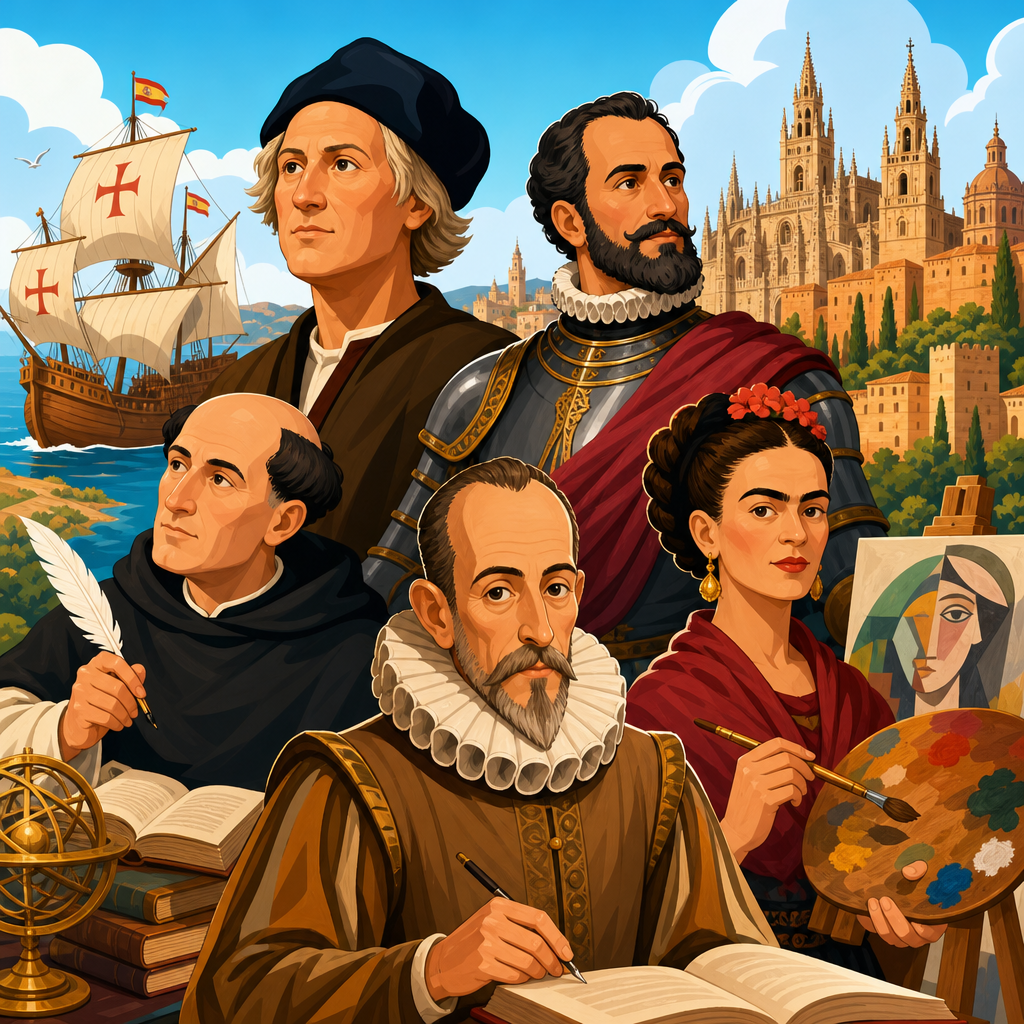
Spain’s history is shaped by individuals whose decisions, discoveries, art, and political struggles influenced not only the Iberian Peninsula but also Europe, the Americas, and the wider world. Famous Spanish historical figures include monarchs, explorers, writers, painters, reformers, and thinkers whose contributions still affect language, law, religion, science, and cultural identity. For anyone exploring Spanish community and interaction, these figures matter because they show how Spain developed through exchange, conflict, creativity, empire, and social change.
When we talk about historical figures, we mean people whose actions left a documented, lasting public impact. In Spain, that impact often crossed borders. A ruler such as Isabella I helped reshape state power and overseas expansion. A writer like Miguel de Cervantes transformed literature. An artist like Pablo Picasso changed modern visual culture. Others, including Bartolomé de las Casas, Francisco de Goya, Clara Campoamor, and Severo Ochoa, influenced debates about human rights, war, democracy, and scientific knowledge.
I have found that readers often ask a simple question first: why study famous Spanish historical figures instead of just studying events? The answer is practical. People make institutions visible. Through individual lives, the Reconquista, imperial expansion, the Golden Age, liberal reform, civil conflict, and democratic modernization become easier to understand. These figures also connect many related topics within Spanish community and interaction, making this article a useful hub for deeper reading on politics, art, religion, exploration, language, and society.
Another key term is contribution. A contribution is not the same as popularity or moral perfection. Some Spanish figures achieved remarkable progress while also being tied to violence, exclusion, or imperial ambition. A balanced view matters. Spain’s past includes achievements in navigation, literature, architecture, medicine, and civic reform, but it also includes persecution, colonial exploitation, censorship, and dictatorship. Understanding both sides gives a more accurate picture of how Spanish identity formed and why many of these figures remain debated today.
Monarchs, state builders, and the making of Spain
Among the most important Spanish historical figures are Ferdinand II of Aragon and Isabella I of Castile, often called the Catholic Monarchs. Their 1469 marriage did not instantly create a unified modern Spain, but it linked two major crowns and laid the groundwork for stronger royal coordination. They completed the conquest of Granada in 1492, ending Muslim rule in Iberia, and expanded royal authority over nobles, towns, and religious institutions. Their reign is central to understanding early state formation in Spain.
Yet their contributions came with hard consequences. In 1492, the Alhambra Decree expelled many Jews who refused conversion, and the Spanish Inquisition intensified religious policing. These policies helped produce a more centralized Christian monarchy, but they also damaged pluralism and caused long-term social and economic loss. Any serious account of Isabella and Ferdinand must include both administrative consolidation and coercive uniformity. They sponsored Columbus’s voyage, but they also reinforced a model of rule that fused power, religion, and imperial ambition.
Charles I of Spain, who was also Holy Roman Emperor Charles V, expanded Spanish power into a global structure. He inherited territories across Europe and the Americas, making Spain a central pillar of Habsburg influence. Under Charles, Spain became deeply involved in wars against France, Protestant forces, and the Ottoman Empire. His son Philip II strengthened bureaucratic government, made Madrid the capital in 1561, and oversaw an empire on which, famously, the sun never set.
Philip II’s rule illustrates both administrative sophistication and strategic overreach. He supported monumental projects such as El Escorial, a royal monastery and political symbol, and he oversaw a vast paper-based bureaucracy that modern historians study as a model of early imperial governance. At the same time, repeated warfare strained finances, leading to state bankruptcies. His failed Armada campaign against England in 1588 is one of the best-known examples of imperial limits. These monarchs matter because they turned Spain into a global power while exposing the costs of sustaining one.
Explorers, empire, and the global Spanish world
Christopher Columbus is often included in discussions of Spanish historical figures because his 1492 voyage sailed under Castilian sponsorship. Although Genoese by birth, his expeditions opened sustained contact between Europe and the Americas under Spanish authority. That contact transformed trade, migration, ecology, religion, and warfare. New crops such as maize and potatoes moved across continents, while conquest, disease, and forced labor devastated Indigenous populations. Columbus therefore belongs in Spanish history as a catalyst of empire, not simply as a navigator.
Hernán Cortés and Francisco Pizarro represent the violent expansion of that empire. Cortés led the campaign that toppled the Aztec Empire in the early sixteenth century, while Pizarro conquered the Inca Empire. Their contributions to Spanish power were undeniable: enormous territorial gains, access to silver, and prestige for the Crown. But these gains depended on alliances, military technology, disease, and brutal coercion. In my experience, readers understand these figures better when they are seen not as lone adventurers but as operators within a larger imperial machine.
Ferdinand Magellan and Juan Sebastián Elcano occupy a different place in Spanish memory. Magellan, Portuguese by birth but sailing for Spain, launched the expedition that achieved the first circumnavigation of the globe. He died in the Philippines in 1521, and Elcano completed the journey in 1522. Their expedition proved in practical terms the global scale of maritime routes and reshaped European geographical knowledge. For Spain, this voyage mattered because it connected trade ambitions, naval capability, and scientific navigation in a measurable, documented way.
| Figure | Main contribution | Why it matters |
|---|---|---|
| Christopher Columbus | Opened sustained Spanish Atlantic expansion after 1492 | Linked Spain to the Americas and global exchange |
| Hernán Cortés | Led conquest of the Aztec Empire | Expanded imperial territory and wealth |
| Francisco Pizarro | Led conquest of the Inca Empire | Secured strategic control in South America |
| Juan Sebastián Elcano | Completed first circumnavigation in 1522 | Demonstrated practical global navigation |
Bartolomé de las Casas offers an essential counterpoint within the history of empire. A Dominican friar and former colonist, he became one of the best-known defenders of Indigenous peoples in the Spanish Americas. His writings, especially A Short Account of the Destruction of the Indies, condemned colonial brutality and influenced debates at the Valladolid controversy in 1550–1551. He did not end exploitation, but he forced Spain to confront the moral and legal status of conquest. That intervention remains one of Spain’s most important contributions to early human rights discourse.
Writers, artists, and the cultural prestige of Spain
No list of famous Spanish historical figures is complete without Miguel de Cervantes. His novel Don Quixote, published in two parts in 1605 and 1615, is widely regarded as a foundational work of the modern novel. Cervantes blended satire, realism, and psychological depth in a way that influenced fiction across Europe and beyond. He also captured tensions between idealism and reality that still resonate. For students of Spanish culture, Cervantes is crucial because he elevated Castilian prose and helped define literary Spanish.
Spain’s Golden Age also produced Lope de Vega and Diego Velázquez. Lope transformed theater through astonishing productivity and a flexible dramatic structure that brought noble and popular audiences together. Velázquez, court painter to Philip IV, mastered portraiture, perspective, and visual ambiguity. His Las Meninas remains one of the most analyzed paintings in Western art because it questions who is looking, who is being represented, and how power appears in images. These figures made Spain a center of European cultural prestige.
Francisco de Goya bridges the old regime and the modern age. Beginning as a court painter, he later produced stark works such as The Third of May 1808 and the Disasters of War prints, which confronted violence without heroic disguise. I return to Goya often when explaining Spanish history because he shows how art can document trauma better than official reports. His later Black Paintings, created in near isolation, anticipate modern expressionism and reveal the psychological damage of war, repression, and disillusion.
In the twentieth century, Pablo Picasso and Salvador Dalí carried Spanish influence into global modernism. Picasso’s Guernica, painted in 1937 after the bombing of the Basque town during the Spanish Civil War, became an international anti-war symbol. Dalí’s surrealism, though very different in method, expanded the imaginative range of modern art and made Spanish avant-garde culture visible worldwide. Their fame can overshadow other creators, but their importance is real: they ensured that Spain remained central to artistic innovation even during political instability.
Reformers, scientists, and defenders of rights
Spanish history is not only a story of rulers and conquerors. It also includes reformers who changed law, education, and public life. Gaspar Melchor de Jovellanos, a major Enlightenment thinker, argued for economic modernization, educational reform, and rational administration in the late eighteenth century. His writings reflected broader European Enlightenment ideas, but they were grounded in Spanish conditions such as agrarian inefficiency and institutional rigidity. He matters because he represents Spain’s internal effort to renew itself through knowledge rather than conquest.
In the twentieth century, Clara Campoamor became one of the most consequential political figures in Spanish democracy. As a lawyer, writer, and deputy during the Second Republic, she defended women’s suffrage in the Cortes. Her speech in 1931 was direct and historically decisive: political equality could not be delayed until women were considered ready. Women voted in Spain’s 1933 general election as a result. Campoamor’s contribution was concrete, legal, and enduring, even though civil war and dictatorship soon interrupted democratic progress.
Another essential figure is Severo Ochoa, the Spanish-born scientist who shared the 1959 Nobel Prize in Physiology or Medicine for work related to the synthesis of RNA. Although much of his career unfolded abroad, he represents the scientific dimension of Spanish historical achievement. His work helped expand molecular biology at a time when genetics was rapidly transforming medicine. When readers ask whether Spain contributed to science as much as to art, Ochoa is one of the clearest answers, alongside Santiago Ramón y Cajal, the pioneer of modern neuroscience.
Ramón y Cajal, winner of the 1906 Nobel Prize in Physiology or Medicine, demonstrated that the nervous system is made of discrete cells rather than a continuous network. Using microscopic observation and refined drawing, he developed the neuron doctrine that underpins modern neuroscience. His contribution was methodological as well as theoretical: careful observation, visual recording, and disciplined inference. He trained generations of researchers and proved that Spanish laboratories could shape international science. His legacy remains strong in medicine, psychology, and brain research today.
Conflict, memory, and contested legacies in modern Spain
Some of the most famous figures in Spanish history remain controversial because they are tied to civil conflict and dictatorship. Francisco Franco dominated Spain from the end of the Civil War in 1939 until his death in 1975. His regime combined authoritarian rule, censorship, political repression, and nationalism, while also delivering later-period economic development under controlled conditions. To describe Franco merely as a stabilizer or merely as a villain misses the historical structure of his rule. He built a durable dictatorship whose social effects lasted well beyond his lifetime.
The democratic transition after Franco produced another category of significant figures, including King Juan Carlos I and Prime Minister Adolfo Suárez. Juan Carlos, initially expected by some to preserve authoritarian continuity, ultimately supported democratic reform. Suárez helped legalize political parties, manage institutional negotiation, and guide Spain toward the 1978 Constitution. Their contributions were not dramatic in the style of conquest or revolution; they were procedural, strategic, and essential. Modern Spanish democracy exists in its current form partly because these figures made compromise politically workable.
Remembering famous Spanish historical figures requires judgment, not hero worship. Some people symbolize creativity, some reform, some oppression, and many combine achievement with damage. That is especially true in a country marked by religious conflict, imperial expansion, regional diversity, civil war, and rapid modernization. If you are building a deeper understanding of Spanish community and interaction, start with the figures in this hub and then follow the connected themes: monarchy, empire, literature, art, science, rights, and democratic change.
The main benefit of studying these figures is clarity. They turn broad historical processes into human stories that can be examined, compared, and debated. Isabella I helps explain state formation, Cervantes explains literary influence, Goya explains war and memory, Campoamor explains citizenship, and Ramón y Cajal explains scientific excellence. Use this hub as a starting point for further reading on each era and contribution. The more closely you study these lives, the more coherent Spain’s complex history becomes.
Frequently Asked Questions
Who are some of the most famous Spanish historical figures, and why are they important?
Some of the most famous Spanish historical figures include Isabella I of Castile, Ferdinand II of Aragon, Christopher Columbus in connection with the Spanish Crown, Miguel de Cervantes, Diego Velázquez, Francisco Goya, El Cid, Hernán Cortés, Bartolomé de las Casas, and Pablo Picasso. Each of these individuals represents a different side of Spain’s long historical development, from state-building and imperial expansion to literature, art, religion, and political debate. Their importance lies not only in their achievements, but also in how their lives reflect the major turning points in Spanish history.
For example, Isabella and Ferdinand are central because their marriage helped unite powerful Spanish kingdoms and laid the foundation for a more consolidated monarchy. Cervantes is celebrated for transforming world literature through Don Quixote, a work that shaped the modern novel. Velázquez and Goya elevated Spanish painting to global prominence, while Picasso, though a modern figure, redefined artistic expression in the twentieth century. Figures such as Las Casas are especially important because they reveal that Spain’s imperial age was also a period of moral and legal argument about conquest, justice, and human rights. Taken together, these historical figures matter because they show how Spain influenced politics, language, art, exploration, and cultural identity on a global scale.
How did Spanish monarchs like Isabella I and Ferdinand II shape Spain’s history?
Isabella I of Castile and Ferdinand II of Aragon are among the most influential rulers in Spanish history because they helped create the political framework that would eventually become modern Spain. Their marriage in 1469 joined two of the most powerful Iberian crowns, although each kingdom kept its own laws and institutions for a time. Even so, their partnership strengthened royal authority, reduced the power of rival nobles, and pushed Spain toward greater political unity. Their reign is often seen as a turning point because it marked the rise of Spain as a major European power.
They are also known for several decisive actions that had lasting consequences. In 1492, their forces completed the Reconquista with the conquest of Granada, ending centuries of Muslim political rule in Iberia. In that same year, they sponsored Columbus’s voyage, opening the way for Spanish expansion into the Americas and the creation of a vast overseas empire. At the same time, their policies promoted religious conformity, including support for the Spanish Inquisition and the expulsion of Jews from Spain, developments that remain deeply controversial. Their legacy is therefore complex: they strengthened monarchy and launched Spain onto the world stage, but they also shaped patterns of exclusion, imperial domination, and centralized power that continue to be debated by historians today.
Why is Miguel de Cervantes considered one of Spain’s greatest contributors to world culture?
Miguel de Cervantes is widely regarded as one of Spain’s greatest cultural figures because his writing, especially Don Quixote, transformed literature far beyond Spain’s borders. Published in two parts in 1605 and 1615, Don Quixote is often described as one of the first modern novels. It blends satire, adventure, psychological depth, and social commentary in a way that was groundbreaking for its time. Cervantes created characters who feel vividly human, especially Don Quixote and Sancho Panza, and he explored the tension between idealism and reality with remarkable sophistication.
His contribution is not limited to literary innovation. Cervantes helped shape the prestige of the Spanish language itself, much as Shakespeare did for English. His work became a cornerstone of Hispanic identity and a reference point for writers across Europe and Latin America. Novelists, philosophers, and critics have returned to Cervantes for centuries because his themes remain universal: imagination, dignity, failure, illusion, freedom, and the search for meaning. He matters in any discussion of Spanish historical figures because he shows that Spain’s influence was not only military or political. It was also intellectual, artistic, and linguistic, with effects that still define global literary culture.
What role did Spanish explorers and empire-builders play in world history?
Spanish explorers and empire-builders played a defining role in connecting Europe, the Americas, Africa, and Asia during the Age of Exploration and the early modern period. Voyages backed by the Spanish Crown helped establish new sea routes, expand geographic knowledge, and initiate sustained contact between continents. Christopher Columbus’s 1492 voyage, although based on mistaken assumptions about geography, triggered a dramatic and irreversible transformation in world history. It opened the way for Spanish colonization in the Americas and contributed to what historians often call the Columbian Exchange, the large-scale movement of plants, animals, diseases, peoples, and ideas across the Atlantic.
Figures such as Hernán Cortés and Francisco Pizarro expanded Spanish imperial power through conquests in the Americas, bringing enormous wealth to Spain but also causing violence, social upheaval, and the collapse of Indigenous political systems. At the same time, explorers and administrators helped spread the Spanish language, legal traditions, Catholic institutions, and cultural practices across vast territories. This legacy remains visible today in the linguistic and cultural ties linking Spain with much of Latin America. However, their role must be understood in full context: Spanish expansion created new global networks and transformed trade, politics, and identity, but it also involved exploitation, forced labor, religious coercion, and enduring inequalities. That complexity is essential to any serious understanding of Spain’s historical impact.
How did Spanish artists and thinkers influence Spain’s identity and the wider world?
Spanish artists and thinkers have been central to the formation of Spain’s identity because they interpreted the nation’s triumphs, tensions, beliefs, and contradictions in ways that still resonate. Painters such as Diego Velázquez and Francisco Goya did far more than produce beautiful works. Velázquez elevated court portraiture into a sophisticated exploration of power, perception, and status, while Goya captured both the brilliance and the darkness of Spain, especially in times of war, political instability, and social change. Their art provides an extraordinary visual record of Spanish society and has influenced generations of artists around the world.
In modern times, Pablo Picasso became one of the most influential artists in global history, and his work, especially Guernica, turned Spanish suffering during civil conflict into an international symbol against war and brutality. Spanish thinkers, reformers, and religious figures also shaped major debates about morality, governance, and human dignity. Bartolomé de las Casas, for instance, challenged the abuses committed against Indigenous peoples in the Americas and helped spark early discussions about rights and justice within the Spanish Empire. These contributions matter because they show that Spain’s historical significance is not limited to rulers and conquerors. Its artists and intellectuals helped define how people understand authority, conscience, memory, and human experience, making Spain a lasting force in world culture and thought.