
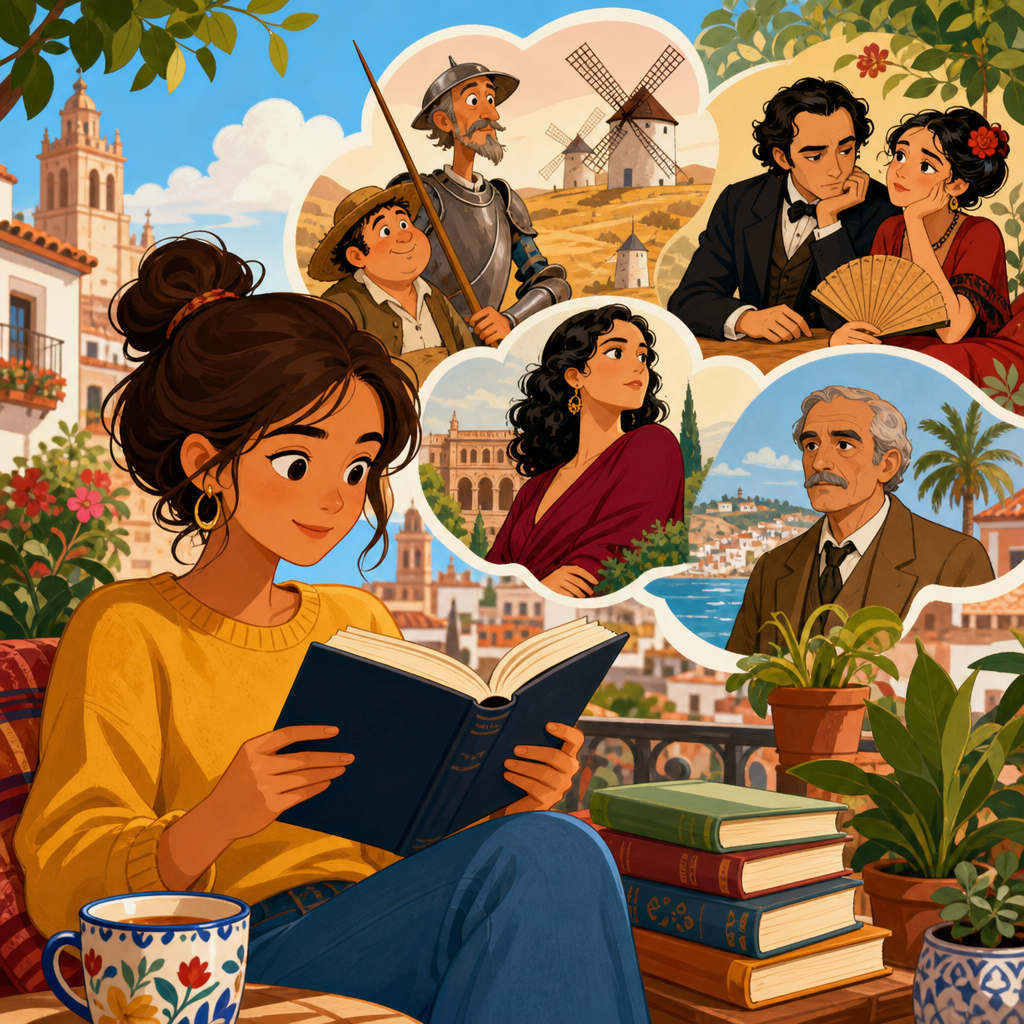
Spanish literature gives language learners something textbooks rarely deliver: living Spanish shaped by history, region, class, humor, and emotion. When you read stories, poems, plays, essays, and modern narrative from the Spanish-speaking world, you see vocabulary in context, grammar operating naturally, and cultural references that explain why people speak the way they do. Exploring Spanish literature for language learners is not only a reading exercise. It is a practical method for building comprehension, retaining phrases, improving writing style, and developing the cultural fluency needed for real interaction in Spanish-speaking communities.
In my work with intermediate and advanced learners, literature has consistently produced better long-term gains than isolated drills alone. A short story by Julio Cortázar can sharpen inferencing skills. A scene from Federico García Lorca can reveal register and rhythm. A children’s novel by Ana María Matute can make past tenses memorable because they are attached to characters and conflict rather than to abstract rules. Spanish literature, in this context, means written works originally produced in Spanish across Spain, Latin America, and the broader Hispanic world, from canonical classics to contemporary popular fiction. For learners, the goal is not to read everything. It is to choose the right texts, use effective reading strategies, and connect reading with speaking, listening, and community participation.
This matters because many learners stall after mastering basic conversation. They can order food, describe routines, and survive travel, yet struggle with nuance, irony, metaphor, or regional wording. Literature closes that gap. It exposes learners to voice, ambiguity, idioms, and social settings that ordinary learner materials simplify away. It also builds stamina. If you can follow a chapter, track a narrator, and notice how a writer signals time, mood, and perspective, everyday Spanish becomes easier. As a hub within Spanish Community and Interaction, this guide covers the miscellaneous literary paths learners can explore, the major text types worth knowing, how to match books to level, and how to turn reading into richer discussion with other Spanish speakers.
Why literature accelerates language growth
Reading literature improves several skills at once because it combines repeated exposure, meaningful context, and memorable language. The first benefit is vocabulary acquisition. Research on extensive reading has repeatedly shown that learners retain words more effectively when they meet them several times in a coherent text rather than on disconnected lists. In practical terms, a learner who encounters esconder, hallazgo, and sospecha throughout a mystery novel is more likely to remember them than a learner who studies them once in a flashcard deck. Literature also teaches collocations, such as tomar una decisión, echar de menos, or darse cuenta, which are essential for natural expression.
The second benefit is grammatical intuition. Literary texts repeatedly model tense contrast, subordination, pronoun use, and discourse markers. Learners often understand the pretérito and imperfecto more deeply after reading narrative passages where background and action are clearly distinguished. They also see how dialogue differs from exposition, how authors create emphasis with word order, and how register shifts between formal narration and colloquial speech. This makes literature especially useful for moving from rule recognition to fluent pattern recognition.
The third benefit is cultural literacy. Spanish is not a single uniform code. Literature introduces learners to Peninsular Spanish, Rioplatense features, Mexican urban vocabulary, Caribbean cadence, Andean imagery, and countless local references. Reading these differences prepares learners for actual community interaction, where accent, idiom, and social context vary. A learner who has read Gabriel García Márquez, Almudena Grandes, and Laura Esquivel will recognize that Spanish changes across regions without becoming mutually inaccessible. That awareness reduces frustration and makes conversations more flexible.
How to choose Spanish literature by level and purpose
The best Spanish literature for language learners is not always the most famous. Difficulty depends on syntax, narrative structure, dialect density, and cultural distance, not just on prestige. Beginners usually do better with graded readers, children’s literature, illustrated narratives, and contemporary prose with straightforward syntax. Early intermediate learners can handle short stories, young adult novels, comics, and adapted classics. Upper intermediate and advanced learners can begin reading unadapted authors with stronger stylistic complexity, including Borges, Cervantes, Isabel Allende, Javier Marías, and Rosa Montero.
Your purpose matters just as much as your level. If your goal is conversation, choose dialogue-heavy texts. If your goal is academic vocabulary, essays and historical fiction are stronger choices. If you want listening support, pick books with quality audiobooks narrated by native speakers. If motivation is your main challenge, select genres you already enjoy in English, such as detective fiction, romance, memoir, or fantasy. I have seen learners persevere through difficult grammar when the plot genuinely interests them, while abandoning easier books that feel like homework.
A practical selection framework helps. Measure the number of unknown words on a page, the clarity of the timeline, and the amount of figurative language. If every sentence requires a dictionary, the text is too hard for extensive reading. If you understand the main action but miss some descriptive detail, the level is usually right. Choose one “comfort” text for fluency and one “stretch” text for growth. That combination keeps reading both productive and sustainable.
| Reading stage | Best text types | What learners gain |
|---|---|---|
| Beginner | Graded readers, bilingual editions, children’s stories | Core vocabulary, basic sentence patterns, confidence |
| Intermediate | Short stories, YA novels, comics, simple nonfiction | Tense control, dialogue recognition, reading stamina |
| Advanced | Unabridged novels, plays, essays, poetry | Nuance, style, regional variation, cultural depth |
Genres that work especially well for learners
Short stories are often the best entry point because they compress plot, character, and language into a manageable length. Authors like Horacio Quiroga, Ana María Matute, and Julio Cortázar offer rich material, but teachers should select stories carefully. Some are linguistically elegant yet structurally demanding. For intermediate learners, contemporary anthologies and microfiction collections often provide cleaner access. You can read one complete piece in a sitting, review the vocabulary, and discuss themes immediately with a tutor or reading group.
Young adult fiction is another strong option. It tends to use current language, concrete settings, and emotional stakes without sacrificing authentic Spanish. Works by Carlos Ruiz Zafón written for younger readers, or accessible contemporary Latin American YA novels, can bridge the gap between learner texts and adult literature. Detective fiction also works well because the narrative drive encourages guessing from context. When learners want to know what happens next, they tolerate ambiguity better and read more extensively.
Plays deserve more attention than they usually receive. Because drama is built around dialogue, it exposes learners to turn-taking, interruption, persuasion, and emotional emphasis. Reading Lorca or modern stage writing aloud can improve pronunciation and prosody in ways silent reading cannot. Poetry is the most difficult genre for many learners, yet short poems can sharpen attention to sound, imagery, and concise expression. The key is not to begin with dense symbolic verse. Start with poems whose emotional situation is clear, then examine repeated structures, metaphor, and rhythm.
Essential authors and texts worth knowing
No hub on Spanish literature would be complete without a map of major names. Miguel de Cervantes matters because Don Quijote shaped the modern novel, though most learners should not start there in the original. Federico García Lorca is central for drama and poetry, especially for understanding symbolism, rural conflict, and twentieth-century Spain. Gabriel García Márquez is indispensable for narrative voice and magical realism, but some learners find his long sentences challenging. Isabel Allende often provides a more approachable gateway to multigenerational storytelling and Latin American history.
Jorge Luis Borges is enormously influential, especially for short fiction about identity, infinity, mirrors, and labyrinths, yet he is conceptually demanding even when the vocabulary seems manageable. Julio Cortázar offers playful, unsettling prose that trains learners to accept ambiguity. Carmen Laforet and Camilo José Cela illuminate postwar Spain. Almudena Grandes, Javier Cercas, and Arturo Pérez-Reverte bring modern historical and political dimensions. From Latin America, Laura Esquivel, Juan Rulfo, Mario Benedetti, Gioconda Belli, and Samanta Schweblin give learners exposure to distinct regional voices.
For easier entry, many learners benefit from bilingual editions, annotated school editions, or abridged versions from publishers such as Difusión, Edelsa, and Penguin Parallel Text. These are not shortcuts in a negative sense. They are scaffolds. Once learners build fluency, they can move to native editions, audiobooks from Audible or Storytel, and public-domain classics through Biblioteca Virtual Miguel de Cervantes. The important point is sequencing. Difficult masterpieces become more rewarding when approached after learners have built familiarity with literary Spanish.
How to read actively without turning literature into a chore
Effective literary reading balances enjoyment and analysis. I advise learners to read the first pass for meaning, not perfection. Mark unknown words only when they block comprehension or recur often. After the reading session, review those terms, note useful phrases, and write a short summary in Spanish. This simple sequence reinforces comprehension, retrieval, and written output without drowning the reader in interruption. A page full of dictionary lookups is usually a sign that the reading method, not just the book, needs adjustment.
Annotation should be selective. Highlight patterns such as repeated connectors, speech tags, or examples of the subjunctive in context. Track who is speaking, when the timeline shifts, and how the author signals attitude. Reading aloud helps with punctuation, rhythm, and sentence grouping. Listening to the audiobook while following the text is especially effective for learners who can decode grammar on the page but struggle to process native-speed speech. It turns literature into a bridge between reading and listening rather than a separate activity.
Discussion completes the learning cycle. Join a Spanish book club, work with a tutor, or exchange voice notes with a language partner. Ask concrete questions: Why did the character choose this word? What social class is suggested by that expression? What changes between narration and dialogue? These questions lead naturally into interaction, which is why literature belongs inside a broader community-learning strategy. Reading alone builds knowledge. Talking about what you read turns that knowledge into usable Spanish.
Using literature as a hub for community and interaction
Literature becomes far more powerful when it connects learners with other people. A novel chapter can anchor a conversation class. A poem can start a pronunciation workshop. A play scene can be role-played in a meetup. In community settings, literary texts give everyone shared material, which reduces the pressure to invent topics from nothing. That is especially helpful for quieter learners. Instead of asking them to “speak freely,” you can ask what they think of a narrator, a conflict, or an ending. The language becomes more specific and more natural.
For online communities, short excerpts work best. Post a paragraph, ask members to identify tone, and invite alternative endings or cultural comparisons. In local Spanish groups, rotate between regions and genres so learners hear broader varieties of Spanish. One month might feature a Mexican short story, the next a Spanish play, the next a Chilean memoir excerpt. This prevents the mistaken idea that there is a single correct literary Spanish. It also mirrors real-life interaction, where learners encounter many accents and cultural frames.
The central benefit of exploring Spanish literature for language learners is depth. Literature teaches words, but it also teaches perspective, ambiguity, humor, memory, and social context. Start with manageable texts, read for meaning before analysis, and use discussion to turn reading into interaction. Over time, books stop feeling like separate study material and become part of your Spanish-speaking life. Choose one story, one author, or one reading group this week, and let literature expand both your language skills and your connection to the Spanish-speaking world.
Frequently Asked Questions
Why is Spanish literature so useful for language learners compared with textbooks alone?
Spanish literature helps learners experience the language as it is actually lived, not just as it is organized for study. Textbooks are useful for building foundations, but they often present vocabulary, grammar, and dialogue in simplified, controlled ways. Literature adds the missing dimension: authentic context. In a novel, short story, poem, or play, words appear alongside character, social setting, emotion, irony, and cultural meaning. That makes new language far more memorable because learners do not just see a term translated; they see how it functions in a real human moment.
Another major benefit is that literature exposes learners to natural sentence patterns and stylistic variety. Instead of only practicing isolated grammar points, readers encounter verb tenses, pronouns, idioms, and transitions working together in full passages. This helps learners develop a stronger instinct for how Spanish flows. Literature also reveals regional differences, levels of formality, and historical layers of the language, all of which are essential for understanding Spanish beyond the classroom.
Just as important, literature builds cultural literacy. Many expressions, references, and ways of speaking come from shared histories, social realities, and traditions across the Spanish-speaking world. Reading literature shows why people speak as they do, not just what they say. For language learners, that creates deeper comprehension, better retention, and a more nuanced relationship with Spanish overall.
What types of Spanish literature are best for beginners, intermediate learners, and advanced students?
The best type of Spanish literature depends on the learner’s current level, reading stamina, and goals. Beginners usually benefit most from short, manageable texts with clear narration and limited stylistic complexity. Adapted readers, children’s literature, simple short stories, and contemporary narratives with straightforward language can be excellent starting points. These texts allow learners to build confidence while still encountering authentic patterns of vocabulary and grammar. Poetry can also work for beginners if the poems are short, but it helps to choose pieces with clear imagery rather than highly abstract or experimental language.
Intermediate learners can expand into short story collections, modern novels with accessible prose, memoir, essays, and selected plays. At this stage, literature becomes especially powerful because learners can begin noticing voice, tone, and subtext while still following the main ideas. Intermediate readers often do well with works that have strong plots, dialogue, and familiar themes, since these features support comprehension even when some vocabulary is unknown. Reading literature from different countries can also help intermediate learners become more comfortable with regional variation.
Advanced students are in a strong position to explore the full range of Spanish literature, including canonical novels, dense essays, complex theater, and poetry with layered symbolism. They can engage more productively with older texts, nonstandard structures, and historical language. Advanced readers may also benefit from comparing authors across regions such as Spain, Mexico, Argentina, Colombia, Chile, or the Caribbean to better understand stylistic and cultural diversity. In general, the ideal progression is not to choose the most famous text first, but the one that offers the right balance of challenge and readability. A book that stretches comprehension without overwhelming it will do more for language growth than a classic that feels impossible to finish.
How can language learners read Spanish literature without getting discouraged by difficult vocabulary and grammar?
The most effective approach is to read for meaning first and perfection second. Many learners become frustrated because they expect to understand every word, but that is not how fluent reading develops. When reading Spanish literature, it is better to focus initially on the main action, emotional tone, and relationships between characters. If the general meaning is clear, occasional unfamiliar words do not prevent progress. In fact, learning to tolerate some ambiguity is a critical reading skill in any language.
It also helps to choose a practical system for dealing with unknown language. Instead of stopping for every new term, learners can underline or note repeated words and only look up vocabulary that seems essential to understanding the passage. This reduces interruption and makes reading more natural. Keeping a reading journal can also be useful. Learners might write down new phrases, idiomatic expressions, interesting verb forms, and short summaries of what they read. This turns reading into active study without destroying enjoyment.
Another strong strategy is to reread selectively. The first reading can be for overall comprehension, while a second pass can focus on language details such as tense usage, dialogue patterns, or descriptive vocabulary. Reading aloud can also improve rhythm, pronunciation, and syntax awareness. If a text is especially challenging, using an annotated edition, audiobook, bilingual edition, or teacher-guided discussion can make a major difference. The key is consistency. A learner who reads a little difficult Spanish regularly will usually make more progress than one who waits for texts that feel completely easy.
Can reading Spanish literature really improve vocabulary, grammar, and speaking skills?
Yes, it can, especially when reading is done actively and consistently. Literature strengthens vocabulary because it presents words in meaningful settings rather than in isolated lists. That context helps learners understand connotation, tone, collocation, and frequency. For example, a learner does not just memorize a verb; they see who uses it, in what emotional situation, and alongside what kinds of nouns or expressions. This creates deeper lexical knowledge and makes recall much easier during conversation and writing.
Grammar improves for similar reasons. Literature shows grammar functioning naturally across complete scenes, arguments, descriptions, and internal reflections. Readers repeatedly encounter structures such as the imperfect and preterite, the subjunctive, object pronouns, relative clauses, and discourse connectors in authentic use. Over time, this repeated exposure helps learners recognize patterns intuitively. Instead of thinking only in rule-based terms, they begin to develop a feel for what sounds natural in Spanish.
Speaking skills also benefit, although often in indirect ways at first. Reading expands expressive range. Learners absorb turns of phrase, transitions, conversational rhythms, and stylistic choices that later appear in speech. Dialogue-heavy texts are especially useful because they reveal how characters interrupt, persuade, joke, hesitate, and respond emotionally. To convert reading gains into spoken ability more quickly, learners can summarize chapters aloud, discuss characters with a tutor, imitate lines of dialogue, or retell scenes in their own words. In that sense, literature does much more than support reading comprehension. It builds the linguistic reservoir that strong speaking depends on.
How should a learner create an effective study routine around Spanish literature?
An effective routine begins with realistic goals. Rather than trying to finish a long classic immediately, learners should set a manageable reading target, such as ten to fifteen minutes a day or a few pages per session. Consistency matters more than volume. A short daily habit creates sustained exposure to vocabulary, syntax, and style, while also making literature feel approachable rather than intimidating. It is usually better to read regularly at a slightly challenging level than to read intensely once in a while and then stop.
A strong routine often includes several layers of engagement. First, read a section for general understanding. Second, review selected vocabulary or grammar that appears repeatedly. Third, respond to the text in some way, such as writing a short summary, noting important quotations, or describing a character’s motivation. This kind of interaction helps transform passive reading into active language acquisition. Learners can also rotate genres over time, mixing short stories, poems, essays, and novels to build flexibility and avoid fatigue.
It is also helpful to connect reading with listening and speaking. If an audiobook is available, listening while reading can improve pronunciation and comprehension. Discussing the text with a teacher, conversation partner, or book club reinforces interpretation and encourages active language use. Some learners benefit from rereading favorite passages aloud to internalize sentence structure and rhythm. Others may prefer to use literature as a source for writing prompts, vocabulary practice, or grammar analysis. The best routine is one that combines enjoyment with structure. When learners choose texts that genuinely interest them and engage with them regularly, Spanish literature becomes not only a cultural experience but one of the most effective long-term tools for building real command of the language.


