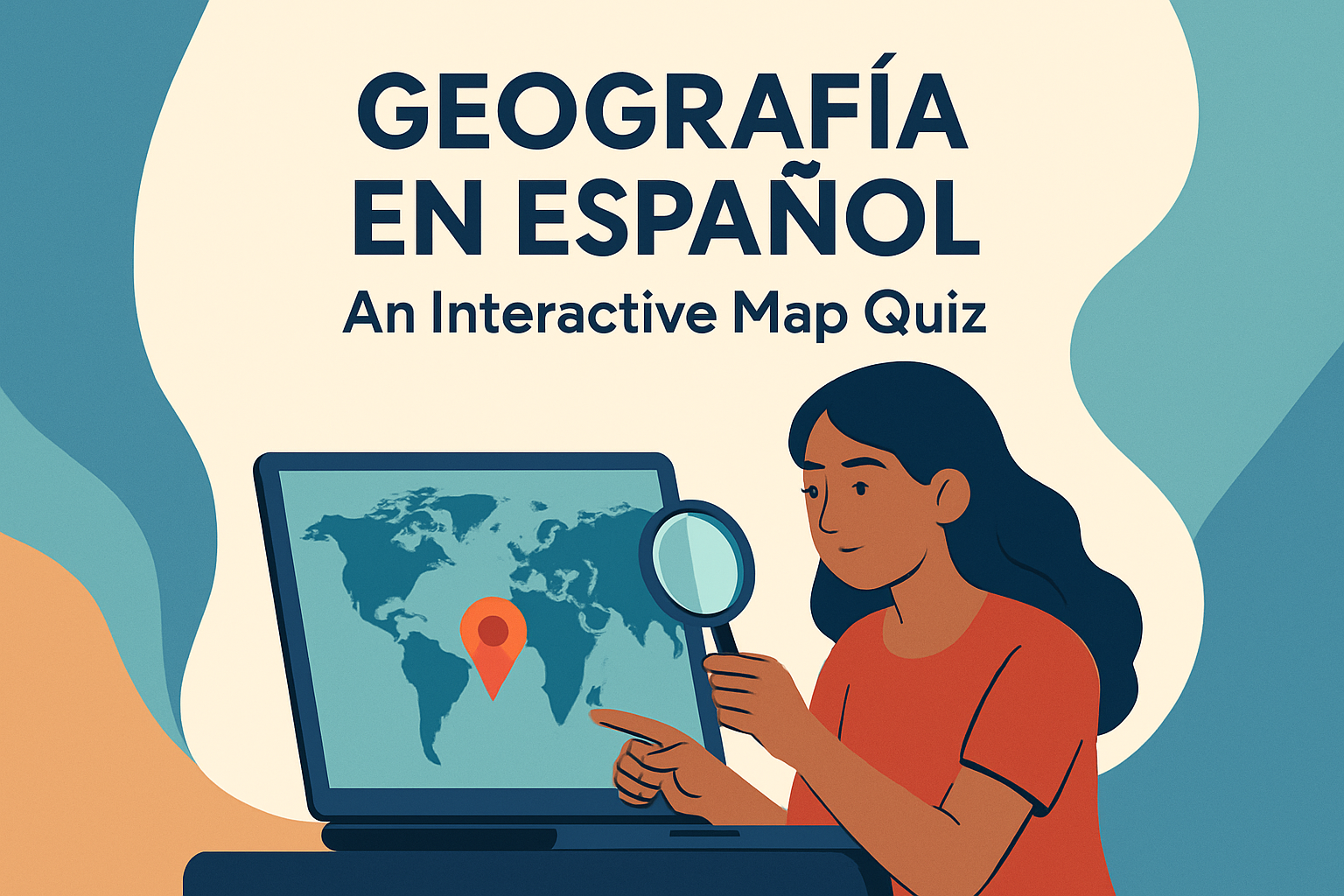
Geography is an essential part of learning about the world around us. It helps us understand the diverse cultures, climates, and landscapes that comprise our planet. When combined with language learning, geography can take on a new dimension, offering exciting opportunities to acquire vocabulary and cultural insights. Spanish, being one of the most spoken languages in the world, provides an excellent platform for such an interdisciplinary learning approach. By engaging in an interactive map quiz focused on geography in Spanish, learners can enhance their language skills while gaining geographical knowledge. This approach not only enriches their vocabulary but also deepens their understanding of Spanish-speaking countries and their unique geographical attributes. In this article, we’ll explore how integrating an interactive map quiz on geography in Spanish can be a valuable tool in education, how it fosters engagement, and why it matters in today’s interconnected world.
Importance of Geography in Language Learning
Geography plays a vital role in language learning by offering contexts and scenarios that language learners might encounter. By understanding the geographical landscape of Spanish-speaking countries, learners can better grasp cultural nuances and regional differences. This is essential because language is not just a set of words and grammar rules; it’s a reflection of the people who speak it and the places where it is spoken. When language learners engage with geography, they are more likely to remember vocabulary associated with different terrains, climates, and cultural contexts.
A practical example of this is understanding the diverse climates of Spanish-speaking countries. From the arid deserts of northern Mexico to the lush rainforests of Costa Rica, each region offers unique geographical features that shape the way people live and speak. Knowing whether a specific vocabulary word is used in a mountain region or by the coast can help learners use language more naturally and accurately.
Interactive Map Quiz: A Tool for Engagement
Interactive map quizzes transform traditional learning methods into engaging experiences by incorporating technology and user interactivity. Unlike standard classroom lessons, map quizzes demand active participation, aiding in retention and understanding. The act of engaging on an interactive platform where students see immediate results of their knowledge—such as identifying a country’s shape, capital, or flag—reinforces memory and learning.
Consider an interactive map quiz that allows learners to drag and drop cities onto their correct locations on a map of Latin America. Such a task not only reinforces spatial awareness but also provides reinforcement through immediate feedback, which is crucial for effective learning. This type of immediate interaction can significantly enhance the user’s experience and retention rate.
Expanding Cultural Awareness Through Geography
Understanding geography in a language learning context goes beyond recognizing maps and locations. It involves a comprehensive grasp of how geography shapes cultural practices and social norms. The geographical diversity among Spanish-speaking countries means there’s rich cultural variety as well. Rivers, mountains, and oceans often draw the boundaries not only of a land but of cultural practices and traditions.
For example, the Andes Mountains significantly influence the countries they traverse—such as Chile and Peru—not only geographically but also culturally. Many indigenous languages are still spoken in these regions, and the geography has played a crucial role in preserving these cultural and linguistic pockets. An interactive map quiz that includes cultural elements like festivals, traditional foods, or languages spoken in different regions can deepen understanding and make learning more immersive.
Motivating Learners with Geographical Challenges
Challenges and rewards are integral to maintaining interest and motivation in learning environments. Interactive map quizzes can incorporate game-like elements, such as badges, rewards, and points, to encourage continuous engagement. By gamifying the learning of geography in Spanish, learners become motivated not only by the desire to learn but also by the pursuit of reaching higher levels and achieving recognition.
Imagine an app feature where learners can earn points for identifying countries, regions, or capitals quickly and accurately while competing with other learners on a global leaderboard. Such competitiveness can boost engagement and lead to more regular participation, thereby enhancing learning outcomes.
Incorporating Technology for Classroom and Self-paced Learning
Technology plays a crucial role in modern education, and integrating technology with traditional learning methods can provide new paths for student success. Interactive map quizzes can be accessed on various devices, allowing for flexibility and adaptability in learning environments. For classroom settings, teachers can use interactive maps as a participatory activity. Similarly, students can employ these maps for self-paced learning, enabling them to advance at their own speed.
A practical framework for this could be an online platform where students log in to complete quizzes and track their progress. The platform might reflect a classroom setting, where teachers can monitor individual achievements and provide tailored assistance. Additionally, features such as audio guides explaining geographical terminology can help learners practice pronunciation and listening skills while they learn.
Sample Components of an Interactive Map Quiz
The implementation of an interactive map quiz involves several compelling components that can enhance language learning. Let’s break down some features that are typically included:
- Map Overview: Displays entire regions and countries, highlighting boundaries and geographical features.
- Point-of-Interest Markers: Visual markers for capitals, major cities, and landmarks.
- Interactive Labels: Pop-up information windows that offer additional details about a specific location.
- Quiz Questions: Time-bound questions requiring students to identify or label certain features on the map.
- Instant Feedback: Correct or incorrect response indicators to reinforce learning.
By incorporating these features, learners get not only geographical insights but also gain language skills by being exposed to reading, listening, and interactive practice in Spanish.
Real-world Example: Duolingo and GeoGuessr
DuoLingo is a language learning app that gamifies the process of language acquisition by offering small, bite-sized lessons intermixed with exercises and challenges. Though DuoLingo focuses primarily on language itself, we can use it as an inspiration for integrating geography into language learning by adopting a similar approach to learning regional geography terms and cultural elements in Spanish.
GeoGuessr, on the other hand, is a geography-based educational game that challenges users to pinpoint their location based on visual clues from random Google Street View images. Combining the geographical challenge concept from GeoGuessr with language learning could lead to a powerful educational tool. Imagine a scenario where learners watch a video clip of a bustling plaza in Madrid, then answer questions in Spanish about what they observe regarding the geography and culture.
By assessing these two real-world platforms, we get an idea of how promising the integration of geography quizzes in language learning can be. Each platform highlights different elements—one through linguistics and the other through geography—and combining their strengths could catalyze language acquisition.
Potential Limitations and Overcoming Challenges
Although incorporating interactive geography quizzes into language instruction offers numerous benefits, it does present some challenges. Perhaps the biggest issue is ensuring that the technical levels match the capabilities of both teachers and students. Not everyone is naturally adept with technology, and setting up platforms or troubleshooting technical issues might pose obstacles.
A second concern is the potential for overwhelming learners with too much content at once. To prevent cognitive overload, educators and developers must carefully balance content delivery, breaking it into manageable segments that facilitate effective learning without overwhelming the user.
Finally, ensuring broad accessibility is essential. It’s important that the platform supports multiple languages and complies with accessibility standards to accommodate learners with disabilities. Tailoring the content to cater to various learner preferences will ensure a more inclusive learning environment.
Conclusion and Call to Action
In conclusion, implementing interactive map quizzes in learning geography within a Spanish language context offers tremendous educational value. By engaging learners through interactive technology, educators can foster increased motivation, enhance vocabulary retention, and offer cultural insights. Furthermore, integrating geography quizzes invigorates traditional language learning by offering context-rich academic challenges in a stimulating format. With geography providing the context, students not only learn to speak a language but also understand the people and structures that speak it.
As educators, students, and curriculum developers, we must aim to bridge language learning with geography to foster holistic education. Consider implementing an interactive map quiz in your language curriculum and observe how much richer language acquisition becomes. As a next step, explore available online platforms, whether in educational apps or bespoke platforms, to experience real-life implementations of these techniques. Moreover, begin small by incorporating geographical elements within current lesson plans, laying the foundation for more comprehensive integration in the future.
Encouraging students to engage with geography in Spanish through an interactive map quiz not only enhances language proficiency but also provides a global perspective, something crucial for navigating today’s interconnected world. Begin exploring the possibilities to bring your language learning experience to the next level.
Frequently Asked Questions
1. What is the purpose of an interactive map quiz in learning geography in Spanish?
An interactive map quiz serves a dual purpose in the context of geography and language learning. Firstly, it helps learners become familiar with different geographical locations and features, enhancing their understanding of the world’s landscapes, climates, and cultural regions. By using a map as the core of the quiz, users can visualize and better retain geographical information. Secondly, by conducting the quiz in Spanish, learners simultaneously acquire new vocabulary related to geography which can include terms for countries, cities, capitals, rivers, mountains, and other physical features. This method not only aids in cementing geographic knowledge but also enriches language skills by contextualizing them in a real-world application. The practice of using Spanish to navigate a map quiz can provide cultural insights as well, offering learners a comprehensive approach to both subjects.
2. How can an interactive map quiz enhance vocabulary acquisition specifically in the Spanish language?
The interactive map quiz method of learning enhances vocabulary acquisition in Spanish by contextualizing language within geography, offering a practical application of language skills. When participants engage with a map quiz, they are required to use Spanish words for countries, states, capitals, rivers, and mountain ranges. For instance, instead of just reading about ‘España’ (Spain) in a textbook, the participant might locate it on a map and connect it with neighboring countries like ‘Francia’ (France) or ‘Portugal’ (Portugal). The repetitive and active engagement required in selecting or identifying regions on the map allows learners to connect words with real-world locations, strengthening memory retention. Additionally, geography-related terms such as ‘cordillera’ (mountain range), ‘rio’ (river), and ‘océano’ (ocean) are frequently used, which consistently builds and broadens a learner’s vocabulary.
3. Why is Spanish a suitable language for learning geography through an interactive map quiz?
Spanish is a suitable language for learning geography through an interactive map quiz due to its status as one of the most widely spoken languages globally and its rich association with diverse geographic locales. Spanish is spoken across multiple continents, from South America and Central America to parts of North America, Europe, and even Africa. This geographic spread offers an abundance of case studies for geographic education, showcasing a variety of climates, terrains, and cultural settings. Engaging with a map using Spanish encourages understanding beyond language learning, fostering an appreciation of the cultural and geographical diversity present in the Hispanic world. For language learners, the consistency in place names and regions across Spanish-speaking nations reinforces language learning, providing a unique opportunity to practice and apply Spanish in contexts that reflect real-world usage.
4. What types of features or tools might a geography interactive map quiz include to facilitate learning?
An effective geography interactive map quiz may include various features and tools designed to facilitate learning. These tools can significantly enhance a learner’s experience by making the activity interactive and engaging. Key features might include: – Interactive Clickable Regions: Segments of the map that users can click to reveal additional information in Spanish about a specific area, such as its name, capital, significant landmarks, and geographic data. – Instant Feedback: A system that provides immediate insights on the learner’s selection, whether right or wrong, with explanations or additional facts. – Layered Maps: Options to view different thematic maps like political, physical, climate, or economic maps, each offering diverse vocabulary sets and educational angles. – Audio Pronunciations: Accompanying Spanish audio pronunciations for place names and key vocabulary to aid in honing listening skills and correct pronunciation. – Quizzes and Challenges: Timed challenges and quizzes to test knowledge retention and encourage repeated practice, often in varying difficulty levels to tailor to learners at different stages. These features combined serve to make the map quiz a comprehensive, multimedia learning tool that actively engages learners with both geography and the Spanish language.
5. How can educators integrate an interactive map quiz focusing on Spanish into their teaching curriculum?
Educators can integrate an interactive map quiz focusing on Spanish into their teaching curriculum by aligning the quiz content with learning objectives across both geography and language standards. A balanced approach would consider the following integration strategies: – Curriculum Alignment: Ensure the map quiz complements thematic units in the curriculum, such as studying Latin America’s geographic regions during a Spanish language module or exploring climate patterns during a global studies course. – Interactive Lessons: Use map quizzes in classroom activities to encourage participation, group work, and peer learning. Teachers can lead by example, demonstrating quiz techniques, or hosting group competitions. – Technology Integration: Leverage technology within the classroom by providing access to digital devices where an interactive map quiz can be accessed and shared on smart boards or tablets. – Homework and Practice: Assign map quizzes as part of homework or extracurricular exploration. This not only reinforces classroom learning but also encourages independent study and the application of both geography and Spanish outside of the classroom setting. – Cross-disciplinary Projects: Develop projects where students research a Spanish-speaking country or region, create presentations incorporating map quiz data, and present findings in Spanish. These methods not only encourage engagement with the map quizzes but also help students apply their knowledge in comprehensive, practical ways, enhancing both geographic understanding and language proficiency.