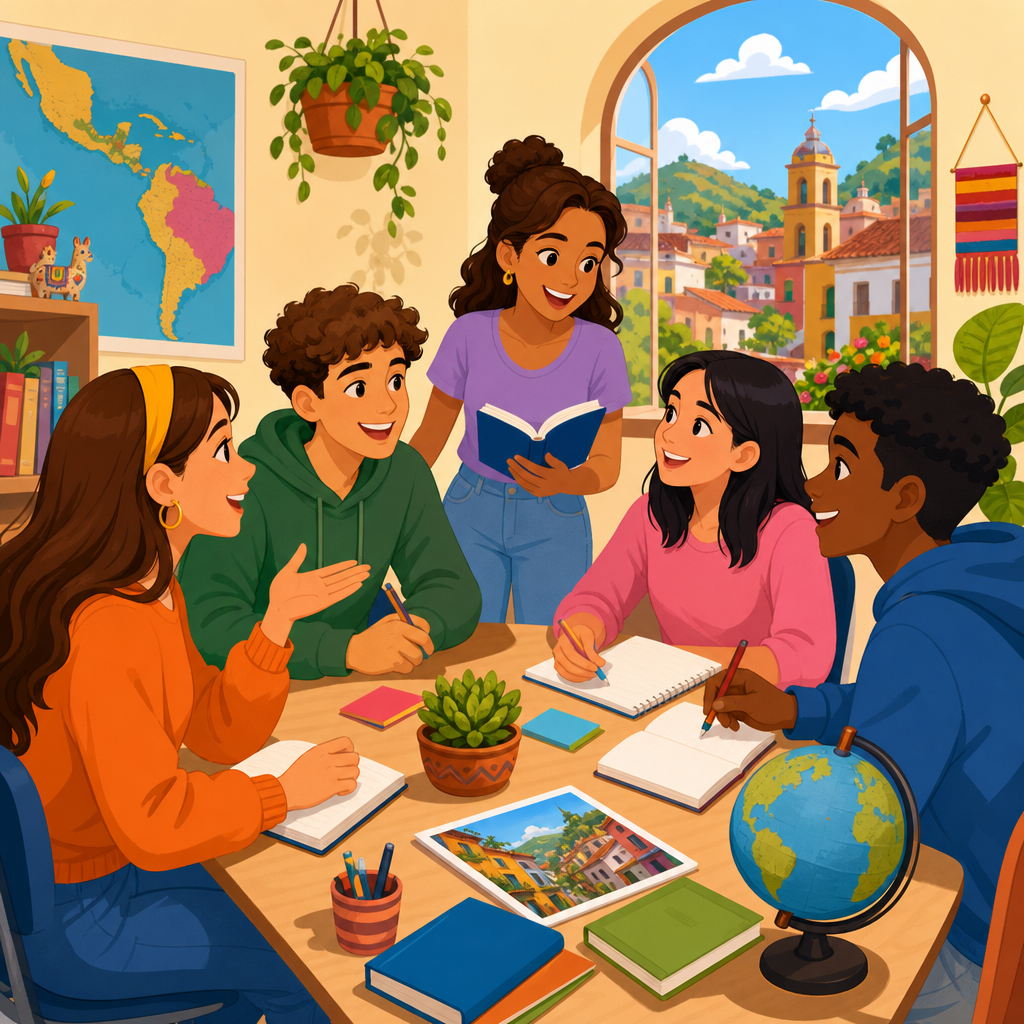
Group activities to enhance Spanish language skills turn passive study into active communication, giving learners repeated, meaningful chances to listen, speak, read, and write with other people. In language teaching, “group activities” means any structured task completed with partners or small teams rather than alone, from role-plays and conversation circles to collaborative storytelling, games, peer editing, and community projects. “Spanish language skills” includes the four core competencies—listening comprehension, speaking fluency, reading comprehension, and writing accuracy—plus pronunciation, vocabulary range, cultural awareness, and pragmatic skills such as turn-taking and politeness. I have used these methods in classrooms, tutoring groups, and community meetups, and the pattern is consistent: learners improve faster when interaction is regular, purposeful, and slightly challenging. This matters because Spanish is a social language learned best through exchange. Group work supplies real feedback, lowers hesitation through repetition, and creates enough communicative pressure to move vocabulary from recognition into use. For a sub-pillar hub under Spanish Community and Interaction, this miscellaneous guide maps the most effective formats, when to use them, what they build, and how to adapt them for beginners, intermediate learners, heritage speakers, and advanced students who need more precision.
Why group interaction accelerates Spanish learning
Group interaction works because language is not only knowledge; it is performance under time pressure. A learner may know that the preterite of ir is fui, but unless they can retrieve it while answering a partner’s question, the knowledge stays inert. In groups, retrieval becomes immediate and repeated. Students hear multiple accents, phrasing choices, and error patterns in a short period, which strengthens comprehension and noticing. This is one reason conversation-rich programs often outperform lecture-heavy formats for spoken ability.
There is also a psychological advantage. Many learners are less anxious speaking to peers than addressing a teacher alone. In my own sessions, reluctant beginners who gave one-word answers in whole-class discussion often produced full sentences in pairs after three minutes of guided prompts. Well-designed group activities create what teachers call high participation ratio: more learners speak more often. Instead of one person answering while ten listen, six pairs can practice the same target structure simultaneously.
Another reason group tasks work is that they naturally blend skills. A debate asks learners to read short source material, listen to opposing arguments, speak persuasively, and sometimes write notes or a summary. This integrated practice mirrors real life more closely than isolated drills. It also makes Spanish Community and Interaction a useful organizing topic because communication competence grows when skills reinforce each other rather than being trained in isolation.
Core group activities that build speaking and listening
The most reliable starting point is the conversation circle. Learners sit in small groups and respond to a theme such as food, travel, family traditions, or work routines using target grammar and vocabulary. The structure matters. Give each person a role—starter, follow-up asker, clarifier, summarizer—and the discussion becomes more balanced. For beginners, prompts like ¿Qué desayunas normalmente? or ¿A qué hora sales de casa? keep language concrete. For advanced learners, issues such as housing costs, environmental policy, or media trust encourage longer, more nuanced speech.
Role-play is equally effective because it simulates realistic exchanges. Ordering in a café, booking a hotel room, resolving a shipping problem, or interviewing for a job requires formulaic expressions, register control, and listening for detail. I have found that role-plays improve quickly when students receive a clear objective and a mild complication. A customer is missing a reservation. A friend gives the wrong directions. A patient must explain symptoms using only common vocabulary. These conditions force learners to negotiate meaning instead of reciting memorized lines.
Information-gap tasks are especially strong for listening and question formation. In these activities, Partner A and Partner B each hold different information, and they must communicate in Spanish to complete the full picture. One student has a bus schedule; the other has destinations and prices. One has part of a family tree; the other has occupations and ages. Because success depends on accurate exchange, learners have a practical reason to ask follow-up questions, confirm details, and repair misunderstandings.
Dictogloss, a less widely used but powerful format, also deserves a place in any hub on group activities to enhance Spanish language skills. The teacher reads a short text at natural speed. Learners listen, take minimal notes, then reconstruct the passage together. This trains careful listening, grammar awareness, and collaborative editing. It works well with news summaries, biographical sketches, or short cultural texts about festivals, cities, or historical events.
Collaborative activities for reading, writing, and vocabulary growth
Group work is not only for speaking. Collaborative reading turns a dense text into a shared meaning-making exercise. In jigsaw reading, each small group reads one section of an article, identifies key points, then teaches the content to another group. This format is ideal for Spanish news pieces, travel guides, or short literary excerpts because it combines comprehension with oral synthesis. Learners must decide what matters, paraphrase it, and answer questions from peers, which deepens retention.
Shared writing tasks are equally useful. A group can produce a restaurant review, event recap, opinion paragraph, or collaborative story in Spanish using a shared document. The strongest version assigns separate responsibilities: one learner drafts ideas, another checks verb forms, another improves connectors, and another looks for vocabulary precision. This mirrors real editing practice and helps students notice patterns such as adjective agreement, preposition use, and sentence flow. Tools like Google Docs, DeepL Write for comparison, and WordReference for vocabulary checking can support the process without replacing judgment.
Vocabulary games become more effective when they require explanation rather than simple recall. Taboo-style activities, category races, and definition challenges push learners to describe words they cannot directly say. If a student cannot use playa, they may say un lugar con arena, mar y turistas. That circumlocution skill is a major marker of communicative growth because fluent speakers regularly work around missing vocabulary.
| Activity | Main skill focus | Best level | Example task |
|---|---|---|---|
| Conversation circle | Speaking, listening | All levels | Discuss daily routines using present tense and time expressions |
| Role-play | Speaking, pragmatics | Beginner to advanced | Resolve a hotel booking problem politely |
| Information gap | Listening, question formation | Beginner to intermediate | Complete a travel schedule with missing details |
| Jigsaw reading | Reading, summarizing | Intermediate to advanced | Teach one section of a news article to peers |
| Collaborative writing | Writing, editing | Intermediate to advanced | Draft and revise a group opinion paragraph |
| Story chain | Fluency, past tenses | All levels | Create a shared narrative about an unexpected trip |
Story chains deserve special mention because they combine grammar, imagination, and peer attention. One learner starts with a sentence, the next adds detail, and the group builds a narrative. Beginners can stay in the present tense with simple settings. Intermediate groups can practice preterite versus imperfect. Advanced learners can add reported speech, connectors, and stylistic variation. Because each contribution changes the direction of the story, students listen closely and stay engaged.
How to match activities to proficiency and goals
Not every activity fits every learner. Beginners need high support, limited choices, and visible language scaffolds. Sentence frames, vocabulary banks, image prompts, and clear turn order are essential. A beginner pair task should not ask students to “discuss culture” with no support; it should ask them to compare two meals, two homes, or two weekend plans using targeted verbs and adjectives. Success at this stage comes from manageable repetition, not from improvisation without structure.
Intermediate learners benefit from tasks that stretch range and accuracy. They can handle opinion sharing, short summaries, and problem-solving tasks where there is no single correct answer. This is the ideal stage for debates with evidence cards, peer interviews, and collaborative writing because learners have enough language to negotiate meaning but still need frequent practice with tense consistency, connectors, and precision.
Advanced students need complexity, not just volume. If they repeat easy conversations, progress stalls. Better options include case-study discussions, moderated debates, mock professional meetings, article-based roundtables, and oral presentations with peer questioning. Heritage speakers may need a different balance: they often speak fluently but benefit from structured vocabulary expansion, formal register practice, spelling work, and explicit attention to grammar conventions used in academic or professional Spanish.
Goals should drive design. If the target is pronunciation, use read-and-repeat pair work, shadowing, and peer feedback on stress and rhythm. If the target is interactional competence, use spontaneous exchanges with clarification moves such as ¿Cómo?, ¿Puedes repetir?, and Entonces quieres decir que…. If the target is writing accuracy, use collaborative drafting followed by focused editing checklists. Group activities to enhance Spanish language skills work best when the desired outcome is narrow, visible, and measured.
Building community through clubs, projects, and digital spaces
The strongest long-term gains often come from recurring group formats outside formal class time. Spanish conversation clubs, book circles, film discussions, game nights, and volunteer projects create continuity. Learners return each week, meet familiar people, and reuse language in new contexts. That continuity matters because retention improves when learners revisit vocabulary and structures over time rather than in one-off sessions.
Community-based projects add real purpose. A group might create a bilingual guide for local services, interview native speakers about migration stories, host a cultural event, or record a short Spanish podcast. These tasks increase accountability because the final product will be seen or heard by others. They also build cultural competence, which is inseparable from communication. Learners must think about audience, tone, regional vocabulary, and respectful framing.
Digital spaces can extend interaction when in-person meetings are limited. WhatsApp voice-note exchanges, Discord conversation channels, Zoom breakout rooms, and collaborative boards like Padlet support frequent, low-friction practice. Voice notes are especially useful because learners can rehearse, listen back, and notice gaps before sending. Still, digital group work should not be unstructured. Clear prompts, response deadlines, and participation norms keep it productive rather than superficial.
For a broader Spanish Community and Interaction hub, it helps to connect this miscellaneous page to related resources on conversation practice, language exchange, Spanish clubs, online communities, games, cultural events, and peer accountability. Internal connections like these guide learners from general strategies to specific formats that match their schedule and confidence level.
Common mistakes and simple ways to improve results
The biggest mistake is assuming that any group work is good group work. Unstructured conversation often lets confident students dominate while quieter learners withdraw. Strong facilitation prevents that. Set time limits, rotate roles, define the target language, and require an outcome such as a summary, decision, or written response. Another common error is overcorrecting during fluency tasks. If every sentence is interrupted, flow collapses. A better approach is to note recurring issues, then address them after the activity with brief, targeted feedback.
Mixed-level groups can either help or hinder. They work well when stronger students model language and weaker students still have a meaningful role. They fail when one person carries the task. Assign information asymmetrically so each learner contributes something necessary. Track progress with simple metrics: turns taken, words used from a target set, successful clarifications, or completion of a final product. These indicators show whether interaction is actually producing language growth.
Consistency beats intensity. Two focused group sessions each week typically produce better speaking gains than a long session once a month. Recordings can also sharpen awareness. When learners listen to a short clip of their own group discussion, they often notice filler words, tense shifts, and pronunciation habits immediately. Reflection turns activity into improvement.
Group activities to enhance Spanish language skills are effective because they transform study into communication, and communication is where durable progress happens. The best formats are not random icebreakers but structured tasks matched to level, goal, and context. Conversation circles increase speaking volume, role-plays develop practical language, information-gap tasks sharpen listening, jigsaw reading improves comprehension, collaborative writing builds accuracy, and long-term clubs or projects create the community that keeps learners engaged. The central lesson is simple: learners improve faster when they must understand others, respond clearly, and work together toward a concrete result. For anyone exploring Spanish Community and Interaction, this miscellaneous hub is the starting map—broad enough to show the landscape, specific enough to help you choose your next step. Pick one activity, run it consistently for a month, and track what changes in fluency, confidence, and participation. That is how group practice becomes measurable Spanish growth.
Frequently Asked Questions
1. Why are group activities so effective for improving Spanish language skills?
Group activities are effective because they move learners from passive recognition into active use of Spanish. Instead of only memorizing vocabulary lists or completing grammar exercises alone, students must listen carefully, respond in real time, negotiate meaning, ask for clarification, and express their own ideas. That kind of interaction strengthens all four core language skills at once: listening improves as learners follow different accents, speaking develops through repeated practice, reading can be built into prompts or task instructions, and writing is reinforced through collaborative notes, scripts, and reflections.
Another major benefit is that group work creates meaningful repetition. In a well-designed activity, students naturally reuse useful words, sentence structures, and conversational patterns many times without the practice feeling mechanical. For example, in a role-play about ordering food, learners repeat question forms, polite expressions, numbers, and common verbs several times in a realistic context. That repeated exposure helps language move from short-term memory into practical, usable knowledge.
Group activities also reduce the pressure many learners feel when speaking a new language. Working with partners or small teams often feels safer than speaking alone in front of a whole class. This lowers anxiety and encourages risk-taking, which is essential for building fluency. Learners become more willing to try unfamiliar vocabulary, experiment with new grammar, and self-correct as they go. Over time, those small moments of practice create greater confidence and faster progress in Spanish communication.
2. Which group activities help learners practice all four Spanish language skills most effectively?
The most effective group activities are the ones that combine listening, speaking, reading, and writing in a single task. Role-plays are one of the strongest examples because learners often begin by reading a scenario, then discuss ideas with teammates, speak during the performance, and sometimes write notes or follow-up reflections afterward. Conversation circles are also valuable, especially when each round includes a prompt card, discussion questions, and a summary task. This gives students a chance to read, respond orally, listen to others, and write key ideas in Spanish.
Collaborative storytelling is another excellent option. One student might begin a story with a sentence, another continues it, and the group works together to shape the plot. This builds vocabulary, verb control, sequencing language, and listening comprehension while keeping the activity creative and memorable. Peer editing is especially useful for writing development because students read each other’s work, discuss corrections, explain grammar choices, and suggest stronger word choices in Spanish. As a result, they are not only writing more, but also reading critically and speaking about language in a purposeful way.
Games and problem-solving tasks can be equally powerful when they are designed around communication rather than speed alone. Information-gap activities, scavenger hunts, board games, and team challenges require students to ask questions, understand directions, read clues, and record answers. Community-based projects, such as interviews or cultural presentations, are especially effective for more advanced learners because they connect classroom Spanish to real-world use. In general, the best activity is not necessarily the most entertaining one, but the one that gives every learner repeated, meaningful opportunities to interact in Spanish with a clear purpose.
3. How can teachers or group leaders make sure everyone participates during Spanish group activities?
Equal participation starts with clear structure. One of the biggest reasons group work fails is that instructions are too vague, which allows confident speakers to dominate while quieter learners stay passive. To avoid that, teachers should assign specific roles such as discussion leader, note-taker, vocabulary monitor, timekeeper, or presenter. These roles give each learner a defined responsibility and make participation visible. Rotating roles from one activity to the next also ensures that students practice different skills rather than staying in their comfort zones.
Task design matters just as much as group management. Activities should require input from all members instead of allowing one student to complete everything. Information-gap tasks are especially effective because each person holds different pieces of information, so success depends on communication. Think-pair-share, round-robin speaking, and collaborative writing tasks also work well because they build turn-taking directly into the activity. Even simple techniques, such as requiring each student to ask one follow-up question or contribute one written sentence, can make participation much more balanced.
It is also important to create an environment where mistakes are treated as part of learning. Students are more likely to participate when they know they will not be embarrassed for imperfect pronunciation or grammar. Teachers can support this by modeling useful phrases for discussion, providing sentence starters, and praising effort as well as accuracy. Strategic grouping helps too: pairing learners with compatible proficiency levels or mixing stronger and developing students thoughtfully can improve both confidence and collaboration. When expectations are clear and support is built in, group activities become more inclusive, productive, and effective for Spanish language growth.
4. What are the best group activities for beginners who are just starting to learn Spanish?
For beginners, the best group activities are simple, highly structured, and focused on practical communication. New learners need tasks that give them clear language goals and predictable patterns, not activities that require long spontaneous conversations too early. Pair dialogues, picture-description tasks, matching games, and question-and-answer drills in small groups are excellent starting points. These activities let students practice essential vocabulary, basic sentence structures, pronunciation, and listening comprehension in manageable steps.
Role-plays built around everyday situations are especially useful for beginners. Short scenarios such as greetings, introductions, shopping, asking for directions, or ordering at a café help students use Spanish in realistic ways without becoming overwhelmed. Conversation circles can work very well too if the prompts stay narrow and familiar, such as favorite foods, family members, daily routines, or hobbies. Teachers can support beginners with word banks, model sentences, visual aids, and repetition. The goal at this stage is not perfect fluency, but frequent success with useful language.
Beginners also benefit from collaborative games because games reduce stress and increase repetition. Memory games, vocabulary bingo, charades, and simple team competitions can make foundational practice more engaging while still building important skills. Short collaborative writing tasks, such as building a class poster or creating mini-dialogues together, are also effective because they help learners connect spoken and written Spanish. The key is to keep the language load appropriate: too much complexity can create frustration, while well-scaffolded group work helps beginners build confidence, accuracy, and a strong base for future communication.
5. How can group activities be adapted for different Spanish proficiency levels?
Group activities are most successful when the task stays consistent but the language demands change based on learner level. For beginners, activities should emphasize recognition, repetition, and controlled production. That means using short prompts, limited vocabulary sets, sentence frames, and predictable conversational patterns. Intermediate learners can handle more open-ended discussion, longer reading passages, and collaborative tasks that require explanation, comparison, and problem-solving. Advanced learners benefit from activities that demand nuance, persuasion, interpretation, and extended interaction, such as debates, presentations, peer workshops, and project-based learning.
One of the best adaptation strategies is scaffolding. A teacher might use the same role-play theme for all levels, but provide different supports. Beginners may receive a full dialogue model and key phrases, intermediate students may get a scenario and vocabulary list, and advanced learners may only receive a goal and context. The same principle works for reading and writing tasks. Less experienced learners may summarize a short text together, while more advanced groups analyze tone, debate ideas, or produce a written response using evidence and more complex grammar.
Mixed-level groups can also be effective when tasks are designed carefully. Stronger students can model language and support peers, but the activity should still require meaningful contributions from everyone. For example, one learner might gather information, another organize ideas, another present, and another write the final summary. Teachers should also adapt success criteria, focusing on communication and participation at lower levels while expecting greater precision and complexity from advanced learners. When group activities are adjusted thoughtfully, they remain challenging without becoming discouraging, and every student can continue building stronger Spanish language skills at an appropriate pace.