Using role-playing games to practice Spanish turns study time into active communication, which is exactly what most learners need once vocabulary apps and grammar drills stop producing real conversational confidence. In this context, role-playing games include tabletop role-playing games, live improv scenarios, classroom simulations, and digital story-driven games where players speak, read, write, or listen in Spanish to solve problems together. I have used these formats with adult learners, exchange groups, and mixed-level conversation clubs, and the pattern is consistent: learners speak longer, remember expressions better, and tolerate mistakes more easily when language is attached to a role, mission, or character. This matters because Spanish fluency is not built by knowing isolated words; it is built by retrieving language under pressure, negotiating meaning, and responding in real time. Role-playing creates those conditions in a structured way. It also fits the broader Spanish Community and Interaction topic because it gives learners a repeatable social framework for practicing with partners, tutors, classmates, or online communities, even when confidence is still fragile.
A useful definition helps. A role-playing game for Spanish practice is any guided activity in which participants adopt identities or scenarios and use Spanish to complete objectives. The objective may be simple, such as ordering food in a simulated café, or complex, such as negotiating a peace treaty between fictional kingdoms in a tabletop campaign. Unlike free conversation, a role-playing game provides context, constraints, and stakes. Those three elements reduce the blank-page feeling many learners experience. Context tells you where you are, constraints limit what language is relevant, and stakes give you a reason to speak. The result is practical language production. Learners stop asking, “What should I say?” and start asking, “How do I say what my character needs?” That shift is powerful because it mirrors real-life communication, where language serves a goal rather than existing as an academic exercise.
Why role-playing games work for Spanish acquisition
Role-playing games work because they combine comprehensible input, meaningful output, repetition with variation, and emotional engagement. In plain terms, learners hear and read Spanish they can mostly follow, then they must produce their own Spanish to keep the scene moving. During a mystery game, for example, one player might ask, “¿Dónde estabas anoche?” and hear several answers using past tense forms. The grammar is not abstract anymore; it is attached to motive, suspicion, and memory. In my experience, students who freeze during standard conversation prompts often become unexpectedly talkative in scenarios with clear objectives because the task itself carries the interaction.
These games also create low-risk repetition. A learner practicing requests may repeat structures such as “Quisiera,” “¿Me puede dar?” and “Necesito” across a shop simulation, a hospital check-in, and a fantasy trading post. The setting changes, but the communicative function remains. That variation strengthens retention more effectively than repeating a single sentence ten times. Cognitive research on retrieval practice and contextual learning supports this: recall improves when information is accessed across multiple situations rather than memorized in one fixed format. For Spanish learners, that means role-play can support both fluency and transfer to real conversations.
Another advantage is affective. Many adults fear sounding childish when speaking a new language. A character solves that problem. If your detective speaks imperfect Spanish, that is part of the scene, not a personal failure. This slight emotional distance lowers inhibition. It also encourages circumlocution, a core fluency skill. When players do not know a precise word, they describe around it. That is exactly what capable speakers do in authentic interaction.
Types of role-playing games that help learners most
Not every game format supports Spanish equally well. The most effective options are those that force interaction, provide understandable language, and match the learner’s level. Scenario role-play is the easiest starting point. These are practical simulations such as checking into a hotel, explaining symptoms at a clinic, interviewing for a job, or resolving a travel problem. They are ideal for beginners and lower-intermediate learners because the vocabulary field is narrow and the exchange has a recognizable structure.
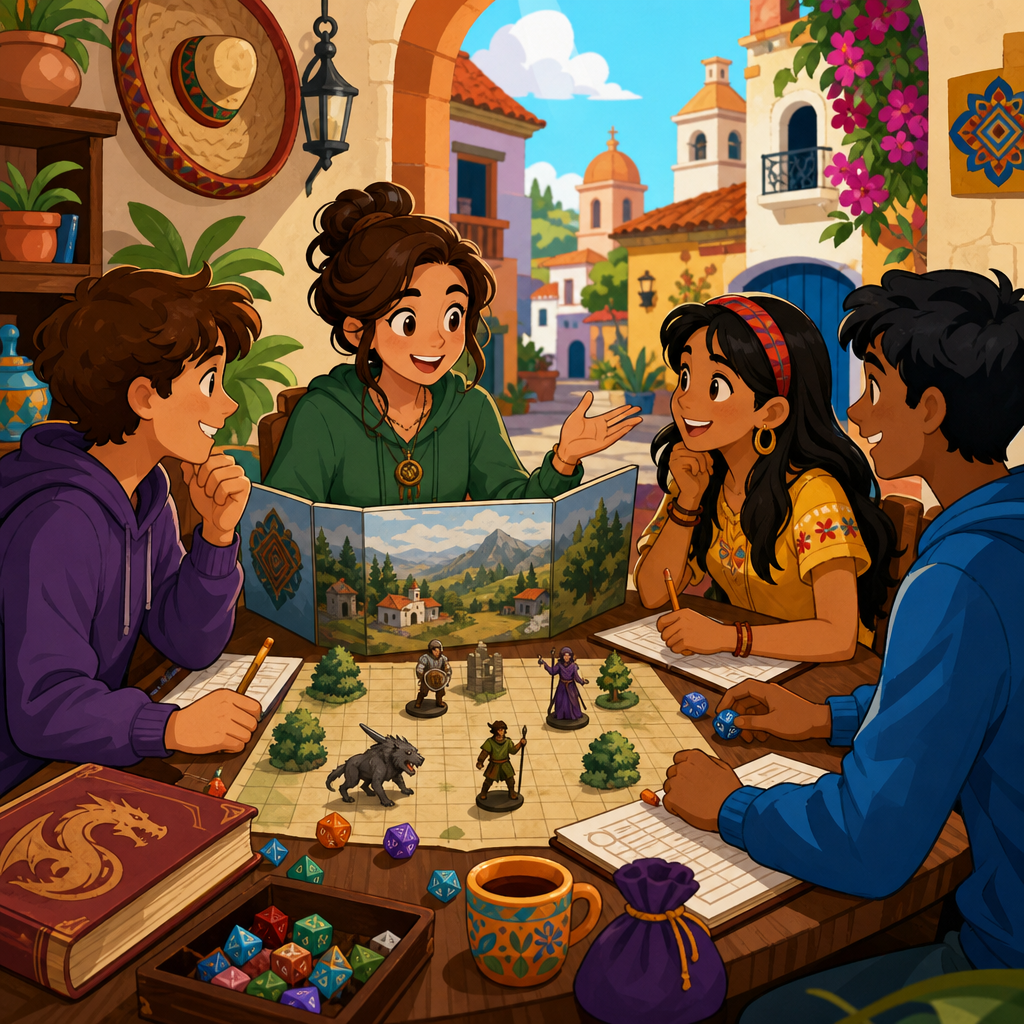
Tabletop role-playing games, including systems inspired by Dungeons & Dragons, work best for intermediate and advanced learners. They demand spontaneous speaking, collaborative problem-solving, and sustained listening. A game master describes the world, players ask questions, and everyone reacts to changing events. This format is excellent for practicing narration, persuasion, conditionals, past tenses, and turn-taking. I have seen learners who struggled with textbook dialogues become highly engaged when discussing whether to trust a suspicious merchant or how to escape from a guarded tower.
Live action role-play and improv games are useful for pronunciation, speed, and physical confidence. Because the body is involved, learners often retain expressions more strongly. Digital role-playing games in Spanish, especially story-driven games with branching dialogue, can support solo practice. They are less effective for open-ended speaking unless paired with shadowing, journaling, or discussion, but they are excellent for reading, listening, and noticing colloquial phrasing. Language exchange communities sometimes build hybrid formats by playing social deduction games, collaborative storytelling games, or mystery nights entirely in Spanish.
| Format | Best for | Spanish skills practiced | Example |
|---|---|---|---|
| Scenario role-play | Beginners to intermediate | Functional phrases, listening, turn-taking | Ordering food, asking directions, clinic visit |
| Tabletop campaign | Intermediate to advanced | Extended speaking, narration, persuasion, past tenses | Fantasy quest run in Spanish |
| Improv or live action | All levels with guidance | Pronunciation, confidence, quick response | Detective scene or marketplace negotiation |
| Digital story RPG | Solo learners | Reading, listening, vocabulary in context | Dialogue-heavy game with Spanish audio |
How to set up a Spanish role-playing session that actually works
The difference between a productive session and a chaotic one is structure. Start with a communicative goal, not a grammar goal. “Negotiate a rental contract” is better than “practice the subjunctive,” because the grammar will emerge from the task. Next, define the scene, the roles, and the success criteria. Who are the participants? What does each person want? What information is hidden? If there is no tension or information gap, the interaction often dies after thirty seconds.
Then prepare linguistic support. For beginners, that means sentence stems, key vocabulary, and model questions on a handout or shared screen. For stronger groups, provide only a glossary and let them improvise. I usually include three layers of support: essential words, useful chunks, and optional upgrade phrases. In a restaurant scenario, essential words might include “mesa,” “cuenta,” and “alérgico.” Useful chunks include “¿Nos puede recomendar algo?” and “Quisiera pedir.” Upgrade phrases might include “¿Sería posible cambiar la guarnición?” This scaffolding keeps the task communicative while preventing total breakdown.
Timeboxing matters. A practical sequence is five minutes of preparation, eight to twelve minutes of play, and five minutes of feedback. Record the interaction if participants consent. A short replay reveals repeated errors, missed vocabulary, and successful strategies far better than memory alone. Use feedback selectively. Correcting every mistake during the scene kills momentum. Instead, note patterns and address them afterward, especially errors that block comprehension or high-frequency forms the group is ready to improve.
Matching game design to Spanish level and learning goals
Role-playing should stretch learners without overwhelming them. For A1 and A2 learners, the best design uses highly predictable interactions with concrete vocabulary: greetings, numbers, food, transportation, family, weather, schedules, and basic health. The objective is not theatrical brilliance. It is successful survival communication. If a beginner can ask for a bus ticket, clarify a price, and confirm a departure time inside a role-play, that is meaningful progress.
B1 and B2 learners can handle ambiguity, opinions, and problem-solving. This is where mystery plots, workplace conflicts, customer service breakdowns, apartment hunting, and travel disruptions become useful. These scenarios naturally trigger past tenses, explanations, comparisons, and polite disagreement. Advanced learners should move into abstract, strategic, or emotionally nuanced play: diplomacy, ethics, leadership, debate, persuasion, and storytelling with shifting timelines. At C1 and above, the challenge is precision, register, and cultural appropriateness, not merely speaking more.
Goals should also shape the design. If the aim is pronunciation, choose short scenes with repeated target phrases. If the aim is listening, build in hidden clues and multiple speakers. If the aim is writing, have players create character backstories, session journals, or post-game reports in Spanish. For exam preparation, align scenarios with oral interview tasks, picture description, or transactional dialogue. The key is specificity. General “conversation practice” often leads to vague results; targeted role-playing creates measurable outcomes.
Vocabulary, grammar, and pronunciation gains from game-based practice
One reason role-playing is so effective is that it bundles language systems together instead of isolating them. Vocabulary is learned in semantic sets tied to action. In a medical role-play, learners do not just memorize “dolor,” “fiebre,” and “receta”; they use them while describing symptoms, asking follow-up questions, and responding to advice. Grammar is reinforced through function. Requests bring in conditional forms, storytelling activates preterite and imperfect contrasts, and negotiation invites the subjunctive through doubt, preference, and recommendation.
Pronunciation improves because repeated interactive phrases become automatized. Learners practice stress patterns, linked speech, and intonation while trying to be understood, which is a stronger driver than isolated repetition. I have found that role-play is especially useful for troublesome contrasts such as rolled versus tapped r, vowel clarity, and question intonation. Because the focus stays on communication, learners tolerate pronunciation work better and self-correct more naturally.
There are limits. Role-playing alone will not systematically teach grammar explanations, spelling conventions, or broad reading comprehension. It works best when paired with review. After a session, extract ten useful phrases, one pronunciation target, and one grammar pattern that actually appeared. That post-game reflection turns a fun activity into a durable learning cycle.
Using communities, tutors, and online platforms for consistent practice
Consistency matters more than complexity, so build role-playing into an existing Spanish practice routine. Conversation clubs can run themed nights. Tutors on platforms such as italki or Preply can prepare scenario-based lessons instead of generic chats. Classroom teachers can assign rotating roles so every student speaks with a purpose. Community centers, university language tables, Discord groups, and Meetup events can host one-shot mystery games or survival Spanish simulations. The strongest communities set expectations clearly: stay in Spanish as much as possible, support beginners with paraphrase rather than immediate translation, and debrief after each session.
For solo learners, online tools still help. Use dialogue generators carefully, then act out both sides aloud. Record yourself, compare with native audio from sources such as Forvo, YouGlish, or Spanish-language game streams, and revise your script. Cooperative digital games can also work if voice chat is active and the group commits to Spanish. The point is not the game brand; it is the amount of meaningful interaction the format forces.
This hub page connects naturally to related articles on conversation clubs, language exchange etiquette, Spanish Discord communities, group activities, and collaborative learning strategies. Role-playing sits in the middle of that ecosystem because it gives people a practical reason to interact instead of waiting for conversation to appear spontaneously.
Common mistakes and the best way to avoid them
The biggest mistake is making the game too linguistically hard. When players lack the language needed to act, they switch to English or shut down. Reduce the cognitive load by narrowing the scene, preteaching chunks, and assigning clear objectives. Another mistake is overcorrecting. If every sentence is interrupted, fluency disappears. Save most correction for the debrief and focus on patterns that matter.
Some groups also confuse entertainment with learning. A game can be fun and still produce very little Spanish if one dominant speaker controls everything. Good facilitation fixes this by distributing turns, giving each role unique information, and designing tasks that require every participant to contribute. Finally, do not ignore cultural realism. A negotiation scene in Spanish should reflect register and politeness norms that fit the setting. Learners benefit when language is not only grammatical, but socially appropriate.
Using role-playing games to practice Spanish is effective because it transforms passive knowledge into active communication under realistic conditions. The best results come from matching the format to the learner’s level, defining a clear task, providing targeted language support, and reviewing what emerged after the scene ends. Scenario role-plays help beginners survive everyday interactions, tabletop campaigns develop extended speaking and listening, and community-based games create the consistency that fluency requires. Role-playing is not a gimmick. It is a structured method for building confidence, recall, pronunciation, and conversational agility in Spanish.
If you want better speaking results, start small: choose one everyday scenario, prepare ten useful phrases, and practice it with a partner, tutor, or group this week. Then expand into more creative formats as your Spanish grows. Done consistently, role-playing turns interaction into progress and makes Spanish feel usable, social, and real.
Frequently Asked Questions
How do role-playing games actually help with learning Spanish better than traditional study methods?
Role-playing games help because they move Spanish from passive study into active use. Many learners reach a point where flashcards, grammar exercises, and vocabulary apps give them recognition skills, but not real conversational confidence. In a role-playing setting, you have to listen, react, ask follow-up questions, describe actions, solve problems, and negotiate meaning in real time. That process mirrors actual communication much more closely than isolated drills do.
Another major advantage is context. Vocabulary learned inside a mission, character interaction, classroom simulation, or story tends to stick better because it is tied to emotion, purpose, and repetition. If a learner repeatedly uses phrases to persuade another player, explain a plan, ask for help, or describe what happened, those structures become easier to retrieve later in real conversations. The language is no longer abstract. It is connected to action.
Role-playing games also naturally train multiple language skills at once. Depending on the format, learners may listen to instructions, read clues, speak to teammates, write messages, and interpret responses. That combination makes practice more complete and practical. It also exposes learners to the kinds of communication breakdowns that happen in real life, which is valuable because learning to repair misunderstandings is part of becoming fluent.
Just as importantly, games reduce the psychological pressure many adults feel when speaking Spanish. When the focus is on completing a task, solving a mystery, or playing a character, learners often become less self-conscious about making mistakes. They are still practicing seriously, but the attention shifts away from perfection and toward communication. That change can make speaking more frequent, more spontaneous, and ultimately more effective.
What types of role-playing games work best for practicing Spanish?
The best type depends on the learner’s level, goals, and comfort with improvisation. Tabletop role-playing games are excellent for learners who want sustained conversation, collaborative storytelling, and repeated interaction over time. These games encourage players to describe actions, ask questions, respond to unexpected events, and develop useful functional language. A well-run tabletop session can create rich opportunities for speaking and listening without feeling like a formal lesson.
Live improv scenarios and classroom simulations work especially well for practical communication. Situations such as ordering at a restaurant, checking into a hotel, resolving a travel problem, attending a job interview, or visiting a doctor give learners direct practice with high-frequency real-world language. These formats are ideal for adults who want immediate relevance and can be adjusted easily for beginner, intermediate, or advanced levels.
Digital story-driven games can also be very effective, particularly for learners who benefit from visual support and structured interaction. Games with dialogue choices, quests, written prompts, and spoken instructions can strengthen reading and listening while creating opportunities for follow-up speaking or writing tasks. Even if the game itself does not require open-ended speech, it can still be turned into an active Spanish exercise by having players summarize scenes, justify decisions, or role-play alternative outcomes aloud.
For most learners, the strongest approach is not choosing one format exclusively, but combining them. A learner might use a digital game for input, a classroom simulation for practical scenarios, and a tabletop game for extended conversation. The key is that the activity should require meaningful communication in Spanish, not just recognition. If players are making decisions, exchanging information, and using language to accomplish something together, the format is doing its job.
Can beginners use role-playing games to practice Spanish, or are they only useful at intermediate and advanced levels?
Beginners can absolutely use role-playing games, but the design needs to match their current ability. The common mistake is assuming role-play must be fully spontaneous and complex from the start. In reality, beginners benefit most from highly structured scenarios with clear goals, limited vocabulary sets, visual support, and useful sentence frames. For example, a simple market scene, restaurant exchange, travel check-in, or introductions activity can give a beginner plenty of productive practice without overwhelming them.
At the beginner level, the goal is not perfect creativity. It is building comfort with essential patterns. Learners can practice asking simple questions, expressing preferences, describing basic needs, and responding with short but meaningful answers. Repetition is a strength here, not a weakness. Replaying a scenario with slight variations helps core language become more automatic. That is exactly what many new learners need before they can handle freer conversation.
Intermediate learners can handle more open-ended role-play, where they must solve problems, explain opinions, negotiate with others, or react to unexpected developments. At this stage, role-playing becomes especially powerful because learners usually know enough Spanish to say many things, but still hesitate under pressure. Games create repeated opportunities to bridge that gap between knowledge and performance.
Advanced learners benefit from role-playing in different ways. They can refine nuance, register, persuasion, storytelling, humor, and cultural appropriateness. More sophisticated scenarios can involve debate, leadership, conflict resolution, mystery-solving, or professional communication. So while role-playing is useful at all levels, the method should evolve with the learner. The more closely the scenario fits the learner’s current range and next step forward, the better the results will be.
How can I make sure role-playing games improve my Spanish instead of becoming just entertainment?
The most important factor is intentional design. A role-playing game becomes powerful language practice when it has clear linguistic objectives, not just a fun storyline. Before starting, decide what you want to practice. That might be past tense narration, asking follow-up questions, giving directions, expressing opinions, persuading others, or using travel vocabulary. Once the goal is clear, the game can be shaped to create repeated opportunities to use that language in meaningful ways.
It also helps to add light structure before, during, and after the activity. Before playing, review key phrases, vocabulary, or grammar patterns that are likely to appear. During the game, encourage players to stay in Spanish as much as possible and use communication strategies when they get stuck, such as paraphrasing, asking for clarification, or using circumlocution. After the game, reflect on what language came up, what caused difficulty, and which useful expressions should be recycled in future sessions.
Another effective strategy is to build accountability into the activity. Players can keep vocabulary logs, write character journals, summarize the session in Spanish, or discuss major decisions afterward. Teachers or study partners can note common errors and turn them into mini review lessons. This post-game review is where a lot of learning becomes permanent, because learners connect spontaneous use with focused correction and reinforcement.
Entertainment is not the enemy of learning. In fact, enjoyment often increases attention, motivation, and consistency. The real question is whether the game requires genuine communication in Spanish and whether learners revisit the language that emerged. If the answer is yes, then the activity is doing much more than entertaining. It is creating exactly the kind of repeated, purposeful use that leads to stronger speaking confidence and retention.
What is the best way to use role-playing games for Spanish practice if I am learning on my own or with other adults?
If you are learning on your own, role-playing can still be very effective, but it requires a little creativity. One strong method is solo scenario practice. You can take on both sides of a conversation, record yourself responding to prompts, or pause a story-driven game and speak your character’s reactions aloud in Spanish. You can also write and then perform mini-dialogues based on real-life situations such as making plans, asking for help, or solving a travel issue. Recording yourself is especially useful because it lets you review pronunciation, fluency, and gaps in vocabulary.
Another solo option is to use structured prompts and branching situations. For example, you can create a simple character, define a setting, and ask yourself questions like: What do you need? Who are you talking to? What problem just happened? What do you say next? This turns language practice into active production rather than passive review. If you pair this with listening input or reading, you can build complete practice cycles around one scenario.
For adults learning with a partner or group, the best results usually come from choosing scenarios that feel relevant and respectful of adult interests. While fantasy settings can be highly motivating, many adult learners also respond well to workplace simulations, travel challenges, family logistics, negotiation tasks, or mystery-based problem solving. The scenario should invite real communication, not just scripted repetition. Adults tend to stay engaged when they can see the practical value of the interaction, even inside a playful format.
Group sessions work best when roles are clear and the language demands are realistic. Give each person a purpose, specific information, or a problem to solve. That creates a reason to ask questions and exchange details. It is also helpful to set expectations about using Spanish as the main language, while still allowing brief support when truly needed. If the group reflects afterward on useful expressions, common mistakes, and phrases worth reusing, the progress tends to accelerate. Whether you practice alone or with other adults, consistency matters most. A short, well-planned role-playing session done regularly can produce more speaking growth than occasional passive study.