
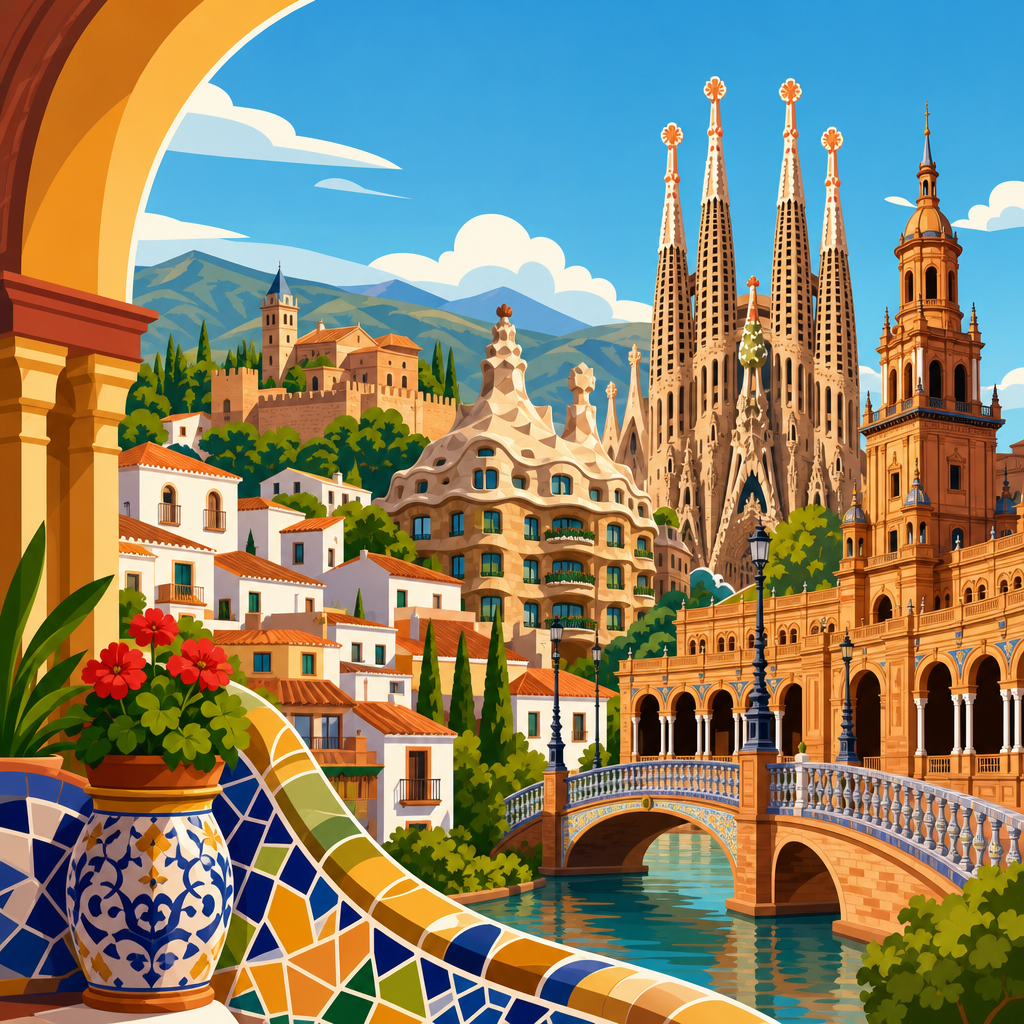
Spanish architecture offers one of the clearest ways to understand how Spanish-speaking communities express identity, memory, and social values through built space. More than a catalog of famous buildings, it is a living record of language contact, religion, migration, climate adaptation, political change, and regional pride. When learners explore Spanish architecture, they are not only looking at stone, tile, wood, and iron; they are encountering the vocabulary, stories, and customs that shape everyday life across Spain and the wider Hispanic world.
In my work with language learners and cultural programs, architecture consistently opens conversations that textbooks often miss. A plaza mayor reveals how public life is organized. A mosque-cathedral shows layers of conquest and coexistence. A modern housing block raises questions about urban planning, class, and community. Even small details such as patios, azulejos, rejas, and portales carry meaning. Architecture, in this sense, functions as a practical cultural text: it gives visible form to history while supplying concrete language learners can use immediately.
This hub article covers Spanish architecture as a broad miscellaneous gateway within Spanish community and interaction. It defines key architectural traditions, explains how buildings reflect language and culture, and points readers toward the themes that matter most when studying this topic comprehensively. The goal is straightforward: to show why architecture matters for cultural fluency, not just art appreciation. If you want to understand how Spanish-speaking societies gather, worship, trade, celebrate, and remember, start by looking carefully at the spaces they build and preserve.
Why architecture matters in Spanish community and interaction
Architecture matters because it shapes human interaction before a word is spoken. In Spanish-speaking societies, the design of streets, squares, homes, markets, schools, and religious buildings often encourages collective life. The plaza is the classic example. Across Spain and Latin America, central squares organize civic rituals, commerce, protests, festivals, and daily social contact. When students ask why public sociability feels different in many Spanish-speaking places, I often begin with urban form: narrow walkable streets, mixed-use centers, shaded arcades, and plazas naturally support conversation and repeated encounters.
Domestic architecture also teaches cultural priorities. The courtyard house, common in Andalusia and influential across the Hispanic world, balances privacy with openness. From the street, a home may appear plain or even closed. Inside, the patio becomes a social heart filled with light, plants, water, and family life. This contrast helps explain communication patterns around hospitality, boundaries, and public versus private identity. Architectural terms such as patio, zaguán, balcón, and terraza are not decorative vocabulary; they describe how people inhabit space and relate to one another.
Religious and civic buildings reveal another layer of interaction. Cathedrals, monasteries, town halls, bullrings, train stations, and markets are institutions in built form. Their placement and design communicate power, tradition, and local memory. In cities such as Seville, Salamanca, Toledo, and Mexico City, architecture is inseparable from public language. Street names, inscriptions, memorial plaques, and guided tours create a continuous educational environment. That is why architecture belongs at the center of any serious study of Spanish community and interaction: it is where social life becomes visible, legible, and shareable.
Key styles that define Spanish architecture
Spanish architecture is best understood as a layered sequence rather than a single style. Roman engineering established durable foundations in roads, bridges, aqueducts, and urban planning. The aqueduct of Segovia remains a benchmark of masonry precision, while Roman theaters and walls across the Iberian Peninsula demonstrate the long continuity of public infrastructure. After Rome, Visigothic and early medieval forms contributed structural and liturgical traditions, though fewer examples survive at monumental scale.
The Islamic period transformed architecture in ways that remain central to Spanish identity. In Al-Andalus, architects refined horseshoe arches, geometric ornament, muqarnas vaulting, water channels, gardens, and courtyard planning. The Alhambra in Granada and the Great Mosque of Córdoba are not only masterpieces; they are essential references for understanding space, rhythm, light control, and symbolic decoration. Their influence continued after Christian rule expanded, producing Mudéjar architecture, where Muslim artisans and techniques shaped churches, palaces, and civic buildings under Christian patrons. Brick towers, ceramic tile, wooden artesonado ceilings, and patterned surfaces became signatures of this synthesis.
From the late medieval period onward, Gothic architecture introduced verticality, rib vaults, and monumental cathedrals, especially in Burgos, León, and Toledo. The Renaissance brought symmetry, classical proportion, and humanist ideals, visible in buildings around Salamanca and the palace-monastery complex of El Escorial. Baroque architecture later emphasized theatrical façades, movement, and ornament, while the Churrigueresque style pushed decorative intensity even further. In the nineteenth and twentieth centuries, historicism, industrial materials, and regional revival movements expanded the architectural vocabulary again. Catalan Modernisme, led by Antoni Gaudí, Lluís Domènech i Montaner, and Josep Puig i Cadafalch, fused craft, symbolism, engineering, and natural forms into one of Europe’s most distinctive modern architectural languages.
| Style | Core features | Representative example | Cultural significance |
|---|---|---|---|
| Roman | Arches, infrastructure, durable stone construction | Aqueduct of Segovia | Shows early urban organization and engineering discipline |
| Islamic | Courtyards, water, geometric ornament, horseshoe arches | Alhambra, Great Mosque of Córdoba | Reflects scientific, artistic, and linguistic exchange |
| Mudéjar | Brickwork, tile, wood ceilings, hybrid decorative systems | Churches and towers in Teruel | Demonstrates coexistence and adaptation across communities |
| Gothic | Height, rib vaults, stained glass, cathedral plans | Cathedral of León | Expresses ecclesiastical power and urban ambition |
| Renaissance/Baroque | Classical order or dramatic ornament | El Escorial, Plaza Mayor of Salamanca | Links monarchy, religion, and civic identity |
| Modernisme | Organic forms, craft detail, structural experimentation | Sagrada Família, Palau de la Música Catalana | Connects regional identity, industry, and artistic innovation |
Architecture as a record of language and identity
Buildings preserve language in direct and indirect ways. Directly, they carry inscriptions, dedications, street names, liturgical texts, and commemorative markers. Indirectly, they preserve the vocabulary communities use to describe space. Terms such as alcázar, aljibe, azulejo, alameda, and ojalá all point, in different ways, to Arabic influence on Spanish culture and language. When learners visit architectural sites or even study them through maps and photographs, they encounter this layered lexicon in context. The result is better retention and a deeper understanding of historical contact.
Regional identity is equally visible. Architecture in Galicia, with its granite construction and rainy climate responses, differs clearly from the whitewashed villages of Andalusia, the stone mountain settlements of Castile, or the urban fabric of Barcelona. These regional variations often align with linguistic and cultural distinctions, including Catalan, Galician, Basque, and regional Spanish speech communities. Built form becomes a practical introduction to diversity within Spain, helping readers avoid the common mistake of treating Spanish culture as uniform.
The same principle applies across the wider Spanish-speaking world. Colonial grids in Mexico, Peru, Colombia, and elsewhere adapted Iberian planning principles to local materials, labor systems, and Indigenous traditions. Churches were built over earlier sacred sites. Courtyard houses evolved for new climates. Decorative programs mixed European iconography with local craftsmanship. When discussing Spanish architecture as a hub topic, it is important to include these transatlantic continuities and changes. Architecture is not just a Spanish national story; it is part of a broader Hispanic conversation shaped by empire, resistance, hybridity, and local creativity.
Famous landmarks and what they teach
Some landmarks appear repeatedly because they condense major historical themes into one site. The Alhambra teaches how architecture choreographs movement, sound, reflection, and political symbolism. Its courts and halls are carefully proportioned to create calm, hierarchy, and sensory richness. The Great Mosque of Córdoba demonstrates how a building can accumulate new meanings over centuries, especially after the insertion of a cathedral nave into the earlier mosque structure. Rather than offering a simple narrative, it teaches complexity, appropriation, and layered heritage.
The Sagrada Família in Barcelona is equally instructive for a different reason. It shows that Spanish architecture is not frozen in the past. Gaudí combined catenary principles, biomorphic geometry, structural logic, and religious symbolism in ways that anticipated later computational design. The building’s long construction timeline also makes it a case study in craft continuity, tourism economics, and public debate about restoration and authorship. Students often remember the site because it turns abstract design principles into something visually unforgettable.
Other landmarks are valuable precisely because they are civic rather than spectacular. The Plaza Mayor in Madrid or Salamanca explains how public order, commerce, ceremony, and surveillance historically worked together. Mercado de San Miguel in Madrid or older covered markets across Spain show how iron, glass, and modern retail transformed urban food culture. Seville’s Archivo de Indias connects architecture to imperial administration and global trade. In each case, the lesson is the same: landmarks are useful not only for beauty, but because they explain how communities functioned and how language, labor, and power circulated through space.
Materials, climate, and everyday design
One of the most practical ways to read Spanish architecture is through materials and climate response. In hot regions, thick walls, internal courtyards, shutters, limited street-facing openings, and reflective surfaces help control temperature before mechanical cooling. In wetter northern areas, roofs, stone detailing, and enclosed galleries respond differently to moisture and wind. These are not minor technical details. They shape daily habits, seasonal routines, and neighborhood rhythms. In my experience, learners understand cultural behavior more quickly when they see how it is tied to heat, shade, sound, and walkability.
Traditional materials also carry strong regional signatures. Brick dominates in many Mudéjar contexts because it was economical, versatile, and well suited to ornamental patterning. Stone signals permanence and local geology. Ceramic tile contributes waterproofing, color, and maintenance efficiency. Wrought iron balconies and grilles manage ventilation and safety while shaping the visual identity of streets. Timber ceiling systems, especially artesonado work, show extraordinary craftsmanship and mathematical planning. These material choices were rarely arbitrary; they solved practical problems while signaling status, belief, and local skill.
Modern Spanish architecture continues this dialogue between place and performance. Architects such as Rafael Moneo and Santiago Calatrava, despite their different reputations and methods, engage public expectations about structure, monumentality, and urban image. Contemporary projects also face harder questions about energy use, heritage conservation, accessibility, overtourism, and housing affordability. That tension matters. Celebrating Spanish architecture without discussing preservation costs, adaptive reuse, or neighborhood displacement gives an incomplete picture. The built environment is cultural heritage, but it is also lived infrastructure that communities must maintain, fund, and negotiate.
How to study Spanish architecture as a cultural hub topic
To study Spanish architecture well, start with themes rather than only timelines. Focus on public space, religion, domestic life, regional identity, colonial exchange, modern urbanism, and conservation. Then connect each theme to useful vocabulary and case studies. For example, a unit on public space might include plaza, ayuntamiento, mercado, and paseo, anchored by Salamanca, Madrid, and Mexico City. A unit on intercultural exchange might center on Córdoba, Granada, and Mudéjar Teruel. This method helps readers move from isolated facts to an organized understanding of Spanish community and interaction.
Use reliable tools when researching. UNESCO World Heritage documentation is useful for site histories and significance statements. The Instituto del Patrimonio Cultural de España provides conservation context. Major museums, cathedral archives, and city heritage offices often publish plans, restoration reports, and virtual tours. For maps and urban comparison, Google Arts & Culture, municipal GIS portals, and historical cartography collections are practical starting points. If the goal is language learning, pair architectural study with travel writing, oral histories, and local news to hear how residents actually talk about neighborhoods and landmarks.
As a miscellaneous hub, this topic should link outward to related articles on Spanish history, religion, regional cultures, public festivals, travel etiquette, urban life, art, and language variation. Architecture connects naturally to all of them. It explains why processions take certain routes, why apartment life sounds the way it does, why some towns center on arcaded plazas, and why certain Arabic-derived words remain common. The strongest takeaway is simple: study buildings as social evidence. When you do, Spanish architecture becomes far more than visual heritage. It becomes a direct window into culture, language, and community. Explore one city, one style, or one landmark next, and let the built environment guide the rest of your learning journey.
Frequently Asked Questions
How does Spanish architecture reflect culture and language at the same time?
Spanish architecture reflects culture and language because buildings are never just physical structures; they are also expressions of how communities organize life, remember history, and describe the world around them. In Spanish-speaking societies, architecture often reveals layers of cultural exchange through materials, layout, ornament, and naming traditions. A plaza, patio, iglesia, alcázar, barrio, or ayuntamiento is not only a place type but also a word tied to social practice, local identity, and historical experience. When learners encounter these terms in context, they begin to see how vocabulary grows out of everyday life. The built environment gives concrete meaning to language that might otherwise remain abstract.
Architecture also preserves the influence of religion, monarchy, trade, migration, and regional diversity. A cathedral may communicate the role of Catholicism in public life, while a courtyard house may show climate adaptation and traditions of family-centered domestic space. Decorative tilework, balconies, interior gardens, arcades, and thick stone walls often tell stories about craftsmanship, status, and environmental knowledge. Even regional differences in style can deepen language learning, because they introduce learners to local terms, place-based identities, and historical references that shaped how Spanish developed across territories. In that sense, architecture becomes a cultural text: it can be read visually, historically, and linguistically all at once.
What are the most important historical influences on Spanish architecture?
Spanish architecture has been shaped by a long sequence of historical influences, and that layered history is one of the reasons it is so culturally rich. Roman engineering left behind roads, bridges, aqueducts, and urban planning traditions that established a foundation for later development. The long Islamic presence in the Iberian Peninsula introduced major artistic and spatial innovations, especially in the use of courtyards, horseshoe arches, geometric decoration, water features, carved stucco, and intricate tilework. These elements can still be seen in some of the most admired buildings in Spain, and they remain essential for understanding the cultural complexity of Spanish history.
Later, Christian kingdoms transformed many cities through churches, monasteries, castles, and civic buildings, producing Romanesque, Gothic, Renaissance, and Baroque landmarks that reflected changing ideas about faith, power, and public life. The colonial era extended Spanish architectural forms into the Americas, where they mixed with Indigenous building traditions, local materials, and regional climates. In the modern period, industrialization, political change, urban growth, and architectural experimentation further expanded the range of styles, from neoclassical government buildings to the modernist creativity associated with figures such as Antoni Gaudí. Each of these periods contributed not only distinctive visual forms but also new terminology, regional expressions, and social meanings, making architecture a valuable guide to broader historical change in the Spanish-speaking world.
Why are regional differences so important when studying Spanish architecture?
Regional differences matter because there is no single, uniform model of Spanish architecture. Spain contains distinct historical regions with their own traditions, materials, climates, and cultural identities, and these differences are visible in the buildings people construct and preserve. Architecture in Andalusia often highlights the legacy of Islamic design, inner courtyards, whitewashed walls, and heat-conscious planning. In Castile, one may encounter monumental stone architecture associated with royal, religious, and civic authority. In Catalonia, modernisme introduced highly expressive decorative forms, fluid lines, and imaginative uses of color and structure. In the Basque Country, Galicia, Valencia, and other regions, architecture likewise reflects local history, economy, and landscape.
These regional variations are important for language learners because they show that Spanish culture is not monolithic. Local identity shapes vocabulary, artistic references, and the symbolic value of space. A learner studying architecture begins to understand why certain building traditions emerge in response to weather, agriculture, religion, or trade, and how those traditions become part of regional pride. This also encourages a more accurate view of the Spanish-speaking world: instead of treating culture as fixed and centralized, it reveals a network of communities with distinct voices. Studying architectural variety therefore builds cultural literacy, sharpens observation, and helps learners connect language to place in a more meaningful way.
What can students and language learners gain from exploring Spanish architecture?
Students and language learners can gain far more than visual appreciation from exploring Spanish architecture. First, they develop cultural context for vocabulary that appears in textbooks, conversations, literature, and travel situations. Words related to homes, neighborhoods, public squares, churches, materials, decoration, and urban life become easier to remember when tied to real examples. Instead of memorizing isolated terms, learners connect language to spaces people actually inhabit. This makes vocabulary more memorable and gives it emotional and cultural depth.
Second, architecture encourages interdisciplinary learning. A single building can open discussion about history, religion, social class, engineering, climate adaptation, migration, and artistic symbolism. Learners begin asking better questions: Why are patios so central in some regions? Why do certain cities preserve medieval street patterns? Why do balconies, tiled facades, or stone walls appear more often in one area than another? Those questions lead naturally into richer language use, including description, comparison, interpretation, and argument. Architecture also supports listening and reading comprehension, since learners encounter authentic materials such as museum texts, guided tours, city maps, and historical essays. For many students, this topic makes language study feel alive because it links communication to visible, tangible evidence of how people live and what they value.
How does Spanish architecture help explain social values such as memory, religion, community, and adaptation?
Spanish architecture helps explain social values because built space records what a society chooses to honor, protect, and repeat. Memory appears in the preservation of old quarters, monuments, cathedrals, fortresses, and civic buildings that connect present-day communities with earlier generations. These structures often serve as public reminders of conquest, coexistence, devotion, conflict, artistic achievement, and local continuity. Architecture can therefore reveal what a society remembers proudly, what it debates, and what it seeks to reinterpret. Even restoration choices and heritage policies tell a story about collective identity and public memory.
Religion is another major value expressed through architecture, especially in churches, monasteries, chapels, and pilgrimage routes that have shaped Spanish urban and rural landscapes for centuries. Community values emerge in plazas, markets, arcades, courtyards, and neighborhood layouts that encourage gathering, conversation, ceremony, and shared daily routines. At the same time, adaptation is visible in practical design decisions such as thick walls for insulation, narrow streets for shade, interior patios for airflow, and local materials suited to the surrounding environment. These features show that architecture is not only symbolic but deeply responsive to climate and lived experience. Together, memory, religion, community, and adaptation reveal why architecture is such a powerful window into culture: it captures both ideals and necessities, both inherited tradition and daily human practice.