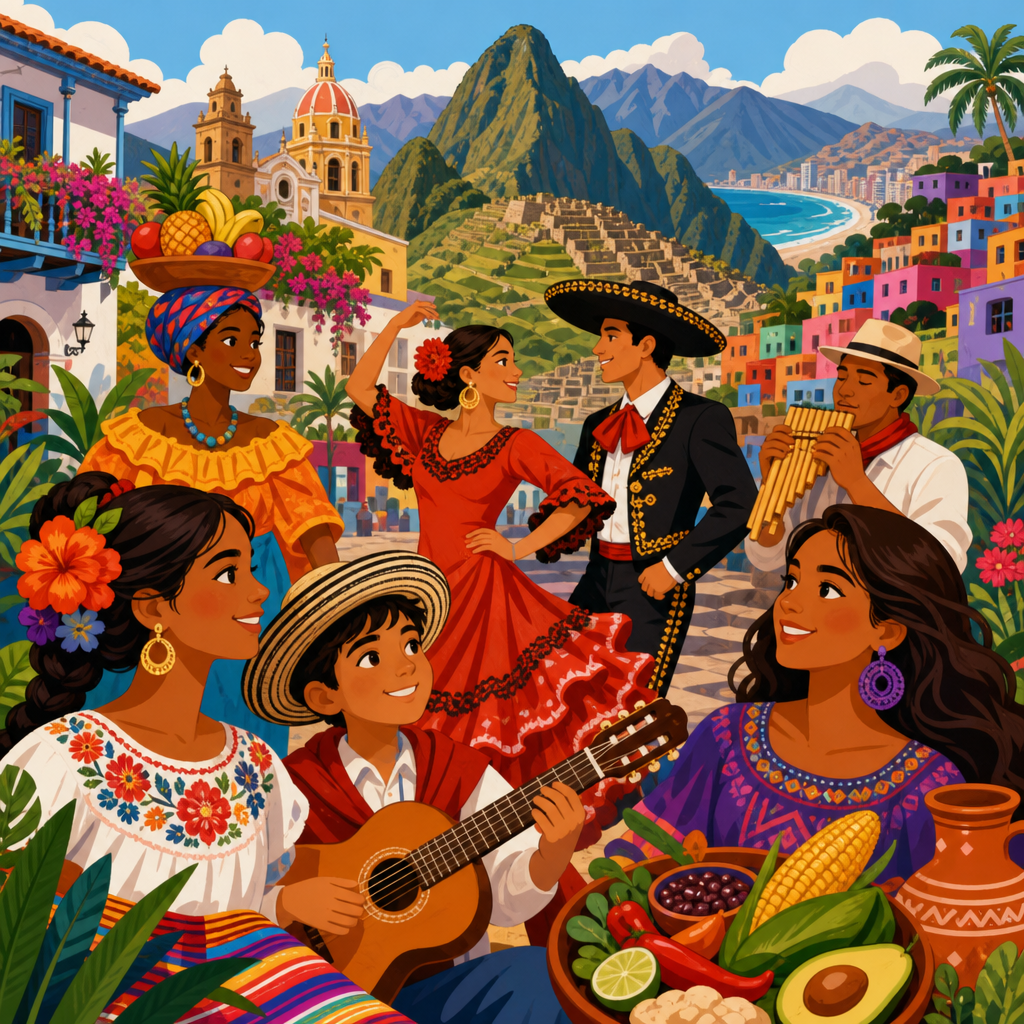
Spanish-speaking cultures form one of the world’s broadest and most dynamic cultural spheres, stretching across Europe, the Americas, Africa, and global diasporas. The phrase refers not to a single identity but to a network of communities linked by the Spanish language and shaped by distinct histories, landscapes, religions, migration patterns, and artistic traditions. In practice, a Madrid neighborhood, a rural town in Oaxaca, a Caribbean barrio in San Juan, and an immigrant block in Miami may all operate in Spanish while expressing culture in very different ways. That diversity is exactly why the topic matters. Anyone exploring Spanish community and interaction needs a hub that explains the shared foundations, the regional variations, and the everyday customs that influence communication, belonging, and cultural exchange.
When I have worked with Spanish-speaking communities in education, publishing, and neighborhood outreach, the biggest mistake I have seen is treating “Spanish culture” as singular. It is far more accurate to think in terms of Spanish-speaking cultures. Language creates connection, but culture is carried through foodways, music, humor, family structure, social etiquette, local memory, and institutions. A learner who understands verb conjugations but not greeting norms, honorifics, regional slang, or holiday practices will still miss essential meaning. Likewise, organizations serving Spanish-speaking audiences need cultural fluency, not just translation, because trust often depends on whether communication reflects local realities.
This hub article covers the miscellaneous cultural dimensions that make Spanish-speaking societies rich, complex, and globally influential. It introduces the historical roots of the Spanish-speaking world, explains how language varies across regions, explores family and social interaction, surveys celebrations and artistic expression, and looks at food, media, migration, and identity. It also highlights the tensions that shape modern cultural life, including colonial legacies, class divisions, racial diversity, and debates over heritage and belonging. As a hub within Spanish Community and Interaction, this page is designed to orient readers before they move into more specialized articles on regional customs, interpersonal communication, or community life.
Historical roots and the making of a shared language world
Spanish became a world language through empire, religion, trade, and migration. Its standard written form emerged in the Iberian Peninsula, especially after the unification processes associated with Castile and Aragon and the publication of Antonio de Nebrija’s grammar in 1492, often cited as the first grammar of a modern European vernacular. Colonization then spread Spanish across most of Latin America and into parts of Africa and Asia. Yet the spread of Spanish never erased preexisting cultures. Instead, it produced layered societies where Indigenous, African, European, and later Asian influences combined in different proportions. Mexico, Peru, Colombia, Cuba, Argentina, Equatorial Guinea, and Spain all use Spanish, but each developed distinct cultural frameworks.
That history matters because it explains both commonality and difference. Shared institutions such as Catholic feast days, legal traditions influenced by Iberian models, and literary reference points from Cervantes to García Márquez create recognizable overlap. At the same time, local histories shape identity just as strongly. In the Andes, Quechua and Aymara traditions continue to inform festivals, cuisine, and social hierarchy. In the Caribbean, African diasporic influence is central to music, religion, and speech rhythm. In the Río de la Plata region, mass immigration from Italy altered pronunciation, gestures, and urban style. Understanding Spanish-speaking cultures starts with this principle: a common language sits on top of many historical foundations.
Language variation, accents, and what they signal socially
One of the clearest markers of cultural diversity is how Spanish sounds and functions from place to place. Vocabulary differs sharply across countries: a straw may be pajita, popote, pitillo, or sorbete. A bus may be autobús, camión, guagua, or colectivo. Pronunciation also varies. Much of Spain distinguishes c and z from s, while most of Latin America does not. Argentina and Uruguay commonly use vos instead of tú, with distinct verb forms like vos tenés. Caribbean Spanish often weakens final consonants, while highland varieties may preserve them more fully.
These differences are not trivial. Accent and word choice often signal region, class, education, age, and social affiliation. In community interaction, they can shape trust instantly. I have seen outreach materials fail because they used neutral textbook Spanish that sounded foreign to the intended audience. A health campaign aimed at Mexican families in the United States may not resonate with Dominican or Salvadoran readers if tone and vocabulary feel off. The most effective communicators respect local speech without caricaturing it. They also recognize the role of formal versus informal address, especially tú, usted, and vos, which encode familiarity, respect, and distance in ways English usually does not.
Family, social etiquette, and community expectations
Across many Spanish-speaking cultures, family networks remain a central organizing force, though the form and intensity vary by country, class, and generation. Extended family often plays a larger role than in highly individualistic societies. Grandparents may help raise children, adult siblings may remain closely involved in daily decisions, and major choices about work, education, migration, or care for elders are frequently discussed collectively. This does not mean every household is traditional. Urbanization, women’s workforce participation, declining birth rates in Spain and parts of Latin America, and migration have reshaped family life dramatically. Still, kinship obligations remain culturally important in much of the Spanish-speaking world.
Social etiquette reflects these communal expectations. Greetings can be warmer and more relational than in low-context cultures; a quick transactional tone may seem cold. In many settings, taking time to ask about family or wellbeing is not small talk but a sign of respect. Physical proximity, expressive intonation, and overlapping conversation may indicate engagement rather than conflict. Time can be understood more flexibly in informal contexts, though professional environments often follow stricter norms. Hospitality is another recurring value. Offering food, coffee, or a seat communicates dignity and welcome. For anyone navigating Spanish community interaction, these habits matter because relationships often open doors that formal credentials alone do not.
Festivals, faith, and public celebrations
Celebration is one of the most visible ways culture becomes communal. The Spanish-speaking world is full of public festivals that blend religion, local history, seasonal cycles, and civic pride. Holy Week processions in Seville are shaped by Catholic brotherhoods, centuries-old sculpture, and neighborhood identity. Mexico’s Day of the Dead combines Indigenous and Catholic elements through altars, marigolds, food offerings, and remembrance. In many countries, patron saint festivals bring together processions, music, dance, fireworks, and regional foods. National days, carnival traditions, harvest events, and town fairs also structure community life and create recurring spaces where belonging is performed and renewed.
Religious practice remains important, even where secularization has advanced. Catholicism has historically dominated, but Protestant evangelical churches have grown rapidly in countries such as Guatemala, Honduras, Brazil’s Spanish-speaking neighbors’ border regions, and parts of the Latino United States. Afro-Caribbean traditions, Indigenous spiritual practices, and syncretic forms also continue to shape ritual life. Public celebration often reveals this layering better than any textbook. A festival may include a Mass, Indigenous dance, a brass band, local political speeches, and street vendors all in one event. That blend shows how Spanish-speaking cultures preserve continuity while constantly adapting to migration, media, and social change.
Music, literature, film, and everyday cultural expression
Spanish-speaking cultures have produced some of the most influential artistic movements in the modern world. In literature alone, the tradition ranges from Miguel de Cervantes and Federico García Lorca to Pablo Neruda, Jorge Luis Borges, Gabriel García Márquez, Isabel Allende, and Javier Marías. The Latin American Boom brought international attention to experimental fiction and magical realism, but regional writing has always been broader than a single style. Oral storytelling, corridos, décimas, testimonial literature, urban poetry, and contemporary digital writing all belong in the picture. Art in Spanish-speaking communities is not a luxury category; it is a daily vehicle for memory, protest, humor, and identity.
Music may be the fastest route into cultural understanding because it makes regional difference audible. Flamenco in Spain carries Romani, Andalusian, and Moorish legacies. Salsa in the Caribbean and diaspora cities like New York reflects Afro-Latin rhythms and transnational exchange. Tango in Argentina and Uruguay grew from port-city migration, class mixing, and melancholy urban modernity. Mariachi, cumbia, reggaeton, bachata, son jarocho, vallenato, and nueva canción each connect communities to specific histories. Film and television add another layer. Directors such as Pedro Almodóvar, Alfonso Cuarón, Guillermo del Toro, Lucrecia Martel, and Alejandro Amenábar show how Spanish-speaking societies debate family, gender, memory, and class through visual storytelling.
Foodways, regional identity, and the social meaning of meals
Food is never just sustenance in Spanish-speaking cultures; it is a map of environment, trade, migration, and status. Staples differ by region. Maize anchors much of Mesoamerica, while wheat and olive oil remain central in Spain. Rice and beans define many Caribbean and mainland Latin American tables, but the combinations and seasonings vary widely. Peru’s cuisine reflects Indigenous ingredients, Spanish colonial influence, African techniques, Chinese migration, and Japanese adaptation. Spain’s regional food cultures are equally distinct, from Galician seafood to Basque pintxos to Valencian paella. Even a familiar item like bread can carry different meanings in urban, rural, festive, and religious contexts.
Meals also organize social life. Long lunches, shared platters, street snacks, late dinners in Spain, and celebratory cooking during holidays all create opportunities for interaction. In many homes, recipes transmit family history more reliably than official documents. A grandmother’s mole, an arepa style tied to one region, or a Christmas dish prepared only once a year can function as a cultural archive. Restaurants and food markets serve a similar role in diaspora settings. I have watched people evaluate whether a business feels “authentic” not through purity claims, but through small details: seasoning, service style, music, and whether the place reproduces the social atmosphere of home.
Migration, diaspora, and cultural reinvention
Spanish-speaking cultures are not contained within national borders. Migration has created major Spanish-speaking communities in the United States, Canada, Western Europe, and beyond, while internal migration has transformed cities across Latin America and Spain. These movements change culture in both sending and receiving regions. Remittances support families and local economies, but migration also reshapes language use, consumer habits, and identity. Second-generation youth may speak English outside the home and Spanish with grandparents, switching registers constantly. Return migrants bring back new attitudes toward work, schooling, religion, and gender roles. Cultural life becomes transnational rather than purely local.
| Area | Common cultural pattern | Practical impact on community interaction |
|---|---|---|
| U.S. Latino neighborhoods | Mixed national origins using shared Spanish in public life | Organizations need flexible vocabulary and culturally specific outreach |
| Spain’s major cities | Latin American migration reshaping food, music, and services | Community identity becomes more multilingual and pan-Hispanic |
| Return-migrant towns in Latin America | Families adapt habits learned abroad | Expectations around education, work, and gender may shift quickly |
| Digital diaspora communities | Identity maintained through messaging apps, radio, and social media | Belonging no longer depends only on physical proximity |
Migration also exposes tensions. Not all Spanish speakers share the same legal status, racial position, or access to institutions. In the United States, for example, the Census Bureau reports that the Hispanic or Latino population exceeds 65 million, but that category includes people with roots in Mexico, Puerto Rico, Cuba, El Salvador, the Dominican Republic, and many other places. Their political priorities and cultural practices differ significantly. Effective engagement therefore avoids flattening communities into a single market segment. The stronger approach is to ask where people come from, how they self-identify, which language variety they use, and what local networks they trust.
Identity, race, class, and contemporary change
No serious overview of Spanish-speaking cultures is complete without addressing inequality and internal diversity. The Spanish-speaking world includes Indigenous peoples, Afro-descendant communities, white elites, mestizo majorities, Asian minorities, and many mixed identities that do not fit neatly into U.S. racial categories. Class often shapes opportunity as much as language does. Access to private education, urban infrastructure, healthcare, and cultural prestige can vary sharply within the same city. Media representation has historically favored lighter-skinned and wealthier groups, though this is being challenged by activism, independent film, and more inclusive publishing.
Contemporary debates around gender, memory, and national identity are equally important. Feminist movements in Argentina, Mexico, and Spain have changed public conversation on violence and reproductive rights. Indigenous language revitalization efforts challenge older assumptions that Spanish alone defines national culture. Historical memory debates in Spain revisit the Civil War and Franco dictatorship, while many Latin American countries continue to confront authoritarian pasts and colonial injustice. The result is a cultural sphere that is not static or nostalgic. Spanish-speaking cultures are constantly renegotiating who belongs, whose stories count, and how tradition should evolve in a rapidly connected world.
The richness of Spanish-speaking cultures lies in their combination of shared language and profound internal variety. History, accent, family life, festivals, artistic production, food traditions, migration, and social change all shape how communities interact and how identity is expressed. Seeing that complexity makes communication better and cultural understanding more honest. It helps educators teach more accurately, helps organizations build trust, and helps readers move beyond stereotypes toward real fluency in social context.
As a hub for the miscellaneous side of Spanish Community and Interaction, this article offers the foundation for exploring more specific topics in depth. Use it as a guide for recognizing regional differences, asking sharper questions, and approaching Spanish-speaking communities with respect for their lived realities. The central lesson is simple: Spanish connects millions of people, but culture gives that connection its texture. Continue through the related articles in this subtopic and build your understanding one community, one practice, and one conversation at a time.
Frequently Asked Questions
What does the term “Spanish-speaking cultures” really mean?
“Spanish-speaking cultures” refers to the wide range of societies, communities, and traditions connected by the use of the Spanish language, but it does not describe a single, uniform cultural identity. It includes people and places across Spain, Latin America, parts of the Caribbean, Equatorial Guinea in Africa, and large diaspora communities in cities around the world. What unites these groups is language, but what distinguishes them are their local histories, Indigenous roots, African influences, regional customs, colonial experiences, migration stories, foodways, music, and social values.
In practical terms, Spanish-speaking cultures are best understood as a cultural network rather than a monolith. The daily life of a family in Seville, a community in the Andes, a neighborhood in San Juan, and a Mexican American household in Chicago may all involve Spanish, yet each setting carries different traditions, accents, celebrations, and historical memories. Even within a single country, cultural variation can be dramatic. Regional identities, class, ethnicity, religion, and geography all shape how people speak, celebrate, create art, and relate to family and community. That complexity is exactly what makes the Spanish-speaking world so rich and globally significant.
Why is it important not to treat all Spanish-speaking communities as the same?
It is important because reducing all Spanish-speaking communities to one shared identity erases the diversity that defines them. Language can create connection, but it does not eliminate the distinct experiences of Indigenous peoples in Latin America, Afro-descendant communities in the Caribbean, regional populations in Spain, or immigrant families building new lives abroad. Every Spanish-speaking society has been shaped by unique political histories, local traditions, religious practices, racial dynamics, and relationships to land, migration, and memory. Treating them as interchangeable can lead to inaccurate assumptions and shallow understanding.
This distinction matters in education, media, travel, business, and everyday conversation. For example, food, music, humor, and even common vocabulary differ significantly from one region to another. A word used casually in one country may sound unusual or even inappropriate in another. Historical experiences also vary: some communities define themselves through Indigenous continuity, others through Caribbean creolization, others through European regionalism, and many through layered mixtures of all of these. Recognizing those differences leads to more respectful engagement and a more accurate appreciation of the Spanish-speaking world as a vibrant collection of cultures rather than a single cultural category.
How have history and migration shaped Spanish-speaking cultures around the world?
History and migration are central to understanding how Spanish-speaking cultures developed and why they remain so dynamic today. The spread of Spanish began with imperial expansion, but the cultures that emerged were never simply copies of Spain. Across the Americas and beyond, Spanish mixed with Indigenous traditions, African cultural inheritances, and later immigrant influences from Europe, Asia, and the Middle East. These encounters shaped everything from religion and architecture to cuisine, music, and social structures. As a result, Spanish-speaking cultures are deeply layered, reflecting centuries of exchange, adaptation, conflict, and creativity.
Migration has continued to reshape these cultures in every era. Rural-to-urban migration transformed national identities within Latin America, while international migration created major Spanish-speaking communities in the United States, Canada, and Europe. Diaspora communities often preserve traditions while also inventing new ones, blending homeland customs with the realities of their adopted cities. A neighborhood in Miami, Los Angeles, or Madrid may contain influences from Cuba, the Dominican Republic, Mexico, Colombia, Venezuela, and many other places all at once. This movement of people keeps language evolving, expands artistic expression, and ensures that Spanish-speaking cultures are not static relics of the past but living, changing cultural worlds.
What are some of the most visible differences among Spanish-speaking cultures?
Some of the most visible differences appear in language, food, music, celebrations, and social customs. Spanish itself varies widely in pronunciation, vocabulary, rhythm, and expressions from one country or region to another. Culinary traditions are equally diverse: Mediterranean olive oil and seafood dishes in Spain differ greatly from the corn-based cuisines of Mexico, the tropical flavors of the Caribbean, or the potato-rich highland food of the Andes. Musical traditions also reveal enormous range, from flamenco and jota to salsa, son, cumbia, tango, mariachi, reggaetón, and folk forms rooted in Indigenous and Afro-descendant communities.
Festivals and public traditions offer another clear example of diversity. Holy Week processions in Spain, Día de los Muertos in Mexico, Carnival celebrations in the Caribbean, and local patron saint festivals throughout Latin America all reflect different blends of religion, history, and local identity. Family structure, social etiquette, humor, and attitudes toward formality can also vary. Even ideas of national identity are expressed differently depending on whether a society emphasizes regional heritage, mestizaje, Indigenous belonging, African heritage, or immigrant experience. Together, these differences show that Spanish-speaking cultures are connected through language but expressed through many distinct ways of life.
How can someone appreciate Spanish-speaking cultures in a respectful and meaningful way?
The best approach is to begin with curiosity, humility, and specificity. Instead of assuming that one experience represents all Spanish-speaking people, take time to learn about individual countries, regions, and communities on their own terms. Listen to how people describe their own identities, whether they identify primarily by nationality, region, ethnicity, race, religion, or diaspora background. Reading literature, exploring history, watching films, listening to music, and engaging with community voices can provide far more meaningful insight than stereotypes or broad labels ever could.
Respect also means recognizing internal diversity and historical complexity. That includes understanding the importance of Indigenous cultures, African diasporic influence, migration, colonial legacies, and the experiences of bilingual and bicultural communities. If you are learning Spanish, pay attention to regional variation instead of searching for one “correct” cultural model. If you are traveling or building relationships across cultures, ask thoughtful questions and avoid making assumptions based on accent, appearance, or country of origin. Meaningful appreciation comes from seeing Spanish-speaking cultures not as a single colorful category, but as a vast, interconnected tapestry of human experience, each thread carrying its own history, voice, and contribution.