Learning Spanish, like any new language, comes with its own unique set of challenges and triumphs. Among these linguistic hurdles stand Spanish prepositions—small yet mighty words that govern the relationship between different elements within a sentence. Prepositions might seem insignificant at first glance, but they play an essential role in understanding and conveying meaning, creating a bedrock upon which clearer communication is built.
Prepositions in Spanish indicate location, time, direction, and more. Examples include familiar words like “en” (in/on/at), “a” (to/at), and “por” and “para” (both often translated as “for”). Just like in English, Spanish prepositions connect nouns, pronouns, and phrases to other words in a sentence. Learning to use these prepositions correctly is vital for anyone aspiring to achieve fluency and natural sentence construction in Spanish.
But why does mastering Spanish prepositions matter? Properly understanding and employing prepositions aids in creating context and nuance in speech as well as writing. They prevent misinterpretations and miscommunications, helping even novice speakers express ideas more accurately and fluidly. Moreover, prepositions are ubiquitous in everyday conversations, thus mastering them boosts one’s confidence in navigating real-world interactions in Spanish.
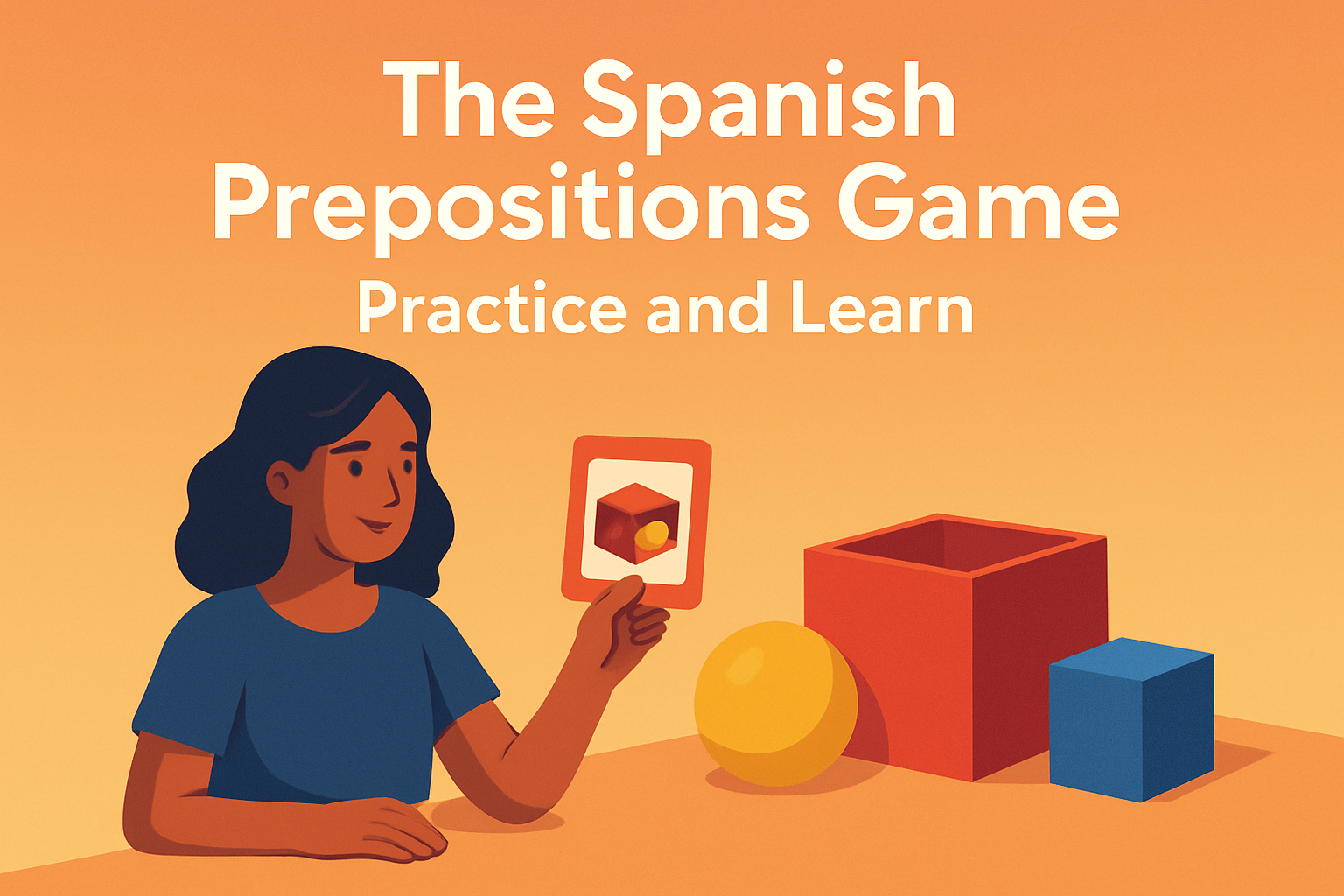
One effective way to conquer Spanish prepositions is through immersion and practice, preferably in a fun and engaging way. Enter the Spanish Prepositions Game—a lively, interactive approach to internalizing these integral elements of the language. By combining learning with play, learners experience a more relaxed environment where they can freely explore, make mistakes, and gradually perfect their understanding of preposition use.
Understanding Basic Spanish Prepositions
Introductory Spanish prepositions include “a” (to/at), “de” (of/from), and “en” (in/on/at). These foundational words appear frequently in everyday conversations and written materials, making them essential for new learners to grasp early on. Basic understanding of these prepositions is necessary for forming simple sentences and queries.
Consider the sentence “Voy a la tienda” meaning “I am going to the store.” Here, “a” directs the action towards “the store,” exemplifying its use to indicate direction or destination. Another example, “Estoy en casa,” translates to “I am at home,” where “en” defines the location. Mastery of these prepositions aids learners in correctly navigating spatial relationships and directions in Spanish.
Differentiating Between “Por” and “Para”
One common stumbling block for Spanish learners is discerning between “por” and “para.” Both prepositions are often translated into English as “for,” yet they are utilized in distinct contexts. Broadly speaking, “por” is used to explain reasons or causes, whereas “para” denotes purpose or intention.
| Usage | Por | Para |
|---|---|---|
| Example 1 | Gracias por la comida. | Este regalo es para ti. |
| Example 2 | Trabajé por dinero. | Estudio para aprender. |
In the first example, “por” is utilized in gratitude—”Thanks for the meal,” whereas “para” specifies the recipient—”This gift is for you.” In the second example, “por” discusses cause, “I worked for money,” while “para” highlights a goal, “I study to learn.” Understanding the distinction between “por” and “para” helps learners articulate motivation and outcome, thus expanding their communicative range.
Expressing Time with Spanish Prepositions
Spanish prepositions also play a critical role in expressing time-related concepts. Expressions like “en la mañana” (in the morning) and “por la tarde” (in the afternoon) show how prepositions define temporal contexts clearly and efficiently. Time-based prepositions often combine with days, months, or specific times to describe activities or events.
For example, “Nos vemos en un mes” translates to “We will see each other in a month,” with “en” signifying the timeframe. Another instance, “Voy a terminarlo para el viernes,” means “I will finish it by Friday,” employing “para” to denote a deadline. Accurate use of time prepositions assists learners in planning and articulating schedules, a useful skill in both personal and professional settings.
Subtle Prepositions: Understanding “Sobre,” “Contra,” and “Entre”
Subtler Spanish prepositions include “sobre” (on/over/about), “contra” (against), and “entre” (between/among). These prepositions contribute a nuanced layer to sentence meaning and usage. Each serves different communicative functions, providing specificity and clarity to statements.
Consider the sentence “El libro está sobre la mesa,” meaning “The book is on the table,” where “sobre” designates position. Meanwhile, “El equipo juega contra el rival,” translates to “The team plays against the opponent,” with “contra” denoting opposition. Lastly, “La carta está entre los documentos” or “The letter is among the documents” places “entre” into the context of location within a collection. Understanding these subtle differences enhances learners’ ability to craft precise descriptions and arguments.
Visual and Interactive Learning: The Role of the Spanish Prepositions Game
The Spanish Prepositions Game provides a creative and interactive way to immerse oneself in the language, offering an enjoyable method to practice preposition usage. Through gamification, learners can place themselves in memorable scenarios that reinforce their command of Spanish prepositions. This might involve matching exercises, fill-in-the-blanks, or role-playing games, all of which encourage active participation and immediate application of knowledge.
An example game might include a character navigating a digital landscape using commands like “mover a la izquierda” (move to the left) or “saltar sobre el obstáculo” (jump over the obstacle). By visualizing how prepositions influence movement and positioning, learners build a mental map, applying theory to practice seamlessly. This playful engagement helps learners retain information better than traditional memorization methods, making preposition mastery a less daunting task.
Using Real-World Scenarios to Solidify Learning
Real-world scenarios present invaluable opportunities to solidify preposition learning. For instance, cooking recipes introduce prepositions through instructions like “Agregar sal a la sopa” (Add salt to the soup) or “Mezclar durante cinco minutos” (Mix for five minutes). Here, learners naturally incorporate prepositions into practical activities, stimulating associative memory by connecting language with tangible experiences.
Travel scenarios also offer fertile ground for practicing prepositions: “Viajaré por España durante las vacaciones” (I will travel around Spain during the holidays) or “Quiero reservar una habitación para tres noches” (I want to book a room for three nights). These applications of language in real-life contexts not only reinforce preposition placement but also boost learners’ confidence, making them more prepared to navigate Spanish-speaking environments.
Concluding Thoughts: The Journey to Mastery
In essence, mastering Spanish prepositions may initially seem overwhelming, yet it offers profound rewards in facilitating clear and concise communication. By understanding and practicing these foundational elements of the language—whether through structured games, daily conversations, or immersive scenarios—learners lay the basis for elevated fluency and confidence when engaging with Spanish speakers.
Recognizing the prominence of prepositions heightens awareness of their impact, not just in Spanish but in language learning broadly. Successful mastery enables the construction of articulate and accurate sentences that effectively convey intent and meaning. In this way, learners move beyond rote memorization, discovering newfound freedom and enjoyment in using Spanish.
In conclusion, anyone embarking on the journey to fluency in Spanish is encouraged to embrace preposition practice as an integral component of their study. By approaching the learning process with curiosity and playfulness, one can transform what might be perceived as linguistic complications into stepping stones toward proficiency. Engage with the Spanish Prepositions Game today to start refining your skills and unlock greater potential in your language learning adventure.
Frequently Asked Questions
1. What are Spanish prepositions and why are they important?
Spanish prepositions are words that establish specific relationships between the elements of a sentence, such as location, time, or direction. They may be small words, but they pack a big punch in terms of meaning. These prepositions are crucial because they help provide clarity and depth to the conversation. By using them correctly, you can navigate through meanings more precisely and assure that you’re understood the way you intend to be.
Imagine trying to describe your vacation without using “in,” “on,” or “at.” It’s a much trickier task, right? In Spanish, prepositions function in similar ways and allow us to weave context into conversation seamlessly. Learning these prepositions enhances your sentence structure and enriches your overall communication skills in Spanish.
2. How can the Spanish Prepositions Game help me in learning?
The Spanish Prepositions Game is a dynamic and interactive way to master those tricky prepositions. Unlike traditional rote memorization, the game immerses you in an engaging environment where you apply what you’ve learned in fun scenarios. This practical approach reinforces knowledge through repetition and context-based learning, helping you to remember better.
The game comprises various levels, each designed to challenge you and reinforce different sets of prepositions. You’ll encounter real-life contexts and situations, making the process feel less like studying and more like an enjoyable challenge. This hands-on experience solidifies your understanding and ultimately leads to fluent, natural communication.
3. Why are prepositions so challenging for Spanish learners?
Prepositions are notoriously tough for learners because their usage often varies widely between languages. While English and Spanish share some prepositions that look similar, their application can differ drastically which often leads to confusion. Also, prepositions are abstract and don’t always have a tangible meaning like nouns or verbs do, making them more difficult to grasp.
Furthermore, there are instances in Spanish where the preposition does not directly translate to English and vice versa, which adds an additional layer of complexity. Consistent practice and exposure through games and immersive experiences are key to overcoming these challenges.
4. Can you give examples of common Spanish prepositions and their uses?
Certain prepositions pop up frequently in Spanish, and familiarizing yourself with them forms a solid foundation for your language studies. Here are a few examples:
- En: Translates to “in” or “on” and is used in phrases like “en la casa” (in the house).
- A: Often means “to” or “at” and is used such as “a la escuela” (to the school).
- De: Means “of” or “from” and appears in phrases like “de mi amigo” (from my friend).
- Por: Used for “by” or “through,” as in “por el parque” (through the park).
- Para: Translates as “for,” like in “para ti” (for you).
Each preposition has nuances and particular cases where they are used, which is why repeated practice and attention to homework and exercises are essential.
5. How can I improve my Spanish prepositions skills outside of the game?
While the Spanish Prepositions Game is a fantastic tool, enhancing your skills outside the game involves diverse approaches. Here are some strategies:
- Read and Listen: Dive into Spanish books, listen to podcasts, or watch films in Spanish to hear prepositions in their natural context.
- Practice Writing: Write short stories or diary entries in Spanish to actively use prepositions, reviewing them afterward to spot errors.
- Engage in Conversation: Whenever possible, speak with native Spanish speakers. Real conversations offer immediate feedback and contextual learning of prepositions.
- Use Flashcards: Create flashcards with different prepositions and sample sentences for daily practice and review.
Mixing these methods can greatly bolster your understanding and confidence in using Spanish prepositions, making you much more fluent and articulate in the language.