Learning a new language is an exhilarating journey, packed with discoveries and challenges. Spanish, being a beautiful and widely spoken language, offers learners the chance to connect with millions of people around the world. One of the most effective ways to deepen your understanding of Spanish and truly master its nuances is through synonym mastery. But why, you ask, does this matter? Synonyms provide depth to our language skills, enabling more effective communication and enhancing comprehension. This is where the Spanish Synonym Matchup game comes in — a fun, interactive way to cement your Spanish language skills.
The Spanish Synonym Matchup is designed to improve vocabulary by encouraging learners to think in the language rather than relying on direct translations. It aids learners in grasping the subtle differences between words and enhancing their contextual understanding. This article will guide you through the game’s methodology, its benefits, and offer practical examples to streamline the learning process. By seeing real-life scenarios and applying what you learn, you’ll gain the ability to speak with more flair and accuracy. Let’s dive into the vibrant world of Spanish synonyms and discover how this matchup game can boost your language prowess.
The Concept of Synonyms in Language Learning
At the core of any language, synonyms offer versatility and rich expression. Recognizing synonyms helps learners appreciate the flexibility and nuances of a language. In Spanish, as in other languages, synonyms aren’t just linguistic embellishments; they’re fundamental to effective communication. For example, the words “feliz” and “contento” both mean “happy” but can be used in slightly different contexts. While “feliz” might describe a more heartfelt emotion, “contento” often conveys a more temporary satisfaction.
Utilizing synonyms in language practice improves fluency by encouraging learners to express the same thought in various ways. This capability is particularly beneficial when facing different conversational contexts or writing scenarios. The Spanish Synonym Matchup game leverages these aspects, emphasizing contextual learning wherein students can discern these subtle differences and apply them properly.
Structure of the Spanish Synonym Matchup Game
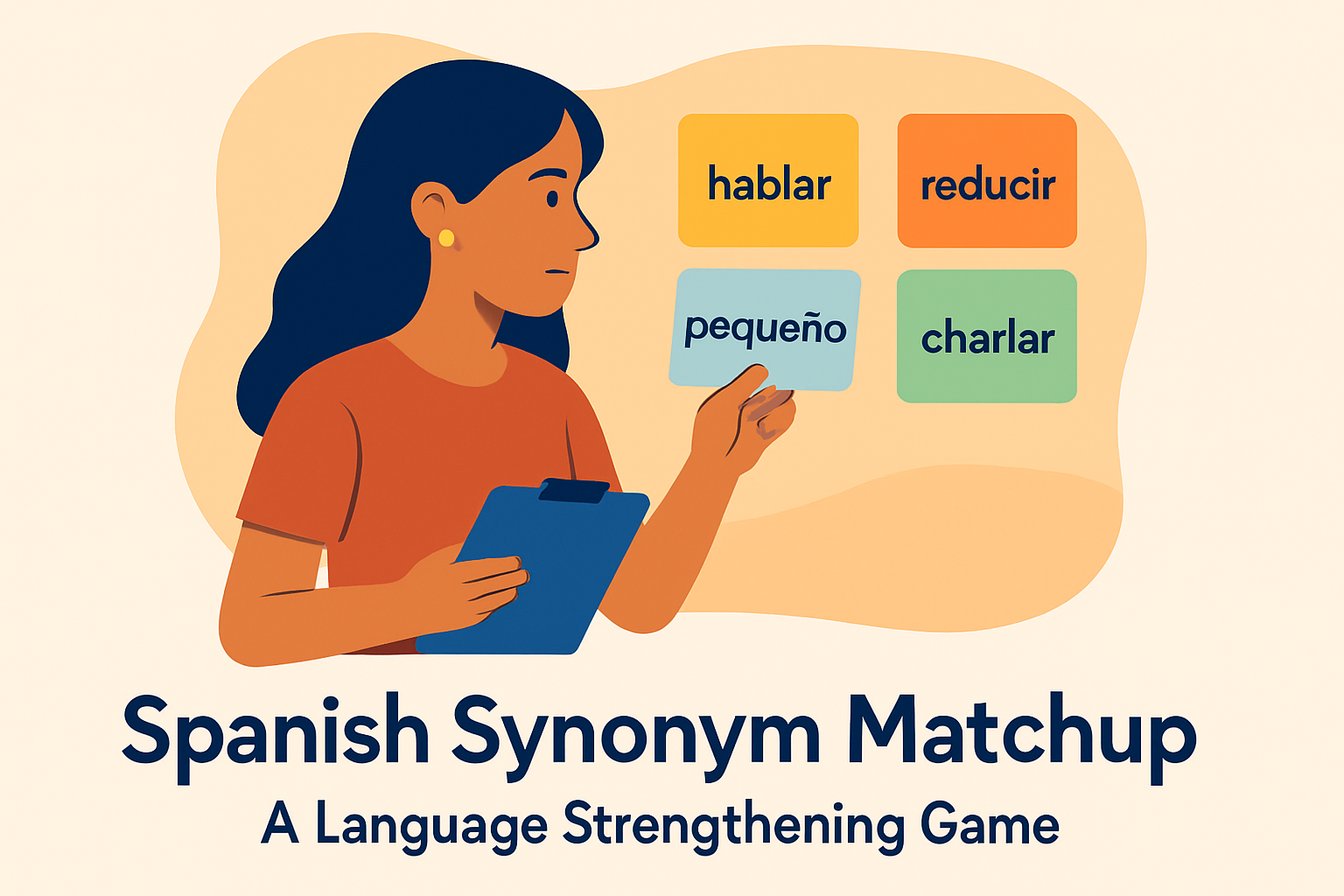
The gameplay is structured to enhance learning through engagement. It is an interactive activity that can be played individually or in groups, both of which offer unique benefits. The game begins with a list of Spanish words on one side and their synonyms mixed in a jumbled order on the other. The task is to correctly match these words with their appropriate synonyms. Let’s break this process down to see what it entails:
- Start with a curated list of common Spanish words suitable for your proficiency level.
- Mix these words with an equal number of their synonyms.
- Attempt to match each word with its correct synonym, keeping track of the reasoning for each match.
- Reflect on any new discoveries or insights gained during the game.
- Repeat the process regularly with new sets of words to strengthen language skills.
The game tactically emphasizes active recall and critical thinking. As learners progress, they’re encouraged to explore advanced words, pay more attention to nuanced meanings, and use synonyms contextually. To illustrate, below is an example that captures the essence of one round of the matchup game:
| Spanish Word | Meaning | Synonym |
|---|---|---|
| Hablar | To Speak | Conversar |
| Comenzar | To Start | Iniciar |
| Difícil | Difficult | Complicado |
| Bello | Beautiful | Hermoso |
Real-world Applications of Synonym Mastery
Understanding synonyms isn’t just an academic exercise; it’s an essential component of effective real-world communication. Imagine being in a business meeting where linguistic precision is crucial; having a repertoire of synonyms enables nuanced discussions and can prevent miscommunication. In written communication — such as writing an essay or a professional email — the ability to select the most fitting synonym enriches your expression and can leave a strong impression.
Consider a scenario where you are reading a Spanish novel. The author’s choice of synonyms paints scenes vividly, and a strong grasp of these words enriches your reading experience. If you’re listening to Spanish music, appreciating the synonymic play can deepen the emotional impact of the lyrics. Moreover, whether you’re in a Spanish-speaking country or conversing with Spanish speakers, understanding and using synonyms can make conversations more natural and relatable.
Benefits of Utilizing Games in Language Acquisition
Game-based learning has become a popular educational approach, especially in language acquisition. It shifts the focus from traditional rote learning to interactive, enjoyable experiences that promote active engagement. The Spanish Synonym Matchup game embodies this method, tapping into several benefits:
- Increased Motivation: The gamified approach keeps interest levels high, helping overcome the monotony often associated with language practice.
- Reinforced Memory: By associating words with their synonyms dynamically, learners reinforce their memory pathways, improving retention.
- Immediate Feedback: Players receive instant feedback on their performance, allowing them to adjust their strategies and learn from mistakes.
- Collaborative Learning: When played in groups, it promotes peer learning and healthy competition, fostering a collaborative environment.
- Adaptability: The game can be easily modified to suit individual learning levels, ensuring that everyone is challenged appropriately.
By transforming language practice into a stimulating game, learners can internalize synonym recognition, making them more adept speakers, readers, and writers in Spanish. Coupling this with real-world usage further cements the knowledge and ensures applicability across diverse contexts.
Building a Robust Vocabulary Through Synonym Familiarity
Developing a wide-ranging vocabulary is crucial for Spanish learners, and becoming familiar with synonyms is a powerful way to do so. When learners engage with synonyms, they effectively double their word bank while simultaneously fine-tuning their understanding of each word’s unique context and implications.
The Spanish Synonym Matchup game is pivotal in this growth. By transforming vocabulary learning from memorizing lists into recognizing relationships between words, learners enhance both their active and passive vocabularies. This means they not only understand more words when they encounter them, but they can also use more words accurately in speech and writing.
To further illustrate, consider how synonyms contribute to describing emotions — instead of only using “triste” to express sadness, learners also familiarize with “afligido” or “desalentado,” each adding a subtlety to emotional expression. In practice, the richness of language usage is evident as learners become more articulate and proficient in Spanish.
Conclusion: The Road Ahead with Synonym Mastery
In conclusion, synonym mastery through games like the Spanish Synonym Matchup provides a multifaceted approach to language learning. It not only enriches vocabulary but also sharpens understanding of contextual nuances. By engaging in this interactive form of learning, learners can quickly transition from basic proficiency to more nuanced language skill levels.
The key takeaway from this exploration is clear: integrating synonym practice into your Spanish learning routine can significantly boost your communication capabilities. It allows for a more dynamic, responsive way of learning that can be seamlessly transitioned from the game environment into real-world application.
If you are ready to enhance your Spanish proficiency, start incorporating the Spanish Synonym Matchup game into your study sessions. Consistent practice will yield noticeable improvements, making your language journey not just educational but also incredibly enjoyable. Commit to this approach, and watch your skills flourish.
Frequently Asked Questions
1. How does the Spanish Synonym Matchup game help improve my language skills?
The Spanish Synonym Matchup game enhances your language skills by deepening your understanding of Spanish vocabulary and its nuances. By learning synonyms, you expand your vocabulary and improve your ability to express thoughts more precisely and vividly. This game challenges you to identify words with similar meanings, thereby reinforcing your memory and comprehension. When you know several synonyms for a single word, it allows you to choose the most appropriate word depending on the context, which makes your communication more effective and engaging. It’s like adding more colors to your palette in painting; having more options allows you to express your creativity more profoundly and accurately.
2. Why is mastering synonyms important in learning Spanish?
Mastering synonyms in Spanish is crucial because it helps you understand the diversity and richness of the language. Spanish, like any language, has multiple words that can be used to express the same or similar ideas, but each comes with slightly different nuances and connotations. Grasping these differences allows you to tailor your language use to suit different situations, audiences, or moods. It also aids in reading comprehension; many Spanish texts use a wide range of vocabulary, and understanding synonyms means you’re less reliant on dictionaries, making reading more enjoyable and less interrupted. Furthermore, it gives you an edge in fluency, as you can choose the most fitting word spontaneously in conversations, making you sound more like a native speaker.
3. How is the game structured, and what can I expect while playing?
The Spanish Synonym Matchup game is structured in a way that allows players to engage with the language interactively and enjoyably. Typically, the game presents you with a list of words, challenging you to match each one with its synonym from another list. Some versions of the game may include multiple choice questions, flashcards, or timed challenges to keep you on your toes and test your speed and accuracy. As you progress through different levels or rounds, the complexity of the words increases, requiring more thought and helping to gradually build your skills. The game often includes fun elements like points, badges, or levels that add a gamified layer to learning, making the process motivational and rewarding.
4. Can playing this game alone significantly enhance my Spanish language proficiency?
While the Spanish Synonym Matchup game is a valuable tool for building vocabulary and understanding word nuances, relying solely on this game is unlikely to lead to comprehensive language proficiency. A well-rounded approach to learning Spanish should include a variety of methods, such as grammar exercises, writing practice, conversation with native speakers, listening to Spanish media, and reading Spanish literature. However, incorporating this game into your routine can significantly enhance specific language skills, particularly your vocabulary and comprehension capabilities. It aids in reinforcing what you’ve learnt through other methods by providing practice in a fun and engaging way. Essentially, it’s one of the layers of learning that, combined with other techniques, can lead to holistic Spanish language mastery.
5. What age or proficiency level is appropriate for playing the Spanish Synonym Matchup game?
The Spanish Synonym Matchup game is suitable for a wide range of age groups and proficiency levels. For younger learners or beginners, simpler versions of the game use basic vocabulary and straightforward synonym pairs, allowing these players to build foundational skills. For intermediate to advanced learners, the game is typically designed with more complex vocabulary and challenging synonyms, encouraging deeper learning and engagement. For adults or those at an advanced proficiency level, some versions of the game incorporate nuanced or rarely-used synonyms, helping to fine-tune language skills and fluency. Ultimately, regardless of your starting point, there’s likely a version of the game suited to your current level, ensuring it remains challenging and beneficial as you progress in your learning journey.