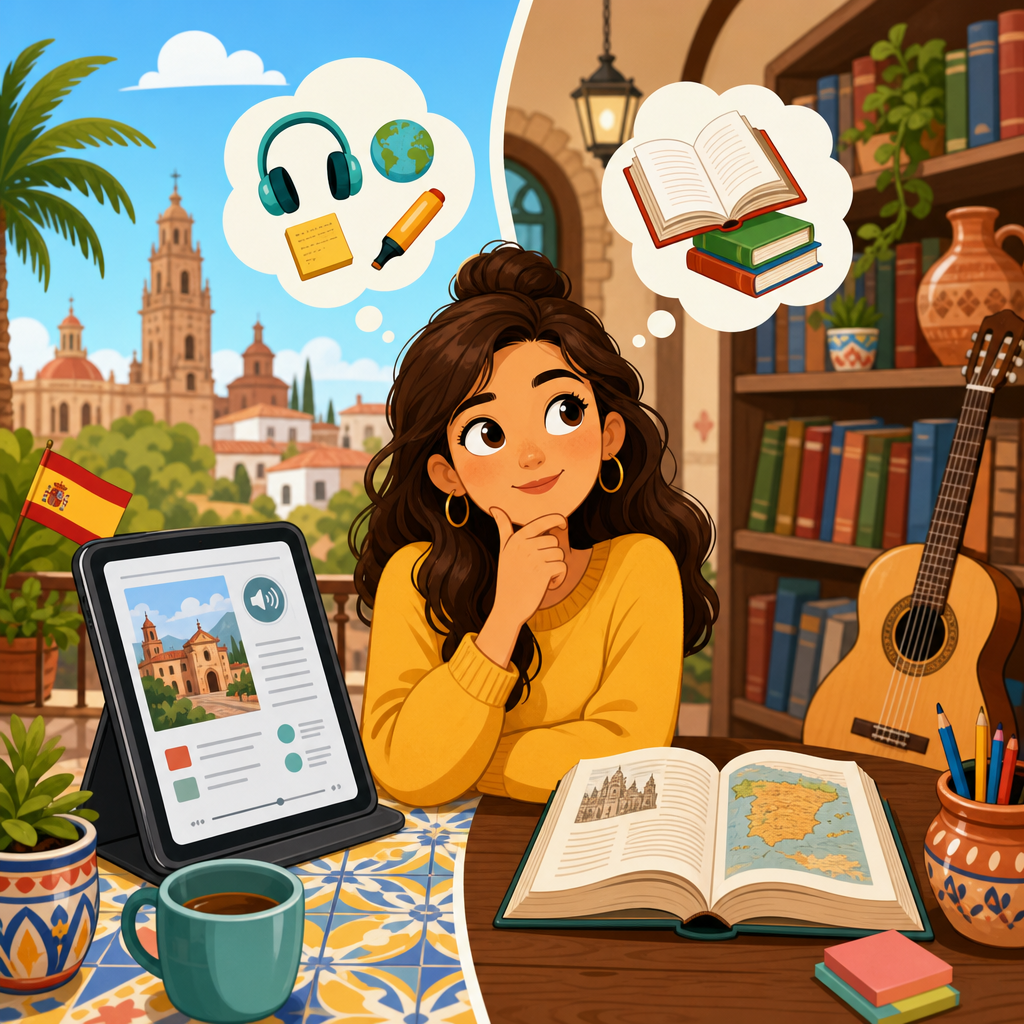
Choosing between e-books and traditional books for learning Spanish is not a minor preference issue; it shapes how you study, review, retain vocabulary, and stay motivated over months of practice. In language learning, format affects behavior. An e-book is a digital text read on a phone, tablet, e-reader, or computer, often with built-in search, highlighting, dictionaries, and audio support. A traditional book is a printed text, workbook, reader, grammar reference, or novel used in physical form. Both can teach Spanish effectively, but they do so through different strengths. I have used both with adult beginners, heritage learners, and advanced students preparing for travel, exams, and bilingual workplaces, and the pattern is consistent: the better format is the one that supports your specific learning task.
This matters because Spanish learners rarely use only one type of material. They move between grammar explanations, graded readers, flashcards, children’s stories, novels, subtitles, conversation notes, and community resources. A hub page on this miscellaneous area has to answer the practical question behind the title: when should you choose digital, when should you choose print, and how do both connect to wider Spanish community and interaction goals? The answer is not ideological. It depends on attention span, screen tolerance, note-taking style, access to native content, reading level, and whether you learn alone or alongside tutors, classmates, or language exchange partners.
Spanish also presents specific challenges that make format choice important. Learners need repeated exposure to accent marks, verb conjugations, gender agreement, punctuation such as inverted question marks, and region-specific vocabulary. They often need quick dictionary checks, but they also need slow, uninterrupted reading to build comprehension. Some learners benefit from searchable digital text when tracking a verb like quedar across contexts. Others retain more when underlining passages by hand in a printed graded reader. Understanding these tradeoffs helps you spend money wisely, build better habits, and create a study system that supports real communication rather than passive collecting of resources.
What e-books do especially well for Spanish learners
E-books are strongest when speed, portability, and instant support matter. If you read Spanish on Kindle, Apple Books, Google Play Books, Kobo, or a reading app tied to a subscription service, you can usually tap an unfamiliar word for a definition or translation, search every instance of a phrase, resize text, and carry dozens of books without physical weight. For students who study during commutes, lunch breaks, or travel, that convenience often means more total reading time each week. More reading time usually beats the romantic appeal of a shelf full of unused books.
Digital text is particularly helpful in the early and intermediate stages, when interruptions are frequent because vocabulary gaps are still large. A beginner reading a short Spanish story may need to confirm whether lleva means “carries,” “wears,” or “has been doing” in context. In a paper book, that check breaks flow. In an e-book, it takes seconds. Over time, fewer interruptions make learners more willing to tackle authentic material. I have seen hesitant students move from textbook dialogues to light news articles and young adult fiction sooner because digital support lowered the friction.
Search is another major advantage. Spanish verbs and idiomatic expressions repeat across chapters. If a learner wants to review every occurrence of por fin, se puso, or the preterite endings in a chapter, e-books make pattern spotting easy. That matters because noticing recurring structures is one of the fastest ways to turn passive exposure into active knowledge. Digital highlights are also exportable in many platforms, which means you can turn reading notes into vocabulary lists, conversation prompts, or tutoring questions without retyping everything.
Cost and access can also favor e-books. Public libraries increasingly offer Spanish titles through OverDrive’s Libby app, Hoopla, and regional digital collections. Learners can sample graded readers, bilingual editions, cookbooks, children’s books, and contemporary novels with little or no added expense. If you are exploring dialects, digital stores make it easier to buy authors from Mexico, Spain, Argentina, Colombia, or the United States without waiting for shipping or paying import prices. That broader access is valuable in a community-oriented learning path because Spanish is not one monolithic variety.
Where traditional books still outperform digital reading
Printed books remain superior for deep focus, long reading sessions, and tactile annotation. Many learners report, correctly, that they remember page location, chapter position, and margin notes better on paper. Research on print versus screen reading has repeatedly shown that comprehension differences are often small for short texts but can widen for longer, denser reading, especially when readers skim more on screens. In Spanish study, where a single paragraph may contain unfamiliar tense shifts or pronoun placement, that deeper attention can matter a lot.
Physical books also create fewer temptations. A phone reading app competes with messages, social media, email, and browser tabs. Even on a dedicated e-reader, a digital environment can encourage quick dictionary tapping instead of inference from context. A printed graded reader or workbook forces slower processing. That slower pace is not always bad. For beginners working through adjective agreement or stem-changing verbs, writing notes in the margins, circling transitions, and flipping back to earlier pages can support stronger retention than tapping through pop-up definitions.
Print is also more reliable for structured study. Grammar references, verb manuals, exam prep books, and teacher-designed workbooks are often easier to use in physical form because you can spread materials out, compare pages, insert sticky notes, and move rapidly between exercises and answer keys. In classes and tutoring sessions, printed pages reduce technical friction. When I work with students on reading aloud, pronunciation markings, or syntax drills, paper often leads to better engagement because learners can physically track lines, jot IPA-style cues, and mark stress patterns.
There is also a practical social dimension. Physical books are easier to lend, display, bring to a study group, or use in a shared family setting. A parent teaching children basic Spanish through picture books usually gets more interactive value from print because both people can point, pause, and talk naturally around the page. In community spaces such as book clubs, church groups, local libraries, and bilingual meetup circles, printed books still function as visible anchors for discussion and accountability.
How the best format depends on your learning goal
The smartest way to choose is by matching format to task. If your goal is extensive reading, meaning large amounts of understandable Spanish for fluency and confidence, e-books have a clear edge because they reduce friction and travel easily. If your goal is intensive reading, meaning close analysis of vocabulary, grammar, and style, print often wins because it supports concentration and handwritten annotation. Learners who confuse these tasks usually end up frustrated, either overanalyzing every page of a digital novel or trying to carry five heavy grammar books around town.
For vocabulary acquisition, e-books help with quick lookups and repeated phrase searches, while traditional books help with memory through physical note placement and deliberate review. For pronunciation-linked reading, digital materials that include synchronized audio can be powerful, especially for shadowing short dialogues. For exam preparation, print often feels better because timed practice, answer checking, and error marking are easier on paper. For pleasure reading in Spanish, the better format is the one you will return to consistently after a tiring workday.
| Learning Goal | Better Default Format | Why | Best Example |
|---|---|---|---|
| Extensive reading | E-book | Portable, searchable, low-friction dictionary access | Reading graded readers during a commute |
| Grammar study | Traditional book | Easier annotation and page comparison | Working through a verb workbook |
| Vocabulary review | Mixed | Digital for lookup, print for retention notes | Highlight in app, rewrite in notebook |
| Book clubs and tutoring | Traditional book | Shared reference points and simpler discussion | Local Spanish reading circle |
| Travel and casual study | E-book | Many titles in one device | Reading on a phone while abroad |
Most serious learners eventually land on a hybrid system. They use e-books for volume and access, then rely on print for difficult material they want to master. That is the approach I recommend most often because it reflects real study behavior instead of forcing an all-or-nothing choice.
Spanish-specific factors learners often overlook
Not all language study behaves like general reading. Spanish learners need to pay attention to orthography, morphology, register, and regional variation. E-books can support this by making it easy to search accent-marked forms such as sí versus si, or formal and informal commands across a text. They also help when comparing variants like ordenador and computadora, coger and tomar, or vosotros and ustedes. If your goal includes interaction with speakers from multiple countries, digital breadth is a real advantage.
Printed books, however, often shine when visual structure matters. Conjugation tables, sentence diagrams, and side-by-side explanations of ser versus estar or por versus para are easier to absorb in a stable physical layout. Many learners underestimate how much screen fatigue affects their ability to notice endings like -aba, -aron, or clitic combinations such as dímelo. On paper, the eye tracks differently, and learners often catch details they skim past on screens.
Another overlooked issue is rights and formatting quality. Some Spanish e-books are excellent, but others suffer from bad OCR, broken accents, awkward line breaks, or missing illustrations. This is especially common with older public-domain texts or cheaply converted files. Before buying, preview the sample and confirm that punctuation, chapter navigation, and dictionary support work correctly. In print, quality problems usually show up as small type, weak binding, or poor paper, but they are easier to spot before purchase.
Finally, consider audio integration. Some digital Spanish readers and apps pair text with narration, which is valuable for building listening-reading connections. If you struggle to map spoken Spanish to written forms, that feature can accelerate progress. Traditional books can still work with separate audiobooks, but the setup is less seamless. For learners targeting conversation, that difference matters because reading alone does not guarantee usable spoken comprehension.
How this choice fits into Spanish community and interaction
This miscellaneous hub sits under Spanish community and interaction for a reason: books are not only private study tools. They are bridges into real participation. A well-chosen e-book can connect you to online annotation groups, digital book clubs, Discord study servers, tutor homework, and articles shared in messaging communities. A printed book can anchor in-person meetups, family reading routines, church classes, library circles, and neighborhood exchange groups. The format you choose affects not just how you read, but how easily you discuss what you read with other people.
In practice, e-books are often better for distributed communities. If a teacher, tutor, or language partner lives in another city or country, everyone can buy or borrow the same digital title instantly. You can quote chapter passages, copy sentences into messages, and keep highlights synchronized across devices. This lowers participation barriers. I have seen online Spanish reading groups maintain momentum for months because members could join from different time zones without waiting for printed copies to arrive.
Traditional books often create stronger commitment in local communities. When learners physically bring the same novel or workbook to a café meetup, pages become shared landmarks: “look at the second paragraph on page 47” is faster than negotiating app versions. Print also encourages slower, richer conversations because participants are less likely to disappear into devices. For community-based learning, that social texture matters. People return when meetings feel human, not merely efficient.
If you are building a broader Spanish ecosystem, connect your reading format to complementary resources. Pair e-books with online tutoring, digital flashcards, and article-sharing groups. Pair printed books with conversation circles, handwritten journals, and local classes. Internal progression across these materials matters more than loyalty to one medium. What counts is whether your reading feeds speaking, listening, writing, and interaction with actual people.
Best practices for choosing, buying, and using both formats
Start with a simple audit. Ask how you actually study, not how you wish you studied. If most of your reading happens in short bursts, buy e-books first. If you reliably sit at a desk for forty-five minutes with a notebook, invest in print. Next, separate resource categories. Use digital for novels, graded readers, and portable reference checks. Use print for grammar books, workbooks, and any title you expect to annotate heavily. This alone prevents expensive duplication.
Choose tools carefully. For e-books, favor platforms with strong Spanish dictionary support, stable highlighting, and note export. Kindle is convenient, but test whether the embedded dictionary handles inflected forms well enough for your level. Libby is excellent for library borrowing. For print, look for publishers known in language learning, such as Difusión, Edelsa, Routledge, Barron’s, Practice Makes Perfect, and graded reader series from reputable educational presses. A good edition matters more than a famous cover.
Use a deliberate workflow. When reading digitally, limit dictionary taps, highlight only high-value phrases, and review notes within twenty-four hours. When reading in print, mark patterns, not every unknown word. Translate less and infer more. If a chapter is hard, read once for gist and again for detail. If you join a Spanish book club or conversation group, prepare three discussion points from each reading session so the book becomes a springboard for interaction, not a private archive of highlighted sentences.
The strongest learners do not ask which format is universally better. They ask which format removes friction, improves recall, and increases meaningful contact with Spanish this week. For many people, the answer will be both. Use e-books to read more widely, access more dialects, and keep Spanish close at hand every day. Use traditional books to slow down, think deeply, and build a durable study routine. If you are refining your Spanish community and interaction system, choose one digital title and one printed resource that serve different purposes, then use them consistently for the next month.
Frequently Asked Questions
Which is better for learning Spanish: e-books or traditional books?
Neither format is universally better for every learner, because the right choice depends on how you study, what level of Spanish you are working on, and what helps you stay consistent over time. E-books are often better for convenience, speed, and interactive support. Many digital Spanish learning books include built-in dictionaries, search tools, highlighting, bookmarking, note-taking, and sometimes even audio features. That makes them especially useful for beginners and lower-intermediate learners who need quick help with vocabulary, verb forms, and pronunciation without interrupting their reading flow.
Traditional books, on the other hand, are often better for focus, deep reading, and long study sessions without digital distractions. Many learners remember grammar notes, vocabulary lists, and reading passages more clearly when they interact with printed pages. A physical workbook or grammar reference can also make it easier to write in margins, flip between sections, and create a stronger sense of progress. If you tend to get distracted on your phone or tablet, a printed Spanish book may support better concentration and retention.
For most learners, the strongest approach is not choosing one format exclusively, but using each for its strengths. An e-book can be ideal for reading on the go, reviewing vocabulary quickly, and accessing Spanish texts anywhere. A traditional book can be ideal for structured grammar study, written exercises, and focused reading practice. In practical terms, e-books often improve access and efficiency, while traditional books often improve attention and discipline. The best format is the one that helps you study more regularly and more effectively.
Are e-books better for building Spanish vocabulary?
E-books can be extremely effective for vocabulary building because they reduce the friction involved in looking up unknown words. When you are reading in Spanish and encounter unfamiliar vocabulary, a digital book often lets you tap a word for an instant definition, translation, or dictionary entry. This keeps you moving through the text instead of stopping repeatedly to use a separate dictionary. That smoother reading experience matters, because frequent interruption can break concentration and reduce motivation.
Search functions also make e-books powerful for vocabulary review. If you want to revisit every time a certain verb, phrase, or grammar pattern appeared in a text, digital search makes that easy. Highlighting features can help you mark useful expressions, idioms, transition words, and recurring sentence structures. Some platforms even allow color-coding or exporting notes, which can support more organized vocabulary study. If the e-book includes audio, it adds another advantage: you can connect spelling, meaning, and pronunciation at the same time.
That said, traditional books still have real advantages for vocabulary retention. Many learners remember words better when they manually write them down, underline them, or create handwritten flashcards from what they read. The physical act of note-taking often strengthens memory. A printed Spanish reader may also encourage slower, more deliberate reading, which can improve depth of processing. In other words, e-books may help you notice and access more vocabulary quickly, while printed books may help some learners remember that vocabulary more deeply. If vocabulary growth is your main goal, a combined method works especially well: use an e-book for discovery and fast lookup, then transfer the most useful words into handwritten notes or a spaced review system.
Do traditional books help with focus and long-term retention when studying Spanish?
Yes, for many learners they do. Traditional books often create a study environment with fewer distractions, and that alone can improve focus. When you are reading a printed Spanish text, there are no notifications, app switches, browser tabs, or battery concerns competing for attention. This matters more than many people realize, because language learning depends on repetition, concentration, and steady mental engagement. If your study sessions are constantly interrupted, your retention usually suffers.
Printed books can also support stronger spatial memory. Learners often remember that a grammar explanation was near the top of a page, or that a vocabulary list appeared on the left side of a chapter opening. That physical sense of location can make review easier. In addition, writing notes in margins, circling endings, underlining verb patterns, and physically flipping back to previous sections can create a more active relationship with the material. This is especially useful in Spanish, where noticing patterns such as gender agreement, verb conjugations, and sentence structure is essential.
Long-term retention is not guaranteed by print alone, but traditional books often make it easier to study intentionally. A printed workbook invites written practice. A grammar book encourages slow review. A physical reader can make extensive reading feel more immersive. These factors can support better memory, especially for learners who benefit from tactile learning and structured routines. If you are serious about building durable Spanish skills over months rather than just consuming content quickly, traditional books remain one of the most reliable tools available.
When should Spanish learners choose e-books instead of print books?
Spanish learners should strongly consider e-books when portability, flexibility, and quick support matter most. If you study during commutes, lunch breaks, travel, or short windows throughout the day, a digital format is often the more practical choice. Carrying several Spanish resources on one device makes it easier to maintain daily contact with the language, and consistency is one of the biggest predictors of progress. An e-book also makes sense if you live in an area with limited access to Spanish learning materials or want immediate access to graded readers, grammar references, bilingual texts, and native content.
E-books are also especially useful for learners who read above their comfort level and need regular help. Beginners and intermediate learners often face constant vocabulary gaps. Instant dictionary support can make native or semi-authentic Spanish texts more approachable and less frustrating. If your goal is to read more and quit less, digital assistance can be a major advantage. Features like adjustable font size, built-in lighting, audio synchronization, and text search can also improve accessibility and make study more comfortable.
Another good reason to choose e-books is review efficiency. Digital annotations are easy to organize, search, and revisit. If you like tracking phrases, collecting example sentences, or reviewing repeated grammar forms, e-books can streamline that process. They are also useful for learners who already use digital flashcards, note apps, or online tutoring platforms and want all study materials in one ecosystem. In short, e-books are usually the better option when convenience, instant support, and frequent mobile study are central to your learning strategy.
Is it best to combine e-books and traditional books for learning Spanish?
Yes, in many cases a hybrid approach is the smartest and most sustainable option. E-books and traditional books solve different problems, and Spanish learners often make faster progress when they use both intentionally. A digital format can help you read more often, look up words faster, and fit Spanish into busy daily routines. A print format can help you slow down, concentrate, complete exercises, and retain information more deeply. Rather than seeing the two as competitors, it is more useful to treat them as complementary tools.
For example, you might use an e-book reader for graded readers, short stories, or native texts during the week, especially when you want quick dictionary access and portability. Then you might use a printed grammar workbook on weekends for focused practice with verb tenses, sentence patterns, and written exercises. You could also read a Spanish novel digitally for convenience while keeping a printed notebook or workbook for vocabulary review and composition practice. This combination allows you to benefit from digital speed without losing the cognitive advantages of paper-based study.
The key is to match the format to the task. Use e-books for access, frequency, and reading flow. Use traditional books for structure, memorization, and distraction-free study. If you build a system around that distinction, you are more likely to stay motivated and cover all major learning areas, including vocabulary, grammar, reading comprehension, and written production. For most learners, the best answer is not e-books versus traditional books, but how to use both formats strategically to make Spanish study easier to maintain and more effective over the long term.