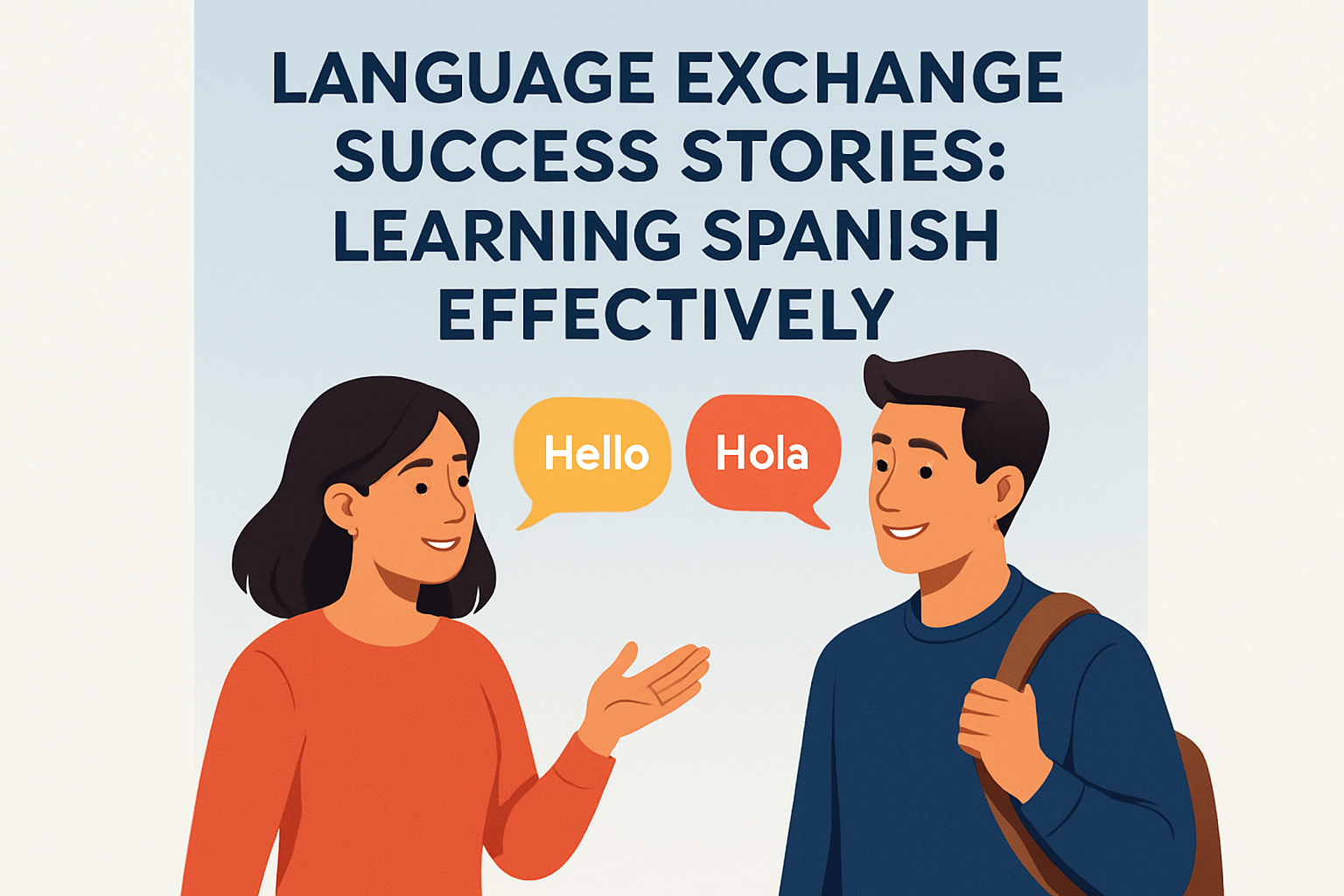
Language exchange success stories prove that learning Spanish effectively depends less on perfect textbooks and more on consistent, meaningful interaction with real people. A language exchange is a structured arrangement in which two speakers help each other practice their target languages, usually by splitting time between both languages and correcting each other in context. Within Spanish community and interaction, language exchange opportunities include in-person meetups, online conversation platforms, tutor-guided exchange groups, university clubs, workplace programs, and local cultural events where Spanish is spoken naturally. This topic matters because Spanish learners often reach a plateau: they know grammar rules, recognize common vocabulary, and can complete app lessons, yet freeze during real conversation. I have seen that gap repeatedly when helping learners move from classroom Spanish to confident communication. The students who improve fastest are rarely the ones memorizing the most isolated words. They are the ones speaking regularly, negotiating meaning, making mistakes, receiving feedback, and hearing how native speakers actually express ideas. Language exchange accelerates that process by turning Spanish from a subject into a social skill. It builds listening endurance, pronunciation accuracy, cultural understanding, and the confidence to speak without translating every sentence. For learners searching for language exchange opportunities, the challenge is not whether exchange works. The real question is how to choose the right format, find reliable partners, set expectations, and turn casual chats into measurable progress. This hub article explains the main options, common mistakes, proven structures, and real-world success patterns that make language exchange one of the most effective ways to learn Spanish.
Why Language Exchange Works for Spanish Learners
Language exchange works because Spanish is a living system of sounds, rhythms, and social cues that cannot be mastered through passive study alone. In practice, learners improve when they are pushed to retrieve words quickly, follow natural speech at normal speed, and react in real time. That combination develops procedural knowledge, which is the ability to use language automatically rather than merely recognize it on a page. Spanish especially rewards this kind of practice because common conversational features such as dropped subjects, regional vocabulary, rapid connected speech, and flexible word order are hard to internalize from drills alone.
I have watched beginners gain confidence after just a few weeks of well-structured exchange sessions. One learner could conjugate the present tense perfectly in writing but hesitated whenever asked a simple question like, “¿Qué hiciste este fin de semana?” Once she began weekly exchanges with a partner from Medellín, she stopped building sentences word by word and started answering in chunks. Her fluency improved not because she learned every grammar rule in advance, but because repeated conversation forced recall, pattern recognition, and adaptation. That is how real speaking ability develops.
There is also a motivation advantage. Many students abandon Spanish because solo study feels abstract. A partner creates accountability, curiosity, and emotional relevance. When learners discuss work, family, travel, food, politics, or daily routines, vocabulary becomes memorable because it is tied to a real interaction. This is why language exchange opportunities are often more effective than additional worksheets for intermediate learners.
Types of Language Exchange Opportunities
Not all language exchange opportunities produce the same results. The best format depends on your level, schedule, confidence, and goals. In-person exchange is often strongest for beginners and lower intermediates because body language, shared context, and social warmth make comprehension easier. Community centers, libraries, universities, and bilingual meetups commonly host Spanish-English conversation circles. These settings reduce pressure and expose learners to multiple accents.
Online exchange offers broader access and is often the best choice for learners who want regular contact with native speakers from specific regions. Apps such as Tandem and HelloTalk connect users for text, voice notes, and video calls. Conversation communities on Meetup, Discord, and Facebook groups can also be effective if they are moderated well. The key benefit is frequency. A learner in a small town can still practice with speakers from Mexico City, Bogotá, Madrid, or Buenos Aires several times a week.
Structured exchange groups sit between informal chat and formal instruction. Some language schools and tutors run paired conversation sessions with prompts, correction guidelines, and rotation systems. These are useful for learners who want support without paying for private lessons every time. Workplace exchange programs are another overlooked option, especially in healthcare, hospitality, construction, education, and public service, where bilingual communication has direct practical value.
| Format | Best For | Main Benefit | Common Limitation |
|---|---|---|---|
| In-person meetup | Beginners, social learners | Strong context and body language support | Limited scheduling and local availability |
| App-based exchange | Busy learners, rural learners | Frequent contact with native speakers | Inconsistent partner commitment |
| Tutor-guided exchange | Learners wanting structure | Clear correction and balanced speaking time | Higher cost than free exchanges |
| University or community group | Students and regular attendees | Reliable routine and varied partners | Mixed proficiency levels |
| Workplace exchange | Professionals needing practical Spanish | Relevant vocabulary in real situations | Narrow topic range |
How to Find the Right Spanish Exchange Partner
A good exchange partner is not simply a native Spanish speaker. The best partner is consistent, patient, curious, and willing to maintain balance between both languages. Many unsuccessful exchanges collapse because one person wants free tutoring, one person dominates the conversation, or neither person sets a clear format. When I evaluate whether a partnership will work, I look for three signs: reliable scheduling, similar seriousness about improvement, and compatible conversation styles.
Start by choosing a partner whose goals overlap with yours. If you need speaking confidence for travel, a relaxed social partner may be ideal. If you need Spanish for work, look for someone comfortable role-playing practical situations. If your goal is pronunciation, choose a partner willing to use voice notes, repeat phrases slowly, and explain sound differences. Region matters too. Spanish from Spain, Mexico, Colombia, Argentina, and other countries differs in vocabulary, pronunciation, and usage. There is no single correct accent, but you should know which varieties are most relevant to your goals.
Before committing, exchange a few messages or a short call to test compatibility. Agree on session length, language split, correction style, and preferred platform. I usually recommend a simple rule: thirty minutes in Spanish, thirty minutes in English, with corrections focused on recurring errors rather than every minor mistake. That keeps conversation flowing while still producing useful feedback. Reliable language exchange opportunities are built on clarity, not guesswork.
What Successful Exchange Sessions Look Like
The most effective language exchange sessions are planned enough to create progress but flexible enough to feel natural. Learners often assume spontaneous conversation is always best, yet completely unstructured sessions can drift into easy topics, repeated vocabulary, and one-sided speaking. A better approach is to set one communication goal per meeting. For example, one session may focus on talking about past experiences, another on giving opinions, and another on describing routines or work processes.
A practical session structure starts with five minutes of warm-up, followed by a focused topic with targeted vocabulary, then a short recap of corrections and new phrases. If both partners are serious, keep a shared document with recurring mistakes, expressions, and follow-up topics. Google Docs works well for this. For pronunciation practice, voice notes on WhatsApp or Telegram are useful because learners can replay difficult phrases. For live calls, Zoom and Google Meet offer stable audio and screen sharing for prompts or visual aids.
Correction should be selective. If a learner is explaining a story, interrupting every sentence damages fluency and confidence. Instead, note major errors involving tense, word choice, or pronunciation patterns and review them after the speaker finishes. I have found that learners improve faster when partners reformulate naturally. If the learner says, “Yo fui en la tienda,” a partner can reply, “Ah, fuiste a la tienda. ¿Qué compraste?” That method provides correction in context without shutting down the conversation.
Real Success Stories and the Patterns Behind Them
Success stories in language exchange are usually less dramatic than viral “learned Spanish in three months” claims, but they are far more instructive. One adult learner I worked with had studied Spanish on and off for years and could read news articles reasonably well, yet she avoided speaking with her in-laws from Mexico. Her breakthrough came after joining a weekly online exchange with two native speakers and one other learner. They discussed the same broad themes every month—family, food, holidays, work, health, and childhood memories—but from new angles each time. After four months, she was not flawless, but she could hold family conversations without rehearsing every sentence.
Another learner was a nurse who needed Spanish for patient intake. General conversation exchanges helped somewhat, but progress accelerated only when he switched to scenario-based sessions. He practiced symptoms, instructions, dates, medications, and follow-up questions with a partner from Peru who worked in healthcare administration. Because the exchange matched his real-world needs, vocabulary retention improved and hesitation dropped. That is a consistent pattern: relevance increases fluency.
A university student preparing for a semester in Spain improved listening dramatically through short, frequent exchanges rather than one long weekly call. She sent daily voice notes, received corrections, and completed two twenty-minute video calls each week. The volume of contact mattered. Language exchange opportunities succeed when they create repetition, accountability, and emotionally meaningful communication over time.
Common Mistakes That Limit Progress
The biggest mistake in language exchange is treating conversation as proof of learning rather than a tool for learning. Casual chatting can feel productive while reinforcing the same limited vocabulary and familiar sentence patterns. To avoid that plateau, learners need rotating topics, deliberate review, and periodic challenge. Another common mistake is choosing a partner solely based on friendliness. A pleasant conversation partner is valuable, but if scheduling is unreliable or the language balance is poor, progress slows quickly.
Many learners also overcorrect the wrong things. Obsessing over every rolled r or tiny accent detail too early can create anxiety. Pronunciation matters, but intelligibility comes first. Focus first on vowel clarity, stress patterns, and high-frequency sounds that affect comprehension. Grammar presents a similar tradeoff. You do not need to master every subjunctive use before speaking, but you do need enough feedback to avoid fossilizing repeated errors.
Another mistake is failing to track progress. If you never record what you discussed, what corrections you received, or which phrases you want to reuse, each session starts from zero. The strongest learners maintain a running list of useful expressions, reviewed mistakes, and unanswered questions. That simple habit turns language exchange from social practice into a structured learning system.
How This Hub Supports Deeper Spanish Community Learning
As a hub within Spanish community and interaction, this page should guide learners toward the full range of language exchange opportunities rather than present exchange as a single method. Some learners need advice on finding local Spanish conversation groups. Others need help choosing between text chat and live calls, navigating accent differences, setting correction rules, or preparing conversation topics. Still others want support for professional Spanish, travel Spanish, or building confidence before joining a bilingual community event.
The core principle across all related resources is simple: effective Spanish grows through repeated interaction with real people in real contexts. Vocabulary lists, grammar study, and listening practice remain important, but they become far more useful when tied to actual conversations. That is why learners benefit from exploring adjacent topics such as conversation prompts, cultural etiquette, online exchange apps, community meetup strategies, pronunciation support, and maintaining long-term speaking habits. Together, these resources create a practical pathway from isolated study to active participation in Spanish-speaking communities.
If you want to learn Spanish effectively, start by choosing one exchange format, one realistic schedule, and one clear communication goal. Commit for eight weeks, track what happens, and adjust based on results. The success stories are consistent: learners improve when they speak often, listen carefully, accept correction, and build relationships through language. Use this hub as your starting point, then take the next step into regular Spanish interaction today.
Frequently Asked Questions
What makes language exchange so effective for learning Spanish compared with studying alone?
Language exchange works so well because it turns Spanish from something you study into something you actually use. Many successful learners discover that progress accelerates when they stop treating the language as a list of grammar rules and vocabulary sets and start using it in real conversations with real people. In a structured exchange, each person supports the other’s target language goals, often dividing time equally between Spanish and the partner’s native language. That format creates accountability, repetition, and immediate feedback, which are all essential for improvement.
What sets language exchange apart is the quality of interaction. Instead of memorizing isolated phrases, learners hear how Spanish is spoken naturally in context. They learn when certain expressions sound formal, casual, regional, or emotionally nuanced. They also get corrected in the moment, which helps them notice recurring mistakes and replace them with more accurate patterns. Success stories often show the same theme: learners become more confident because they are practicing communication, not perfection. Over time, that consistency improves listening comprehension, pronunciation, speaking fluency, and cultural understanding in a way that solo study rarely achieves on its own.
How should a Spanish language exchange be structured to produce the best results?
The most effective language exchanges usually have a simple but clear structure. A common approach is to split the session evenly between both languages, such as 30 minutes in Spanish and 30 minutes in English or another shared language. That balance ensures both partners benefit and helps maintain commitment over time. Successful learners also agree in advance on how corrections will work. Some prefer to be corrected immediately, while others want notes saved for the end of the conversation. Setting expectations early makes the experience smoother and more productive for both people.
It also helps to give each session a purpose. Rather than talking randomly every time, strong exchange partners often choose themes such as travel, work, daily routines, news, family, or hobbies. Some include mini-goals like using the past tense correctly, practicing question formation, or improving pronunciation of specific sounds. Many success stories involve learners who combined natural conversation with light structure: they spoke freely, but they also tracked recurring errors, reviewed new vocabulary after each session, and came prepared with a few discussion prompts. That combination of spontaneity and focus is often what makes language exchange truly effective for learning Spanish.
Can beginners really succeed in a Spanish language exchange, or is it better for intermediate learners?
Beginners can absolutely succeed in a language exchange, provided the exchange is matched to their level and expectations are realistic. One of the biggest misconceptions is that learners need a large vocabulary before they start speaking. In reality, many success stories begin with very simple conversations: greetings, introductions, likes and dislikes, daily schedules, and basic questions. A patient partner can make a huge difference by speaking clearly, using familiar words, repeating key phrases, and gradually expanding the conversation as the learner becomes more comfortable.
That said, beginners often do best when language exchange is combined with some basic independent study. Learning essential verbs, common sentence patterns, and survival vocabulary gives them enough foundation to participate meaningfully. Visual aids, chat messages, shared notes, and translation tools can also help early on. Intermediate learners may be able to discuss more complex topics right away, but beginners often gain something equally important: confidence. They learn that communication is possible long before their Spanish is perfect. That shift in mindset is powerful, and it is frequently the starting point in stories of long-term language learning success.
What challenges do people commonly face in language exchange, and how do successful learners overcome them?
The most common challenges include inconsistent scheduling, uneven language balance, lack of correction, fear of making mistakes, and conversations that stay too easy. Some partners naturally drift into one language because it feels more comfortable, which reduces the value of the exchange. Others are so polite that they avoid correcting errors, even when correction is one of the main reasons for meeting. There can also be practical issues, such as time zone conflicts for online conversation partners or differences in commitment levels. These obstacles are normal, and they do not mean language exchange is ineffective. They simply mean the exchange needs better structure.
Successful learners overcome these issues by communicating clearly and treating the exchange like a real learning partnership. They set regular meeting times, define how long each language will be used, ask for specific kinds of feedback, and occasionally refresh the format when conversations become repetitive. They also learn to tolerate discomfort. Many success stories include moments of embarrassment, confusion, or slow progress, but the learners kept showing up. That consistency matters more than flawless sessions. The people who improve most are usually the ones who accept mistakes as part of the process, stay open to correction, and continue engaging in meaningful Spanish interaction week after week.
How can someone find good language exchange opportunities and turn them into a real Spanish success story?
Good language exchange opportunities can be found both in person and online. In-person meetups, community groups, university language clubs, cultural centers, and local Spanish-speaking communities can all provide valuable practice. Online conversation platforms, video calls, language exchange apps, and social communities make it possible to connect with Spanish speakers from different countries and dialect backgrounds. The key is not just finding any partner, but finding someone whose goals, availability, and communication style align well with your own. A strong match usually leads to more consistent sessions and more natural conversation.
To turn that opportunity into a success story, learners need to focus on consistency and reflection. It helps to choose one or two partners and build a regular routine instead of constantly starting over with new people. After each session, reviewing vocabulary, noting repeated mistakes, and identifying one small speaking goal for next time can dramatically improve results. It is also important to stay curious about culture, not just language. Asking about everyday life, traditions, humor, food, and regional expressions makes Spanish more memorable and more personal. Over time, these repeated, meaningful interactions create the kind of progress that shows up in real success stories: better fluency, stronger listening skills, greater confidence, and the ability to connect authentically in Spanish.