Spanish culture comes alive most vividly through its festivals and celebrations, where history, religion, regional identity, food, music, and social life meet in public spaces. To understand Spain beyond guidebook stereotypes, it helps to look at how communities celebrate: what they honor, how they gather, and why these rituals continue to matter in modern life. In practical terms, festivals are one of the clearest windows into Spanish community and interaction because they show how neighborhoods, families, visitors, local governments, and religious brotherhoods all share space and meaning.
In Spain, a festival can mean many things. It may be a solemn Holy Week procession, a town patron saint day, a harvest fair, a historical reenactment, a giant street party, or a culinary event centered on local products. Some celebrations follow the Catholic calendar, while others reflect older seasonal customs, civic pride, or regional language and identity. The word fiesta usually describes a festive communal event, but not every fiesta is purely recreational. Many combine devotion, ceremony, and entertainment in ways that can seem unusual to outsiders yet feel natural within Spanish life.
This matters because Spain is not culturally uniform. Andalusia, Catalonia, the Basque Country, Galicia, Valencia, Castile, the Balearic Islands, and the Canary Islands each maintain distinct traditions, and festivals make those differences visible. After years of researching Spanish local life and observing celebrations in cities and small towns, I have found that festivals reveal how people actually interact: who organizes events, which generations participate, how public plazas function, and how identity is negotiated between tradition and tourism. A hub article on Spanish culture through festivals must therefore cover the broad landscape, not just the most famous events, because the lesser-known celebrations often explain community life best.
For learners, travelers, researchers, and anyone exploring Spanish community and interaction, festivals answer core questions directly. What values are emphasized in Spanish public life? How do religion and secular culture coexist? Why are food, music, and processions so central? How do local traditions survive globalization? The best way to answer is to examine the major patterns behind the celebrations and the regional examples that define them.
Festivals as a map of Spanish identity
Spanish festivals are not random entertainment on a civic calendar. They work as a social map that shows what a town or region believes about itself. In many places, the annual festival cycle structures community memory: winter brings Epiphany parades, spring brings Holy Week and April fairs, summer brings patron saint fiestas, and autumn often centers harvests, wine, chestnuts, or local saints. Municipal governments may fund logistics, but much of the continuity comes from neighborhood associations, parish groups, peñas, cultural clubs, and families who repeat the same roles year after year.
One reason festivals matter so much in Spain is the continued importance of public social life. Plazas, streets, and promenades are not simply transit spaces; they are places where people see and are seen. During celebrations, those ordinary spaces become ceremonial stages. The community does not retreat indoors. It gathers, walks, sings, watches, eats, and argues in public. That habit of collective participation is essential to understanding Spanish interaction styles, especially in smaller towns where local identity is reinforced through repeated face-to-face contact.
Regional diversity is especially visible in festival forms. In Seville, Semana Santa processions involve penitential brotherhoods, elaborate pasos, incense, marching bands, and intense emotional spectatorship. In Valencia, Las Fallas combines satire, fireworks, neighborhood organization, and giant sculptural monuments that are burned on Saint Joseph’s Day. In Pamplona, San Fermín is internationally known for the running of the bulls, yet locals also emphasize religious ceremonies, brass bands, communal breakfasts, and peñas. In Buñol, La Tomatina attracts global media attention, but it represents only one small part of Spain’s broader culture of local festive invention.
These celebrations also preserve language and symbolism. Catalan festivals feature castells, the human towers recognized by UNESCO as intangible cultural heritage. Galicia’s festivals may include gaita music, seafood traditions, and strong parish-based participation. The Basque Country highlights rural sports, drumming, giant figures, and events tied to local saints and civic history. When people attend these festivals, they are not merely consuming entertainment. They are rehearsing belonging.
Religion, ritual, and the public calendar
Religion remains central to many Spanish celebrations, even in an increasingly secular society. The Catholic liturgical calendar still shapes public holidays, school schedules, and community planning. The most powerful example is Semana Santa, observed across Spain but expressed differently by region. Andalusian processions in Seville, Málaga, and Granada are famous for their scale and artistry, while Castilian Holy Week in cities such as Valladolid and Zamora is noted for austerity, silence, and sculptural realism. Both styles communicate devotion, but they do so through different regional aesthetics.
From direct observation, what stands out is the organizational sophistication behind these events. Brotherhoods maintain floats, coordinate candle bearers, train bands, preserve embroidery, and manage routes with precision. These are living institutions, not museum pieces. Participation often passes through families, and children learn local customs early, whether by dressing in procession clothing, attending rehearsals, or waiting overnight for key moments. Even people who are not practicing Catholics may still participate because the celebration is also heritage, neighborhood identity, and emotional memory.
Other religious celebrations extend across the year. The Epiphany on January 6 is marked by cabalgatas, or parades of the Three Kings, which distribute sweets and reinforce the child-centered festive cycle. Corpus Christi processions continue in many towns, especially Toledo. Romerías, or pilgrimages, mix devotion with outdoor social gathering; the Romería del Rocío in Andalusia is one of the most significant, drawing confraternities traveling by foot, horse, and decorated wagons to honor the Virgin del Rocío. These events blur the line between pilgrimage, festival, and social reunion.
The key point is that Spanish religious celebration is public and embodied. It involves movement through streets, sound, costume, flowers, candles, and food. Even when church attendance declines, ritual forms often remain socially strong because they organize communal time and transmit place-based identity more effectively than abstract civic messaging.
Music, food, dress, and shared participation
Festivals endure because they engage every sense. Music is rarely decorative in Spain; it structures movement and emotion. Processional marches in Holy Week, charangas in summer fiestas, jota and sardana performances, flamenco during Andalusian fairs, txistu and tamborrada traditions in Basque events, and bagpipes in Galicia all signal who is celebrating and where. Sound marks territory. A town in festival mode announces itself long before a visitor reaches the central square.
Food is equally important because eating in Spain is social, scheduled, and regional. During Las Fallas, Valencia is associated with buñuelos and churros as well as paella culture. During fairs and patron saint festivals, people gather for communal meals, tapas routes, grilled sardines, churros at dawn, or local pastries linked to religious dates. In Galicia, octopus festivals and seafood fairs are expressions of regional economy as much as culinary pride. In wine regions such as La Rioja or Jerez, harvest and product-based events support local producers while reinforcing cultural prestige.
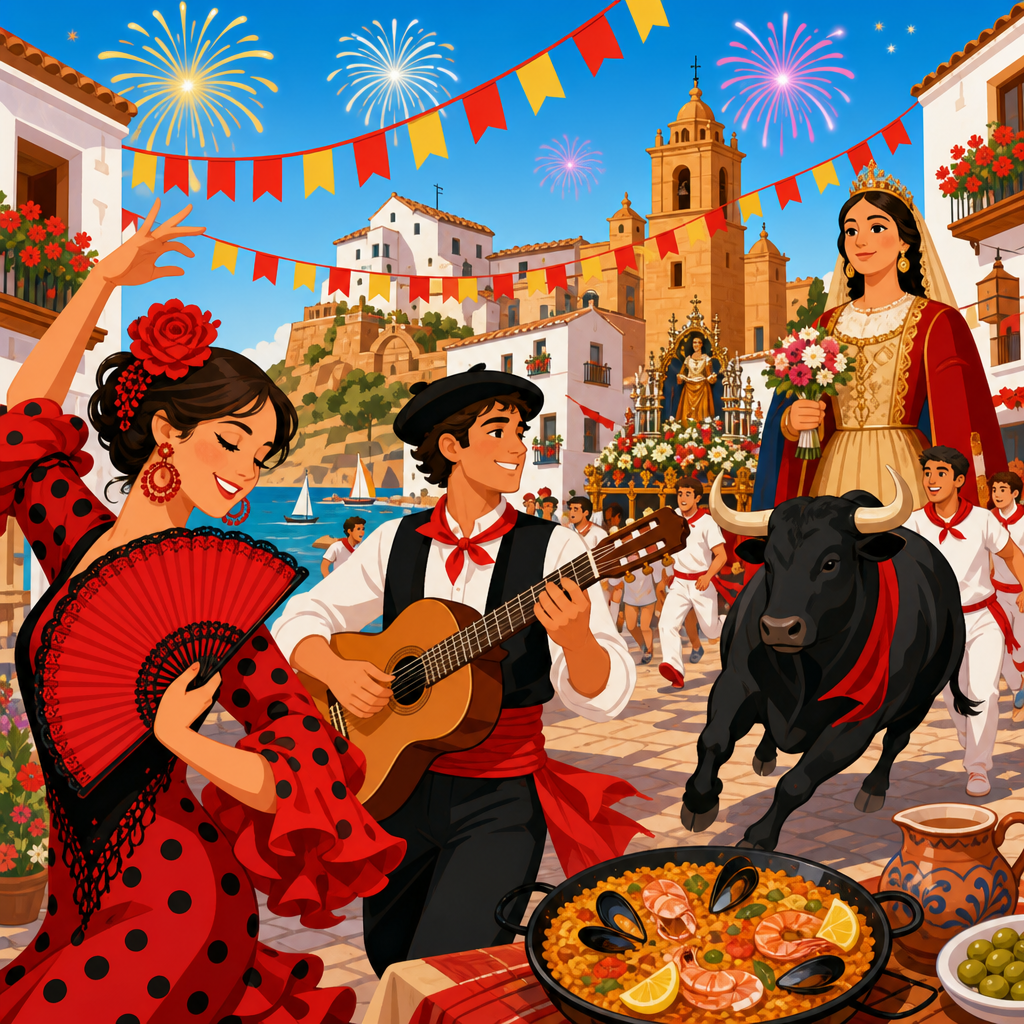
Dress also carries meaning. Flamenco dresses at the Feria de Abril are not generic “Spanish costumes” but a specific Andalusian fair tradition with its own codes. During Sanfermines, the white outfit with red scarf creates immediate shared identity and practical visibility. In Moors and Christians festivals, especially in Alicante province, elaborate costumes dramatize historical memory through parades and staged battles. Uniform dress reduces social distance and turns individual attendees into participants.
| Festival | Region | Main features | What it reveals about Spanish culture |
|---|---|---|---|
| Semana Santa | Nationwide, especially Andalusia and Castile | Processions, brotherhoods, sacred images, marching bands | Religious heritage, family continuity, public ritual |
| Las Fallas | Valencia | Satirical monuments, fireworks, neighborhood commissions, burning of fallas | Art, satire, civic organization, collective spectacle |
| San Fermín | Pamplona, Navarre | Encierro, parades, peñas, masses, concerts | Risk, tradition, tourism, local group identity |
| Feria de Abril | Seville, Andalusia | Casetas, flamenco, horses, social visiting, late-night dancing | Hospitality, status, performance, sociability |
| La Tomatina | Buñol, Valencia | Tomato fight, crowd management, global media attention | Local invention, play, tourism branding |
These examples show that celebration in Spain is participatory, not passive. The crowd is part of the event. People dress for it, cook for it, sing for it, volunteer for it, and discuss it for months before and after it happens. That shared preparation is often more culturally significant than the headline moment itself.
Regional celebrations beyond the global stereotypes
International media tends to reduce Spanish festivals to bull-running, flamenco, and tomato throwing, but the real landscape is much broader. In Catalonia, castells demonstrate disciplined cooperation, with teams building human towers through technique, trust, and rehearsed coordination. Also important are correfocs, where participants dressed as devils run with fireworks in events that combine medieval imagery with modern street theater. These traditions help explain Catalan civic culture better than any generic national summary could.
In the Basque Country, the Tamborrada in San Sebastián fills the city with drum companies on January 20, linking military imagery, gastronomy, and civic pride. Aste Nagusia in Bilbao mixes concerts, comparsas, giant figures, and strong neighborhood participation. In Galicia, festivals often revolve around parish life, pilgrimage, seafood, Celtic musical heritage, and saint days. The Feast of Saint James in Santiago de Compostela carries religious meaning, national symbolism, and international pilgrimage significance through the Camino de Santiago.
Central Spain offers another pattern. In Castile and León, many celebrations are marked by sobriety, historical depth, and strong brotherhood structures. Medieval fairs and Holy Week events often emphasize sculpture, silence, and processional order rather than flamboyance. Aragón maintains distinctive traditions tied to jota music and local patron saints. In the Canary Islands, Carnival in Santa Cruz de Tenerife is among the world’s largest, showing how Atlantic influences, costume culture, and performance create a festive identity different from mainland models.
What connects these varied examples is local ownership. A festival succeeds in Spain when residents recognize it as theirs, even if visitors arrive in large numbers. When that balance weakens, communities often respond by creating rules, limiting access, adjusting routes, or reviving less commercial rituals. That is why understanding Spanish festivals requires attention to governance, community groups, and regional history, not just colorful imagery.
Tourism, controversy, and the future of celebration
Spanish festivals generate enormous cultural and economic value, but they also create tensions. Major events attract international tourism, support hotels and restaurants, and strengthen city branding. At the same time, overcrowding can distort local participation, raise prices, increase waste, and pressure historic centers. Cities such as Seville, Valencia, and Pamplona constantly manage the balance between authenticity and spectacle. Good festival policy now involves crowd control, accessibility planning, emergency response, noise regulation, and heritage protection.
Controversy also surrounds animal-related traditions. Bull-running, bullfighting-linked festivities, and certain rural events face growing ethical criticism within Spain as well as abroad. Some municipalities defend them as heritage; others restrict or abolish them. This debate is part of contemporary Spanish culture, not external misunderstanding. It shows that traditions survive through negotiation, not automatic preservation.
Another major shift is digital visibility. Social media has changed how festivals are promoted, documented, and judged. Local celebrations that were once primarily communal can now become viral attractions overnight. That creates opportunity for small towns seeking recognition, but it also accelerates commercialization. In my experience, the healthiest celebrations are those with strong local committees, clear rules, and year-round cultural education. They welcome visitors while keeping decision-making in community hands.
Spain’s festival culture remains resilient because it is rooted in relationships. Celebrations are where grandparents transmit custom, young people test identity, migrants join neighborhood life, and local institutions prove their relevance. If you want to understand Spanish community and interaction, start with the festival calendar, then look beyond the postcard image to the people doing the organizing. Explore regional traditions, attend respectfully, ask locals what matters most, and follow those connections into the wider story of Spanish cultural life.
Frequently Asked Questions
Why are festivals so important for understanding Spanish culture?
Festivals are one of the best ways to understand Spanish culture because they bring together many of the country’s most important social and historical influences in one visible, shared experience. In Spain, celebrations are rarely just entertainment. They often reflect centuries of local history, Catholic traditions, seasonal rhythms, regional pride, and the strong value placed on community life. When a town gathers for a patron saint festival, a Holy Week procession, a harvest celebration, or a major city fair, it is expressing more than celebration alone. It is showing how people relate to their past, their neighbors, their streets, and their public spaces.
These events also reveal how Spanish identity works at both the national and regional level. Spain is not culturally uniform, and festivals make that clear. What matters in Seville may look very different from what matters in Valencia, Pamplona, Bilbao, or a small village in Galicia. Each place emphasizes its own customs, music, dress, food, and rituals, which helps explain why regional identity is such a central part of life in Spain. At the same time, many festivals share common themes such as religion, family gatherings, public participation, and the importance of spending time together outdoors. That balance between local distinctiveness and shared cultural habits is one reason festivals are so revealing.
Perhaps most importantly, festivals show Spanish culture as something lived rather than simply described. Instead of learning about values in the abstract, you see them in action: neighborhoods organizing events, multi-generational families gathering in plazas, friends eating together late into the evening, and communities preserving traditions while adapting them to modern life. For anyone trying to move beyond stereotypes, festivals offer a direct view of how Spanish society actually functions and what it chooses to celebrate.
How do religion and history shape Spanish festivals and celebrations?
Religion and history play a major role in shaping Spanish festivals, even when the atmosphere today feels festive, secular, or touristic. Many of Spain’s most famous celebrations began as religious observances tied to the Catholic calendar, local patron saints, Marian devotions, or Holy Week traditions. Over time, these events grew beyond church ritual and became broader expressions of civic identity. That is why a festival in Spain may include solemn processions, church services, historical symbolism, music, fireworks, communal meals, and street parties all within the same celebration.
Holy Week, or Semana Santa, is one of the clearest examples. In cities such as Seville, Málaga, and Valladolid, elaborate processions combine religious devotion, visual art, music, and deeply rooted local tradition. Brotherhoods and confraternities carry pasos, or religious floats, through the streets, and entire communities participate as members, spectators, musicians, or family supporters. Even for people who are not strongly religious, these events often remain culturally significant because they connect the present generation to local memory and inherited ritual.
History also shapes secular-looking festivals. Some celebrations recall medieval victories, old trade fairs, agricultural cycles, or historic tensions between religious groups and kingdoms. Festivals such as Moros y Cristianos dramatize historical conflict through parades and costumes, while many local fairs grew from livestock markets or seasonal gatherings that later took on a more celebratory form. In this way, Spanish festivals preserve fragments of the country’s complex past, from Catholic monarchy and regional tradition to village life and urban growth.
What makes Spain especially interesting is that these historical and religious layers are still active rather than purely symbolic. A festival may be centuries old, but it continues to matter because people keep participating in it, debating it, and passing it on. That continuity helps explain why celebrations in Spain often feel meaningful even when they are joyful, noisy, and highly public.
What do Spanish festivals reveal about regional identity across the country?
Spanish festivals reveal that regional identity is one of the most powerful forces in the country’s cultural life. Spain is made up of distinct regions with their own histories, languages, culinary traditions, music, and social customs, and festivals put those differences on display in a very public way. Rather than presenting a single national culture, celebrations often highlight what makes a particular city, province, or autonomous community unique. This is why attending festivals in different parts of Spain can feel like encountering several cultural worlds within one country.
In Andalusia, for example, festivals often emphasize religious brotherhoods, flamenco, horses, fairgrounds, and an especially visible street culture. In Valencia, Las Fallas reflects craftsmanship, satire, neighborhood organization, and a dramatic relationship with fire and spectacle. In the Basque Country, festivals may feature strong local symbols, traditional rural sports, and public expressions of Basque identity. In Catalonia, celebrations often include castells, or human towers, giant figures, and local associations that reinforce civic participation. In Galicia, festivals may reflect maritime culture, Celtic-influenced music traditions, and ties to pilgrimage or rural life.
These regional differences are not superficial details. They show how people in Spain often define themselves first through place: town, province, or region. Festivals give communities a chance to affirm that identity collectively through dress, language, ritual, and public performance. They also show how tradition is maintained through associations, neighborhood committees, religious groups, cultural clubs, and families who return every year to participate.
At the same time, regional festivals help outsiders understand Spain more accurately. They challenge the idea that one image of Spain can represent the whole country. Bullfighting, flamenco, tapas, or even certain holiday customs may be important in some areas and far less central in others. Festivals make those distinctions visible, which is why they are such a valuable guide to Spain’s cultural diversity.
What role do food, music, and public gathering play in Spanish celebrations?
Food, music, and public gathering are not secondary features of Spanish festivals. They are central to how celebration is experienced and understood. In Spain, festivals are deeply social events, and much of their meaning comes from shared presence in public spaces such as plazas, streets, fairgrounds, church routes, and neighborhood centers. People do not simply watch a festival; they inhabit it together. That communal atmosphere helps explain why celebrations remain so important even in a modern, fast-moving society.
Food is one of the clearest expressions of local identity during festivals. Special dishes, sweets, wines, and regional products often appear at specific times of year or during particular celebrations. These foods are not just consumed for pleasure. They reinforce memory, seasonality, family tradition, and local pride. A festival meal can connect people to grandparents, village customs, religious feast days, or regional ingredients that define a place. Whether the setting is a formal family table, a shared outdoor meal, or snacks eaten while moving through the streets, food helps turn celebration into a lived, sensory experience.
Music performs a similar function. Brass bands, drums, processional music, folk ensembles, flamenco performances, regional dances, and popular songs all shape the emotional tone of a festival. Music can create solemnity in a religious procession, excitement in a parade, or joy at a late-night fair. It also acts as a form of cultural continuity, teaching people what belongs to a given celebration and helping younger generations recognize the sounds associated with their community’s traditions.
Public gathering may be the most important element of all. Spanish festivals often depend on the use of shared urban and village space, where private life opens outward into collective experience. Neighbors meet, families reconnect, and strangers participate side by side. This public dimension reflects a broader feature of Spanish culture: the importance of social interaction, conversation, and community presence in everyday life. Festivals intensify those habits, making them more visible and more meaningful.
Why do traditional Spanish festivals continue to matter in modern society?
Traditional Spanish festivals continue to matter because they provide continuity, identity, and community in a rapidly changing world. Modern Spain is urban, digitally connected, economically diverse, and socially evolving, yet festivals remain relevant because they answer needs that modern life does not replace easily. They offer a sense of belonging, a calendar of shared meaning, and a public reminder that communities are built through participation, not only through institutions or private routines.
For many people, festivals connect generations. Grandparents, parents, and children often take part in the same events, even if they do so in different ways. One generation may organize a procession, another may prepare food, and younger participants may join parades, concerts, or neighborhood activities. This intergenerational structure helps preserve tradition without freezing it. Customs can adapt to new attitudes, tourism, technology, and changing social values while still maintaining a recognizable core.
Festivals also matter because they strengthen local social networks. In many Spanish towns and neighborhoods, preparations involve volunteer groups, cultural associations, religious brotherhoods, artists, musicians, and municipal authorities. The process of organizing the event can be just as important as the celebration itself because it reinforces cooperation and civic engagement. In that sense, festivals are not only displays of culture; they are engines of community life.
They also continue to matter economically and symbolically. Major celebrations attract tourism, support local businesses, and increase the visibility of a region or city. But beyond economics, they give communities a language for expressing what they value. Even when debates arise about commercialization, crowding, animal welfare, or the role of religion, those debates show