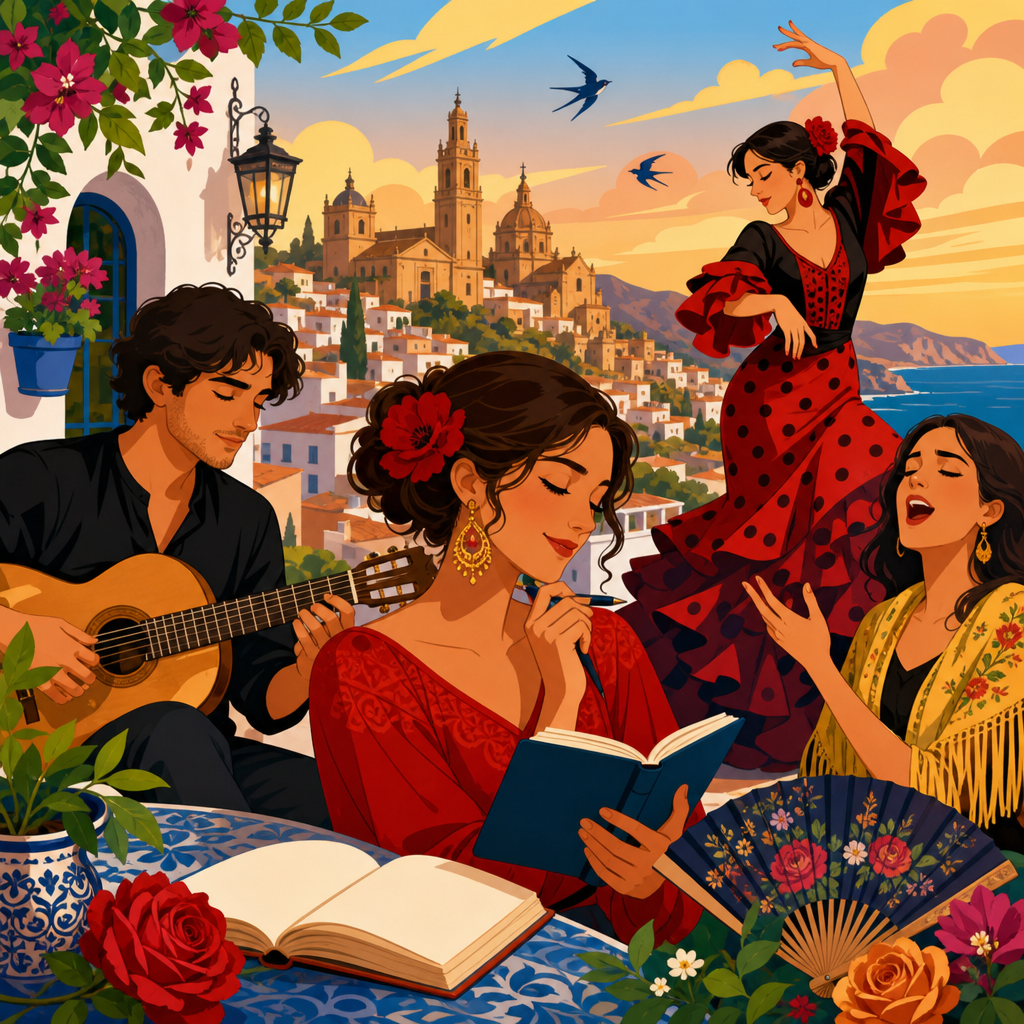
Spanish poetry and song reveal how a language carries memory, emotion, rhythm, and social identity across centuries of change. In the Spanish-speaking world, verse is not confined to books and music is not limited to entertainment; both function as public speech, private reflection, political testimony, and communal ritual. I have worked with learners, performers, and community groups using poems and song lyrics as language materials, and the pattern is consistent: people understand Spanish culture faster when they hear how it sounds in art. That is why Spanish poetry and song matter within Spanish community and interaction. They show how people greet, mourn, flirt, protest, celebrate, and remember.
In practical terms, poetry refers to language shaped by meter, imagery, repetition, and lineation, while song combines lyrics with melody, phrasing, and performance. In Spanish, the border between the two is unusually porous. Medieval lyric traditions were sung. The romance, copla, villancico, and canción all moved between oral circulation and written record. Later, poets such as Federico García Lorca drew directly from flamenco forms, while many singers turned canonical poems into recordings that reached mass audiences. This exchange matters for language study because pronunciation, syntax, register, and metaphor become easier to notice when they are tied to rhythm.
This hub article surveys the linguistic and cultural dimensions of Spanish poetry and song under a broad miscellaneous lens. Instead of isolating one period or genre, it maps the key themes readers need to understand the field: major traditions, regional variation, performance practices, teaching value, and the role of community. It also answers common questions directly. Why do lyrics often seem easier than prose? How do poetic devices affect meaning? What is the relationship between Spanish from Spain and Spanish from Latin America in music? By the end, you will have a clear framework for exploring related articles in this subtopic and a stronger sense of how artistic language supports real interaction.
Historical roots and the oral tradition
Spanish poetry and song begin in oral culture, where memorability is essential. Before widespread literacy, rhyme, assonance, refrains, and formulaic openings helped performers retain and transmit texts. One foundational example is the romance, a narrative ballad form typically built on octosyllabic lines with assonant rhyme in even lines. These ballads preserved frontier stories, local scandals, heroic episodes, and family dramas. Their language tends to be direct, image-rich, and repetitive because oral audiences need clarity in real time. Even today, listening to romances is a useful way to hear older narrative Spanish without reading dense archival prose.
Religious and courtly traditions also shaped poetic song. Medieval cantigas, villancicos, and devotional lyrics circulated through both elite and popular spaces. During the Siglo de Oro, poets including Luis de Góngora, Francisco de Quevedo, and Lope de Vega expanded literary complexity, but their works remained closely linked to recitation and musical adaptation. In classrooms and community workshops, I have seen students grasp baroque contrast more quickly when a sonnet is read aloud rather than silently analyzed. Sound reveals structure. Enjambment, stress patterns, and vowel sequences show why Spanish verse is designed for the ear as much as the page.
The modern era added new channels without erasing oral logic. Printed songbooks, radio, vinyl, film, television, and streaming all changed distribution, yet many successful Spanish songs still depend on old mnemonic techniques: repeated choruses, parallel syntax, incremental variation, and strong final vowels. Whether the genre is bolero, flamenco, nueva canción, pop, corrido, or urban Latin music, the underlying principle remains the same. A line survives when it can be remembered, quoted, and shared. That is one reason poetry and song remain central to Spanish community life: they travel well across generations, borders, and levels of literacy.
How Spanish works inside verse and lyrics
The linguistic power of Spanish poetry and song comes partly from the structure of the language itself. Spanish is syllable-timed compared with English stress timing, so sequences often feel more even and flowing. Its five-vowel system gives clarity to rhyme and assonance. Verb conjugation allows compact expression of time, mood, and person, which means a short lyric line can carry precise emotional information. Word order is flexible enough to create emphasis without destroying comprehension. As a result, poets and songwriters can move between conversational directness and high compression with unusual efficiency.
Several devices appear constantly. Metaphor and symbol create layered meaning: Lorca uses moon, horse, blood, and metal as recurring image systems. Anaphora and parallelism provide momentum, as in protest songs where repeated openings turn private feeling into collective chant. Diminutives such as -ito and -ita can signal affection, irony, or social intimacy depending on context. Vocatives like mi amor, hijo, or compañera anchor relationships. Code-switching and regional lexicon introduce identity markers. In performance, elision, aspiration of final s, or yeísmo may appear, not as mistakes, but as normal phonetic features tied to place and class.
For readers and listeners, one challenge is that poetic Spanish often compresses grammar. Articles may disappear, subjects may remain implicit, and metaphors may replace literal connectors. The best way to interpret a difficult lyric is to ask four direct questions: who is speaking, to whom, in what moment, and through which repeated images? Once those anchors are clear, ambiguity becomes productive rather than confusing. In my experience, learners improve listening and reading faster when they study one short poem deeply than when they skim many texts superficially.
| Feature | How it appears in Spanish poetry and song | Why it matters for meaning |
|---|---|---|
| Assonance | Repeated vowel sounds, common in romances and flamenco lyrics | Creates cohesion without rigid full rhyme |
| Octosyllabic lines | Frequent in ballads, coplas, and popular song | Supports oral delivery and memorization |
| Refrain | Recurring line or chorus | Signals the emotional center and aids recall |
| Symbolic imagery | Moon, road, sea, night, blood, garden | Builds cultural resonance beyond literal description |
| Regional pronunciation | Aspiration, seseo, yeísmo, voseo in sung language | Marks origin, identity, and social belonging |
Regional voices across Spain and Latin America
There is no single Spanish sound in poetry and song. Spain alone contains major regional traditions, including flamenco in Andalusia, jota in Aragón, muiñeira in Galicia, bertsolaritza in the Basque sphere, and Catalan-language songwriting alongside Castilian traditions. Flamenco deserves special attention because it fuses lyric compression, melismatic singing, improvisational intensity, and deep historical layering shaped by Romani, Andalusi, Jewish, and broader Mediterranean influences. Terms such as cante jondo, duende, and compás are not decorative labels; they describe performance concepts tied to emotional depth and rhythmic architecture.
Latin America extends the map dramatically. In Mexico, the corrido narrates social conflict, migration, revolution, and regional pride. In the Río de la Plata, tango lyrics use lunfardo, urban irony, and compressed nostalgia. In the Caribbean, son, bolero, salsa, and trova connect poetic language with dance and diaspora. In Chile, Violeta Parra and Víctor Jara showed how simple diction can carry profound political force. In Cuba, Silvio Rodríguez blended literary density with singer-songwriter intimacy. In Puerto Rico and across the urban diaspora, rap and reggaetón continue the tradition of rhythmic speech shaped by local vocabulary and neighborhood realities.
These regional forms are not isolated museums pieces. They interact constantly through migration, recording industries, festivals, and digital platforms. A listener in Madrid can absorb Argentine phrasing, Mexican narrative style, and Caribbean rhythmic syntax in a single playlist. That circulation changes language perception. Learners quickly discover that vos, ustedes, guagua, chamba, pibe, or chévere are not random slang words; they belong to communities with distinct histories. Studying poetry and song by region helps readers understand variation without treating one standard as the only legitimate Spanish.
Poetry, music, and social life
Spanish poetry and song matter because they are social acts. A lullaby transmits care and pronunciation patterns at the same time. A wedding song marks belonging. A protest chorus allows people to synchronize breath, stance, and message. Funeral laments preserve collective grief. In many Spanish-speaking communities, lyrics become part of daily speech through quotation. People answer disappointment with a half-remembered bolero line, describe longing through a ranchera phrase, or invoke a poem at civic ceremonies. This everyday reuse turns artistic language into social currency.
Politics is especially important. During dictatorship, censorship, exile, and democratic transition, poetic and musical language often carried coded criticism when plain speech was dangerous. Lorca’s legacy became inseparable from political memory after his murder in 1936. Nueva canción movements in Chile, Argentina, Uruguay, and elsewhere used accessible melodies and morally direct language to mobilize listeners. In Spain, cantautores connected lyric craft with public debate during late Francoism and the transition. These works are culturally significant not only because of their messages, but because they trained audiences to hear metaphor as a civic skill.
Community interaction also includes festivals, peñas, open mics, church choirs, neighborhood gatherings, and school recitals. I have watched hesitant learners join a group more quickly through chorus singing than through free conversation. The reason is simple. Melody provides timing, repetition reduces pressure, and shared text lowers the fear of making mistakes. In that sense, Spanish song is not just a cultural object; it is a participation technology. It gives people a structured way to enter pronunciation, turn-taking, emotion, and memory within a group setting.
Using poetry and song for language learning and cultural literacy
For language learners, Spanish poetry and song are effective because they train multiple systems at once: listening, pronunciation, vocabulary retention, syntax awareness, and cultural interpretation. Research in applied linguistics consistently shows that patterned repetition improves recall. Songs add melody, which strengthens chunking. Poems add line breaks and sound patterning, which sharpen attention to form. A short text can therefore produce high learning value if used correctly. The key is not to treat lyrics as random entertainment. They should be chosen for level, diction, speed, and cultural relevance.
A practical method works well. First, listen or read once for gist. Second, mark repeated words and verbs. Third, identify who is speaking and the emotional situation. Fourth, notice pronunciation features such as dropped consonants or linked vowels. Fifth, compare regional vocabulary with a reliable dictionary, such as the Diccionario de la lengua española from the Real Academia Española or Corpus del Español for usage patterns. Finally, recite or sing aloud. Active vocal production matters. In workshops, learners who perform texts retain collocations better than those who only complete worksheet exercises.
There are limits. Not every lyric is clear, and not every poem reflects everyday speech. Some songs distort syntax for rhyme, while some highly literary poems demand historical context that beginners do not yet have. The solution is sequencing. Start with accessible forms such as boleros, simple contemporary singer-songwriter pieces, children’s songs, or narrative ballads. Then move toward denser poets and more region-specific genres. Used this way, Spanish poetry and song become a bridge between textbook language and lived community speech, which is exactly why they belong at the center of this subtopic hub.
How to explore this hub and build deeper understanding
This miscellaneous hub should guide readers outward rather than end the conversation. The most productive next step is to explore by lens. One route is historical: medieval ballads, Golden Age poetry, nineteenth-century romanticism, twentieth-century avant-garde writing, singer-songwriter traditions, and contemporary urban lyricism. Another route is regional: Andalusian flamenco, Mexican corrido, Argentine tango, Caribbean bolero and salsa, Andean nueva canción, and diasporic bilingual forms. A third route is thematic: love, migration, faith, labor, childhood, exile, race, and political memory. Each lens reveals a different relationship between language and community.
When evaluating texts, use a few stable criteria. Ask how sound supports meaning. Ask what social context shaped the work. Ask whether the language is formal, colloquial, rural, urban, intimate, or public. Ask what kind of audience the text expects. These questions prevent shallow interpretation. They also help readers compare unlike genres without flattening them. A flamenco letra, a Neruda poem, a corrido, and a reggaetón track should not be judged by the same standards, yet all can be analyzed seriously through voice, structure, imagery, rhythm, and social purpose.
Spanish poetry and song offer one of the clearest paths into Spanish community and interaction because they join language with lived experience. They preserve history, display regional identity, sharpen listening, and invite participation. Most importantly, they make cultural knowledge audible. If you want to understand how Spanish speakers remember, persuade, grieve, celebrate, and belong, start here. Read poems aloud, study lyrics closely, compare regions, and follow the related articles in this hub to deepen your view of the Spanish-speaking world. The language becomes richer when you hear it in verse and song.
Frequently Asked Questions
Why are poetry and song so important for understanding Spanish language and culture?
Poetry and song matter because they show Spanish as a lived language rather than a purely grammatical system. In both forms, words are shaped by rhythm, memory, emotion, and social context, so learners and readers encounter Spanish not only as vocabulary and syntax, but as a way of feeling, remembering, persuading, mourning, celebrating, and belonging. Across the Spanish-speaking world, poems and songs have long circulated in homes, streets, classrooms, festivals, religious events, protests, and family gatherings. That wide social presence means they preserve layers of cultural experience that may not appear as clearly in formal prose.
They are also powerful records of historical change. A poem can preserve older expressions, regional turns of phrase, or cultural symbols tied to a specific moment. A song can reveal migration, class identity, political struggle, romance, humor, or collective grief in a form people remember and repeat. Because these texts are often performed aloud, they help listeners hear stress, melody, pause, and emphasis, all of which deepen understanding of how Spanish communicates meaning beyond literal definitions. For anyone exploring Spanish linguistically and culturally, poetry and song offer direct access to the relationship between language, identity, and community.
How do Spanish poems and songs help language learners develop deeper comprehension?
Poems and songs help learners move beyond translation and into interpretation. In ordinary study, students often focus on isolated words or rule-based exercises. By contrast, poetic lines and song lyrics encourage attention to tone, implication, repetition, metaphor, register, and sound pattern. This develops a more flexible and more mature kind of comprehension. Learners begin to notice that meaning in Spanish is often built through rhythm, emotional framing, and cultural reference as much as through dictionary equivalence.
They are especially useful for listening and pronunciation. Songs make stress patterns, vowel clarity, elision, and regional pronunciation more noticeable because sound is central to the experience. Poetry, when read aloud, highlights cadence, line breaks, breath, and emphasis, helping learners hear how spoken Spanish can be structured for emotional effect. These forms also improve vocabulary retention because repeated refrains, memorable imagery, and strong emotional associations make language easier to remember. In teaching practice, many learners understand difficult structures more readily when they encounter them in a compelling lyric or poem than when they see them in a detached grammar exercise. The text becomes meaningful first, and analysis follows more naturally.
What linguistic features stand out most in Spanish poetry and song?
Several features stand out immediately: rhythm, repetition, metaphor, and variation in register. Spanish is a language with strong syllabic flow and highly audible stress, so poetic meter and musical phrasing often bring out qualities that learners may overlook in ordinary prose. Repetition is especially important. Repeated verbs, parallel structures, refrains, and recurring images create emotional emphasis while also making grammatical patterns more visible. This is one reason poetry and song are so effective for language study: form supports comprehension.
Another notable feature is the density of figurative language. Spanish poems and songs frequently use symbols drawn from landscape, religion, the body, family life, work, and everyday objects. A simple word such as luz, tierra, sangre, camino, sombra, or voz can carry emotional, political, or spiritual meaning depending on context. Regional and social variation also plays a major role. Lyrics may include dialect vocabulary, local pronunciation reflected in spelling, informal contractions, or forms associated with a particular country or community. This reminds readers that there is no single monolithic Spanish; instead, poetry and song reveal a language shaped by geography, history, and social experience. For linguistic exploration, that diversity is not a complication but a core part of what makes Spanish rich and culturally revealing.
How have Spanish poetry and song functioned as forms of public speech and political testimony?
Throughout the Spanish-speaking world, poetry and song have often carried public meaning in periods when direct speech was limited, dangerous, or socially contested. A poem can condense protest into image and metaphor, making difficult truths speakable. A song can circulate widely, allowing communities to share memory, resistance, grief, or hope in a form that is easy to remember and repeat. Because these genres are performative and communal, they can transform private feeling into collective expression.
This public function appears in many settings: labor movements, anti-dictatorial resistance, civil rights struggles, feminist expression, Indigenous cultural affirmation, exile literature, and songs of migration and displacement. Even when not overtly political, many poems and songs still testify to lived realities such as poverty, racial identity, regional belonging, or generational change. Their authority comes partly from voice. A sung refrain or a spoken stanza can feel immediate and embodied, as though someone is speaking from within experience rather than describing it from a distance. That is why these forms are so often central to cultural memory. They do not merely document events; they help communities interpret what those events mean and how they should be remembered.
What is the best way to read or listen to Spanish poetry and song for cultural and linguistic insight?
The most effective approach is to combine close attention with openness. Start by listening or reading for overall feeling before trying to decode every word. Ask what mood the piece creates, whose voice is speaking, and what social world seems to surround the language. Then return to the text more closely. Notice repeated words, unusual images, verb tenses, terms of address, and shifts in formality. If it is a song, listen more than once and pay attention to pronunciation, pace, and emotional emphasis. If it is a poem, read it aloud to hear how line breaks and sound patterns shape meaning.
It also helps to place the work in context. Knowing the region, historical moment, genre, and performer or poet can clarify references that might otherwise seem obscure. A love lyric, a flamenco copla, a protest song, a son jarocho verse, or an urban popular ballad each carries different traditions and expectations. Comparing versions, performances, or translations can be especially revealing because it shows what changes and what remains central. Most importantly, treat the text as both language and cultural action. Spanish poetry and song are not just decorative forms; they are ways communities speak to themselves and to others. When approached with that awareness, they become invaluable tools for understanding how Spanish carries memory, identity, and shared emotion across time.