

Nestled in the vast Pacific Ocean lies a treasure trove of biodiversity and cultural uniqueness: the Galápagos Islands. Most people know this archipelago for its haunting beauty and its pivotal role in Charles Darwin’s theory of evolution. However, there’s another equally fascinating aspect that often goes unnoticed—the unique Spanish vocabulary spoken by the islanders. The language here is a reflection of the vibrant yet isolated lifestyle led by the Galápagos inhabitants.
This Spanish isn’t just any kind of Spanish; it’s a version that comes with its own set of words, phrases, and idioms shaped by the region’s seclusion and its deep connection with the environment. As you navigate this article, you will gain an understanding of the distinct vocabulary that has evolved in this isolated ecosystem. From terms associated with local wildlife to words borne out of necessity and convenience, each term provides a glimpse into the daily life and culture of the Galápagos residents.
You don’t need to be a linguistic expert to appreciate the nuances here—just a curious mind open to exploring the regional flavors of the Spanish language. In this article, we will journey through the unique Spanish vocabulary of the Galápagos Islands, explore the intriguing words exclusive to this archipelago, and delve into the cultural underpinnings and influences that have shaped them. By the end, you’ll have a newfound appreciation for this unique dialect and perhaps even pick up a few quirky words to add to your Spanish lexicon.
Origin and Evolution of Galápagos Spanish
The Spanish spoken in the Galápagos Islands has an interesting history shaped by various influences. The Galápagos were first discovered in 1535 by Fray Tomás de Berlanga, the bishop of Panama, who stumbled upon them after his ship drifted off course. Since then, the islands have attracted pirates, whalers, and settlers from various parts of the world. This diverse mixture of people brought with them their languages and dialects, which eventually blended to form the unique Galápagos Spanish.
Initially, the primary influence on the language was the Spanish spoken by the early settlers from mainland Ecuador. Over time, the language began to absorb words from indigenous languages as well as from English, thanks to the presence of British and American whalers in the 18th and 19th centuries. This eclectic mix gave rise to a distinct vocabulary that cannot be found anywhere else.
Another unique element contributing to the evolution of Galápagos Spanish is the island environment itself. Isolated from the mainland, the islanders had to coin new words and phrases to describe local flora, fauna, and other aspects of daily life. This led to the creation of terms that are almost entirely absent in other forms of Spanish.
Vocabulary Rooted in Nature
One of the most fascinating aspects of Galápagos Spanish is the rich array of words that relate to the island’s unique ecology. Given that the Galápagos Islands are home to numerous species that can’t be found anywhere else in the world, it’s no surprise that the local vocabulary reflects this biodiversity.
For instance, terms like “pinzón” (finch) have special significance. On the mainland, “pinzón” might just refer to any ordinary finch, but in the Galápagos, it evokes the famous Darwin finches that played a crucial role in the development of the theory of evolution. The word is laden with scientific and historical importance.
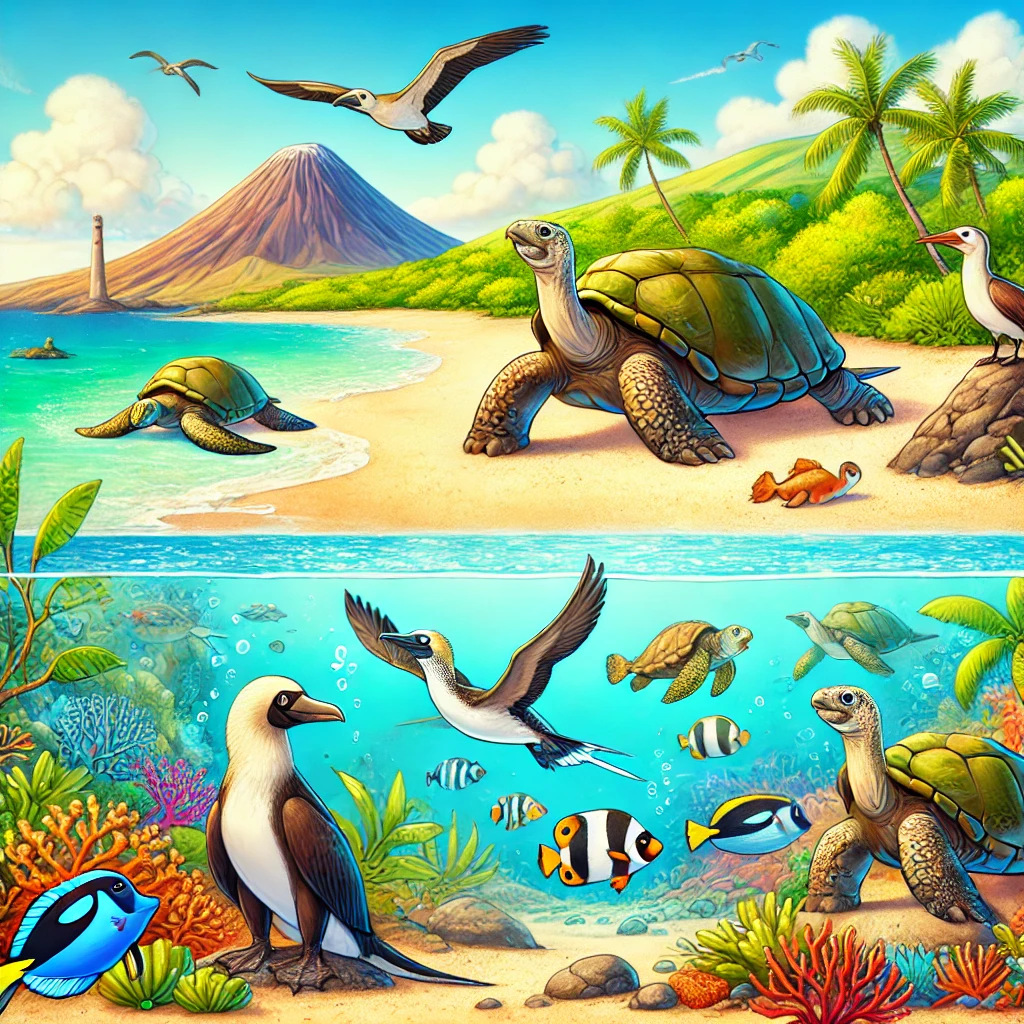
Another example is “booby,” or “piquero” in Spanish. The Galápagos is home to several types of boobies, such as the Blue-footed Booby (piquero patiazul) and the Red-footed Booby (piquero patirrojo). While “piquero” might mean very little to Spanish speakers elsewhere, to Galápagos residents, it signifies one of the most iconic and recognizable birds of the islands.
Cultural Influences and Local Slang
Beyond the vocabulary related to nature, the Galápagos Islands also have their own set of colloquial expressions and slang. The isolation of the islands has allowed these phrases to evolve independently from the mainland, giving them a unique flavor.
For example, “chapear” is a local term that means to clear an area of brush or weeds. While it holds little significance elsewhere, on the islands it’s a common activity and therefore a frequently used word. Meanwhile, “patón” is a playful way to describe someone who has big feet—a term likely influenced by the noticeable feet of the Blue-footed Booby.
Another interesting expression is “estar en el limbo,” which translates to “being in limbo.” While this phrase is used in other Spanish-speaking regions, in the Galápagos, it typically refers to the feeling of disorientation due to the islands’ isolated nature. It captures the unique sense of being detached from the hustle and bustle of mainland life.
Food and Lifestyle-Related Vocabulary
The local cuisine and lifestyle of Galápagos residents have also given rise to specific vocabulary that you won’t find elsewhere. Take the term “culebra,” which typically means snake but in the Galápagos often refers to the Pacific green sea turtle. Due to the abundance of these turtles around the islands, it’s a staple of local discussions and thus has earned its own distinct name.
“Caldo de pescado” is another term worth noting. While it means “fish soup” in general Spanish, in the Galápagos it often refers to a specific, popular dish made with freshly caught local fish. This is not just any fish soup but a culinary experience deeply embedded in the daily life and culture of the people.
In terms of daily activities, “machete” is an essential word. While it literally means “machete” or “large knife,” it refers to the tool used almost ubiquitously by islanders for various tasks, from clearing vegetation to opening coconuts. It’s a word that speaks volumes about the self-sufficiency required to live on such remote islands.
Interactions with Tourists
Tourism plays a significant role in the Galápagos economy, and this interaction between locals and tourists has led to the incorporation of additional vocabulary. Words and phrases from other languages, particularly English, have found their way into everyday conversations. Terms like “tour” and “guide” are commonly used, albeit with a distinct Galápagos accent that sets them apart. Even names of popular tourist hotspots such as “Tortuga Bay” are well known and often referenced in both languages.
This bilingual blend adds another layer of richness to the Galápagos vocabulary, embodying the intersection of local culture and global influence. Similarly, “buceo” (diving) and “snorkel” are terms that have become deeply embedded in the local dialogue. Given the islands’ unparalleled marine life, these activities are not just popular among tourists but also among the locals, contributing further to the specialized jargon of the Galápagos.
The Future of Galápagos Spanish
As the world becomes increasingly interconnected, the Spanish spoken in the Galápagos Islands is also evolving. The influence of digital media and the internet means that younger generations are exposed to diverse forms of Spanish as well as other languages. This exposure is leading to a gradual shift in the local vocabulary, with some traditional words and phrases slowly being replaced by more universally understood terms. However, it is this very interplay between tradition and modernity that makes the study of Galápagos Spanish so fascinating.
While some unique words may fade into obscurity, others will continue to adapt and evolve, reflecting the dynamic nature of language itself. Efforts to preserve this unique dialect are also underway. Local educational programs aimed at teaching children the history and significance of their language, and initiatives to document the distinct vocabulary can help to ensure that the unique Spanish of the Galápagos Islands is not lost.
Conclusion
The unique Spanish vocabulary of the Galápagos Islands offers a captivating glimpse into the lives and culture of its residents. From words deeply rooted in nature and wildlife to the everyday slang that carries the flavor of island life, every term tells a story of isolation, adaptation, and an undeniable connection to the environment.
Understanding this vocabulary not only enhances our appreciation for the Galápagos Islands but also enriches our grasp of the Spanish language as a whole. Each unique word or phrase is a reminder of the diverse and ever-evolving nature of language, shaped by geography, history, and human interaction. Whether you’re a language enthusiast, a traveler planning a trip to these islands, or simply someone curious about different cultures, diving into the unique Spanish vocabulary of the Galápagos is like embarking on a linguistic adventure.
And who knows? The next time you find yourself in a linguistic conversation, you might just drop a Galápagos-specific term, providing a unique and enriching layer to your dialogue. In essence, the Spanish spoken in the Galápagos Islands is more than just a means of communication; it’s a testament to the islanders’ resilience, their deep connection to the natural world, and their rich cultural heritage. It’s a linguistic treasure waiting to be discovered and appreciated.


