The Spanish ‘R’ is one of the most challenging sounds for non-native speakers to master. Whether it’s the soft, single-tap ‘R’ found in words like “pero,” or the iconic trilled ‘RR’ in “perro,” the ‘R’ sound is integral to speaking Spanish with confidence and authenticity. This article covers advanced pronunciation techniques to help you master both variations of the Spanish ‘R’ for improved fluency. By adopting these practices and integrating them into your language learning routine, you’ll be able to speak more like a native speaker.
Introduction
Learning Spanish often involves more than just memorizing vocabulary and understanding grammar. Pronunciation plays a vital role, especially when it comes to mastering the complex sounds of the language. Among these, the Spanish ‘R’ stands out as particularly challenging for many learners. This distinctive sound can make or break one’s accent and overall comprehensibility. The Spanish ‘R’ can appear as either a single-tap (soft ‘R’) or a trill (hard ‘R’). While the single-tap ‘R’ is similar to the American English ‘d’ in “butter” when said quickly, the trilled ‘R’ is entirely different and has no equivalent in English. This makes the trilled ‘R’ both fascinating and intimidating for learners. Advanced pronunciation techniques can make a significant difference in mastering these sounds. In this article, you’ll find detailed guidance on achieving precise pronunciation of both the soft and hard ‘R.’ These techniques are designed to be practical and accessible, enabling you to incorporate them into your daily practice easily. Understanding the mechanics behind these sounds is the first step. The soft ‘R’ is typically produced by allowing the tongue to tap quickly against the alveolar ridge—the small bump located just behind the upper front teeth. The hard ‘R’ or trilled ‘R,’ on the other hand, involves a flap or vibration of the tongue against the same area. Next, you’ll learn specialized exercises aimed at strengthening the muscles needed for correct pronunciation. These include tongue twisters, tapping exercises, and listening practices designed to fine-tune your auditory discrimination and mimicry abilities. By immersing yourself in native resources and practicing consistently, you’ll eventually develop the muscle memory and auditory skills necessary for mastering the Spanish ‘R.’
Understanding the Basics of the Spanish ‘R’
Before diving into advanced techniques, it’s essential to understand the basic principles of Spanish ‘R’ pronunciation. Spanish has two primary ‘R’ sounds: the single-tap ‘R’ (soft ‘R’) and the trilled ‘R’ (hard ‘R’). The single-tap ‘R’ is simpler and occurs between vowels or in intervocalic positions (e.g., “caro”). It involves a quick tap of the tongue against the alveolar ridge, similar to the American English ‘d’ in “ladder.” Practicing this sound requires brief, controlled tongue movements. You can start by saying words that have a quick ‘D’ sound in English and then gradually transition into the Spanish ‘R.’ The trilled ‘R’ (hard ‘R’) is more complex and occurs primarily at the beginning of words (e.g., “ratón”) or between vowels as a doubled ‘R’ (e.g., “carro”). This sound requires multiple flaps or vibrations of the tongue against the alveolar ridge. Producing this sound is where most learners struggle, as it demands significant tongue strength and agility. To understand how these sounds feel in your mouth, try placing a hand on your throat while practicing. The single-tap ‘R’ will produce a minimal vibration, while the trilled ‘R’ will create a more resonant, rolling vibration that you can feel in your tongue and throat.
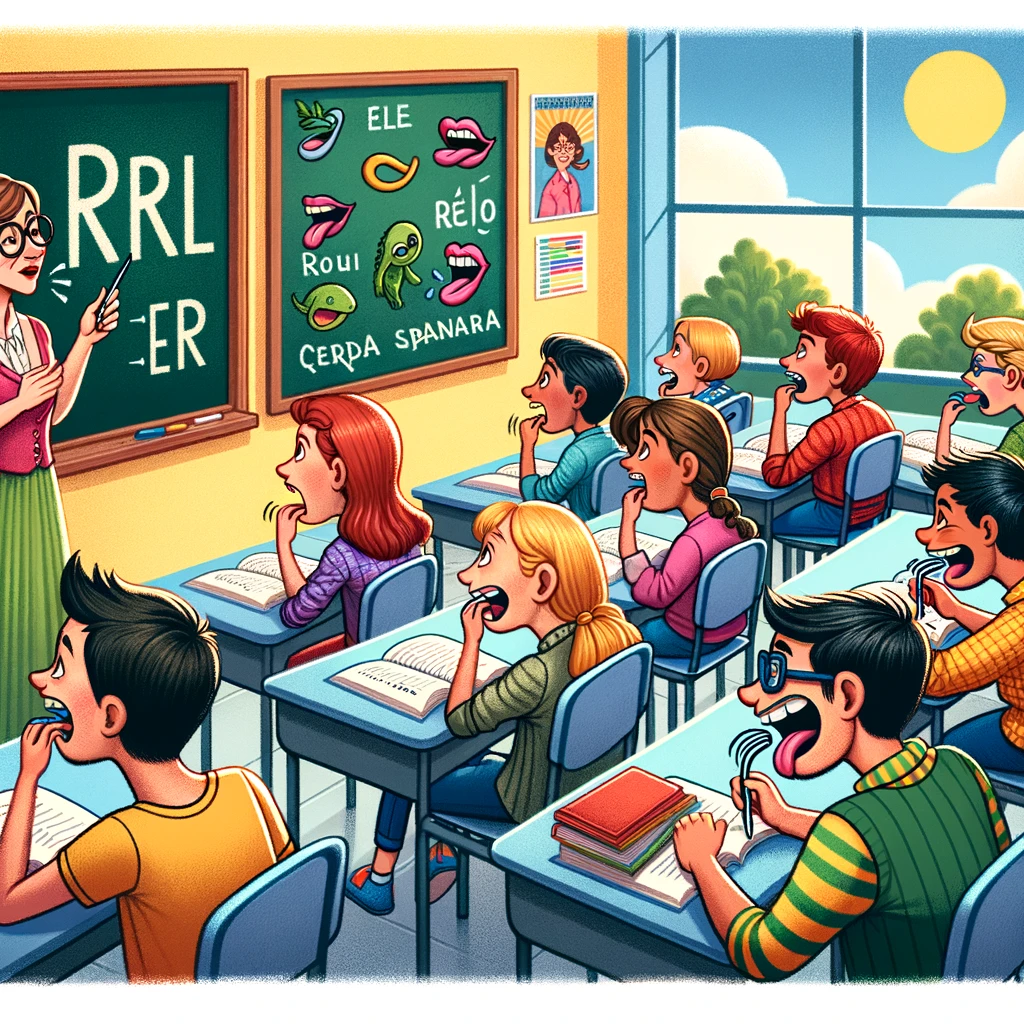
Tongue Position and Muscle Strengthening
The proper tongue position is critical for producing both the single-tap and trilled ‘R’ sounds. For the single-tap ‘R,’ your tongue should be relaxed and held close to the alveolar ridge. A quick, flicking motion will create the desired sound. To practice, try saying “butter” rapidly to simulate the tongue movement, and then apply the same motion to Spanish words. For the trilled ‘R,’ your tongue tip should be close to the alveolar ridge but not touching it until you produce the vibration. An effective way to start is to place your tongue in the correct position and blow air gently over it, creating a flutter. This exercise helps familiarize your tongue with the feeling of vibration and builds the necessary muscle memory. Muscle strengthening exercises are also beneficial. One technique involves holding your tongue in the trilled ‘R’ position and attempting to make the sound while exhaling forcefully. Another exercise includes tongue-tapping, where you rapidly tap your tongue against the alveolar ridge without voicing, similar to a ‘tsk’ sound. Over time, these exercises will train your tongue to move quickly and accurately.
Listening and Mimicking
Listening to native speakers is a crucial component of mastering the Spanish ‘R.’ Immersion in authentic audio resources, such as Spanish-language podcasts, movies, and songs, will help you internalize the sound and rhythm of the language. Pay particular attention to how native speakers pronounce the ‘R’ in various contexts and try to mimic their pronunciation. One of the most effective ways to improve is through shadowing, where you listen to a sentence and then repeat it immediately, trying to match the speaker’s intonation, rhythm, and pronunciation as closely as possible. This technique not only improves your ‘R’ sound but also enhances your overall speaking fluency. Another useful practice is to record yourself speaking and compare your pronunciation to that of native speakers. This self-assessment helps you identify specific areas where you need improvement and track your progress over time.
Incorporating Pronunciation Practice into Your Routine
Consistency is key when it comes to mastering any aspect of language learning, and the Spanish ‘R’ is no exception. Incorporate pronunciation practice into your daily routine to see the best results. Set aside dedicated time each day for focused practice on the ‘R’ sounds, combining muscle-strengthening exercises with listening and mimicking activities. Additionally, consider integrating pronunciation practice into your regular Spanish study sessions. For example, when learning new vocabulary, pay special attention to words that contain the ‘R’ sound and practice them repeatedly. Use flashcards, language apps, or other tools that allow you to hear and repeat the words. Engaging in conversation with native speakers, whether in person or through language exchange programs, also provides valuable real-world practice. Don’t be afraid to ask for feedback on your pronunciation. Native speakers often appreciate the effort and can offer helpful tips.
Common Challenges and Solutions
Despite your best efforts, you may encounter challenges while mastering the Spanish ‘R.’ Common issues include difficulty in producing the trilled ‘R,’ tongue fatigue, and lack of confidence. If you’re struggling with the trilled ‘R,’ go back to basic exercises and focus on building up your tongue strength. Be patient with yourself, as this sound can take time to master. Use a mirror to watch your tongue placement and movement, ensuring that you are following the correct technique. For tongue fatigue, take breaks during your practice sessions to allow your muscles to recover. Gradually increase the duration and intensity of your practice to build endurance over time. Hydration and proper rest also play a role in maintaining muscle health. Lack of confidence can hinder your progress, but it’s important to stay positive and persistent. Celebrate small victories along the way, and remember that making mistakes is a natural part of the learning process. Record your improvements and reflect on how far you’ve come.
Conclusion
Mastering the Spanish ‘R’ takes time, dedication, and consistent practice, but the rewards are well worth the effort. Achieving accurate pronunciation enhances your communication abilities and brings you closer to fluency. By understanding the mechanics of the single-tap and trilled ‘R’, strengthening your tongue muscles, practicing regularly, and seeking feedback, you’ll make significant strides in your Spanish-speaking journey. Remember that every learner progresses at their own pace, so be patient with yourself and keep pushing forward. Use the techniques and exercises outlined in this article as part of your regular language practice, and you’ll find that the once-intimidating Spanish ‘R’ becomes a natural part of your speech. Good luck, and ¡buena suerte!