
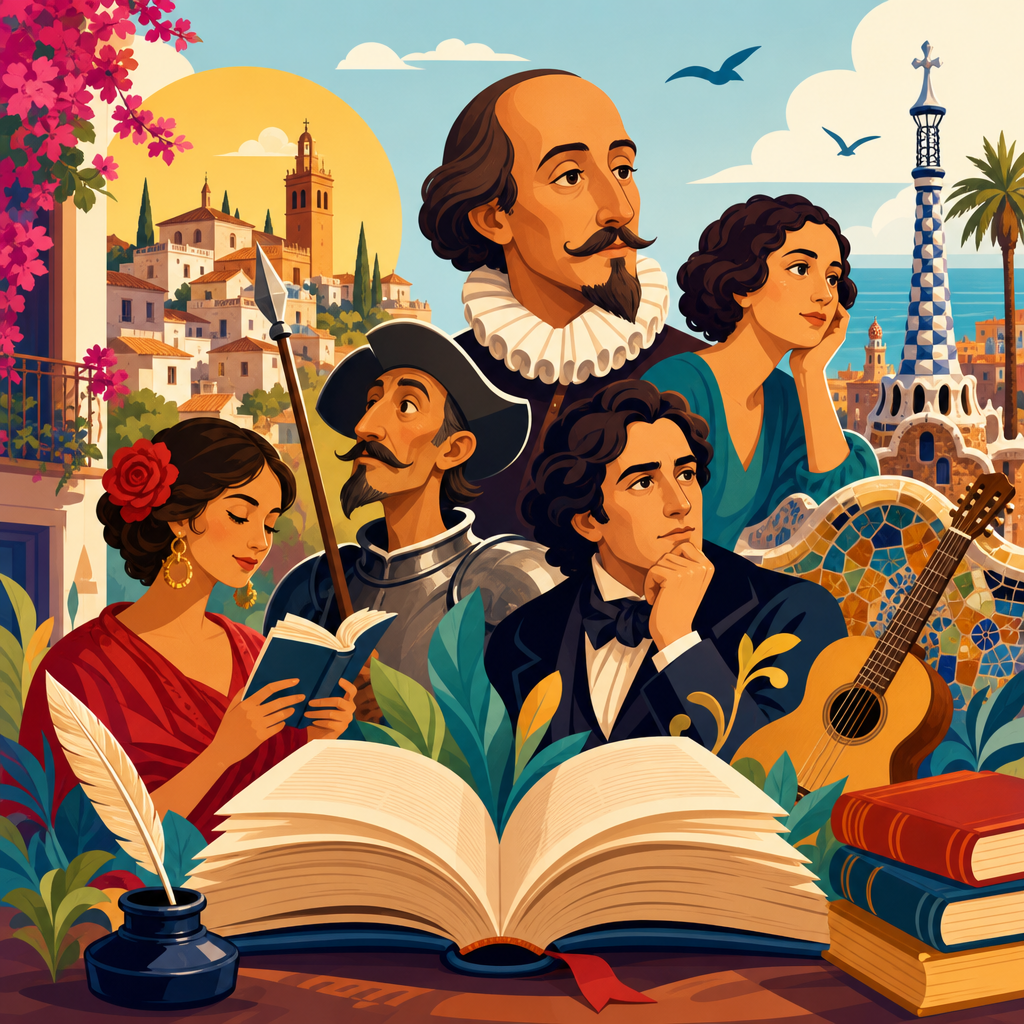
Spanish literature has shaped not only the Spanish language but also the cultural imagination of Spain, Latin America, and communities far beyond the Iberian Peninsula. When people ask how stories, poems, and plays can influence daily speech, national identity, and social values, Spanish literature offers one of the clearest examples. Across centuries, writers in Castilian Spanish, regional languages, and colonial and postcolonial settings have introduced new vocabulary, fixed idioms in common use, challenged political authority, and given readers a shared storehouse of symbols and references that still guide public conversation.
In practical terms, Spanish literature includes epic poetry, courtly prose, religious writing, Golden Age drama, realist novels, avant-garde experimentation, testimonial narratives, and contemporary fiction. Its influence on language can be seen in lexical standardization, the prestige of certain styles, and the survival of sayings drawn from canonical texts. Its influence on culture appears in education, theater, film, journalism, political rhetoric, and community traditions such as public readings, literary festivals, and school commemorations. I have seen this firsthand in language classrooms and cultural programs, where even learners with limited fluency recognize names like Cervantes, Lorca, and García Márquez because their works circulate as cultural shorthand.
This matters for anyone interested in Spanish community and interaction because literature does more than entertain. It creates a common reference system that helps speakers understand humor, irony, values, and historical memory. A phrase from Don Quijote, a line from Neruda, or an image from Lorca can signal education, regional background, political stance, or emotional tone. Literature also travels: texts written in one century or continent are reinterpreted in another, influencing migration communities, bilingual education, and digital communication. To understand how Spanish-speaking communities interact, it is essential to see how literature has continually shaped the language they speak and the cultural frameworks they share.
How Spanish Literature Shaped the Spanish Language
Spanish literature helped stabilize and elevate Castilian at key moments in history. In medieval Iberia, texts such as the Cantar de mio Cid preserved early forms of vernacular expression at a time when Latin still dominated learned writing. As prose expanded under Alfonso X in the thirteenth century, written Castilian gained administrative and intellectual prestige. Literature mattered because it demonstrated that the vernacular could handle law, history, science, and narrative, not just oral storytelling. Once a language proves itself in writing, it becomes easier to standardize spelling, syntax, and rhetorical norms.
The publication and diffusion of major literary works accelerated this process. La Celestina, the picaresque tradition beginning with Lazarillo de Tormes, and especially Cervantes’ Don Quijote gave readers influential models of dialogue, narration, irony, and social register. Cervantes is central not because he single-handedly created modern Spanish, but because his prose captured a broad spectrum of living speech. His work balanced learned language with colloquial rhythm, helping later writers and readers recognize flexibility as a strength of Spanish. That is one reason Don Quijote remains a touchstone in discussions of prose style and linguistic identity.
Literature also introduced expressions that entered common speech. Terms such as “quijotesco” now describe idealistic, impractical behavior, proving how a fictional character can become a linguistic category. “Celestina” came to mean a go-between in love affairs. “Lazarillo” evokes a guide, especially for someone who cannot see, due in part to the enduring visibility of the picaresque hero. These are not minor curiosities; they show how literary texts become embedded in social vocabulary. In classrooms, media commentary, and everyday conversation, speakers continue to use literary references because they communicate complex meanings efficiently.
Golden Age Literature and Cultural Identity
The Spanish Golden Age, roughly the sixteenth and seventeenth centuries, produced a concentration of literary influence that still shapes cultural identity. This was the period of Cervantes, Lope de Vega, Calderón de la Barca, Francisco de Quevedo, and Luis de Góngora. Their works emerged alongside imperial expansion, religious conflict, urban growth, and social stratification. Because these writers addressed honor, faith, power, class, and appearance versus reality, they helped define themes that remain central in Spanish-speaking cultures.
Golden Age drama had unusually broad social reach. Lope de Vega transformed theater into a mass cultural form, and his comedia nueva appealed to mixed audiences in public playhouses. Drama was not merely literary; it was civic performance. Communities saw their tensions acted out in stories about loyalty, monarchy, peasant dignity, and women’s agency under restrictive norms. Calderón refined philosophical and theological drama, asking what freedom, illusion, and responsibility mean in human life. These questions still resonate because they connect literary heritage with enduring moral debates.
Poetry from the same era shaped cultural taste and linguistic ambition. Góngora’s dense, allusive style and Quevedo’s sharp conceptual wit created competing models of eloquence. Even readers who never study them in depth encounter the larger lesson they established: Spanish can be both precise and baroque, musical and satirical. The prestige of rhetorical richness in public speaking, sermons, journalism, and political oratory owes much to this period. In my experience reviewing school curricula and cultural programming, Golden Age authors remain foundational because they offer both national prestige and a toolkit for interpreting social performance in Spanish-speaking settings.
Literature Across Spain and Latin America
The influence of Spanish literature cannot be confined to Spain alone. Once Spanish spread through colonization, literature became a site of exchange, conflict, and reinvention across Latin America. Colonial chronicles, Indigenous accounts mediated through Spanish, and later independence-era essays expanded the language’s expressive range while exposing its political complexity. Spanish was a shared medium, but not a uniform one. Local realities changed vocabulary, imagery, cadence, and narrative priorities.
In the nineteenth century, writers used literature to imagine nations. Andrés Bello, Domingo Faustino Sarmiento, José Martí, and Benito Pérez Galdós, though writing in different contexts, showed that literature and public thought were deeply linked. Essays, novels, and journalism helped define citizenship, education, modernization, and cultural autonomy. By the twentieth century, the Latin American Boom transformed global expectations of Spanish-language fiction. Gabriel García Márquez, Julio Cortázar, Mario Vargas Llosa, and Carlos Fuentes demonstrated that Spanish could carry experimental structure, political critique, and mythic realism with worldwide appeal.
The result was a two-way cultural current. Spain influenced the Americas through inherited forms and institutions, while Latin America reshaped the prestige and international image of Spanish literature. Today, many readers encounter Spanish through Latin American authors first, especially in translation, classrooms, or book clubs. This broader literary map matters for a hub on miscellaneous community interaction because language communities are built through circulation: books move, teachers assign texts, migrants carry reading traditions, and digital media revives authors for new audiences. Spanish literature is best understood as a transatlantic system, not a single national canon.
Key Literary Works and Their Lasting Impact
Certain works have had disproportionate influence because they changed both literary form and public discourse. Don Quijote is the clearest case: often described by scholars as the first modern novel, it examines fiction itself, social aspiration, and the gap between ideals and material reality. Its central pair, Don Quijote and Sancho Panza, offers a durable symbolic contrast between idealism and pragmatism. That pairing appears constantly in politics, education, and everyday commentary.
Lazarillo de Tormes established the picaresque mode, centering a marginal protagonist who survives through wit in a corrupt society. This narrative lens influenced later Spanish and European fiction by legitimizing low-status experience as a literary subject. Federico García Lorca’s poetry and plays fused folklore, musicality, and modern anxiety, making him a lasting symbol of artistic freedom and cultural memory, especially after his murder during the Spanish Civil War. In Latin America, García Márquez’s Cien años de soledad became a landmark because it presented history, family, and myth as inseparable, shaping how global readers imagined the region.
| Work | Author | Main Influence on Language or Culture | Enduring Example |
|---|---|---|---|
| Don Quijote | Miguel de Cervantes | Popularized flexible prose and symbolic vocabulary | “Quixotic” idealism in politics and media |
| Lazarillo de Tormes | Anonymous | Legitimized colloquial, marginal perspectives | Picaresque antiheroes in novels and film |
| Fuenteovejuna | Lope de Vega | Linked theater to collective justice | Used in discussions of solidarity and resistance |
| Romancero Gitano | Federico García Lorca | Elevated folk imagery in modern poetry | Influence on music, performance, and education |
| Cien años de soledad | Gabriel García Márquez | Globalized mythic realism in Spanish prose | Framing family history through layered memory |
These works endure because they are reusable. Teachers use them to explain social values, journalists cite them to sharpen analysis, and artists adapt them into theater, film, visual art, and song. A literary classic remains culturally powerful when its characters and conflicts become part of public reasoning, and that is exactly what has happened across the Spanish-speaking world.
Literature, Education, and Everyday Communication
One of the strongest channels of influence is formal education. School systems across Spain and Latin America use literature to teach grammar, reading comprehension, historical memory, and civic identity at the same time. Students do not simply learn plots; they absorb pronunciation patterns through recitation, rhetorical structures through essay writing, and cultural references that later function as social signals. When adults quote Machado, allude to Lorca, or invoke Don Quijote, they rely on a foundation built in school.
Literature also affects everyday communication through media and public discourse. Newspapers, political speeches, advertising campaigns, and television commentary often borrow literary titles, archetypes, or quotations because they condense meaning. Calling a failed reform “quijotesca” or describing a manipulator as a “celestina” instantly carries historical and emotional context. In bilingual communities, these references can persist even when speakers shift between Spanish and English, showing how literature helps preserve cultural continuity across migration.
Community interaction is shaped by shared reading practices as well. Book fairs in Madrid, Guadalajara, and Bogotá attract large public audiences. UNESCO has recognized several Spanish-speaking cities as World Book Capitals, reflecting the strong civic role of reading culture. In libraries, cultural centers, and neighborhood festivals, literature becomes a social event rather than a solitary act. I have watched discussions of a single poem open broader conversations about memory, gender, religion, and regional identity. That is the practical cultural power of literature: it gives communities language for discussing difficult subjects with depth and nuance.
Modern Relevance in a Digital and Global Age
Spanish literature remains influential because it adapts well to new platforms and new audiences. Digital archives from institutions such as the Biblioteca Nacional de España, Instituto Cervantes, and major university collections have made canonical texts more accessible than ever. Audiobooks, podcasts, online reading groups, and educational video channels now introduce classic and contemporary authors to younger audiences who may never encounter them through traditional print first. Accessibility has widened participation without reducing the seriousness of the material.
Contemporary writers also continue the tradition of shaping language and culture in real time. Authors such as Javier Marías, Almudena Grandes, Rosa Montero, Isabel Allende, Arturo Pérez-Reverte, and Valeria Luiselli contribute new idioms, ethical debates, and narrative models that enter public discussion. Their work engages migration, memory, dictatorship, feminism, urban life, and globalization, proving that Spanish literature is not a museum object. It remains a living system through which communities test values and revise identity.
There are limits, of course. Literature does not influence all speakers equally, and canon formation has often excluded women, Afro-descendant voices, Indigenous perspectives, and writing in Catalan, Galician, and Basque. That imbalance is now being corrected through revised curricula, translation, and broader publishing attention. The most accurate view is not that one fixed canon defines Spanish culture, but that a long literary tradition provides an evolving conversation. Readers, teachers, and community leaders should engage that conversation actively: read across regions, revisit classics critically, and use literature as a practical tool for deeper cultural understanding and stronger interaction within the Spanish-speaking world.
Frequently Asked Questions
How has Spanish literature influenced the development of the Spanish language?
Spanish literature has played a central role in shaping how the Spanish language is written, spoken, and understood across different eras. Literary works helped stabilize grammar, spelling, and style, especially as Castilian Spanish became the dominant written language in Spain. Medieval texts, Renaissance poetry, Golden Age drama, and later novels all contributed to turning regional usage into recognizable literary standards. Writers did not simply reflect the language of their time; they actively expanded it by introducing new expressions, refining sentence structures, and demonstrating how Spanish could be used for philosophy, satire, romance, religion, and political commentary.
One of the clearest examples is the long-term influence of canonical authors whose phrasing entered common usage. Miguel de Cervantes, for instance, helped elevate prose fiction and gave Spanish a rich model of irony, dialogue, and narrative flexibility. Over time, literary language also circulated through schools, printing culture, journalism, and public institutions, which meant that phrases first encountered in books gradually became part of everyday speech. In this way, Spanish literature did more than produce masterpieces: it helped define what counted as eloquent, expressive, and culturally prestigious Spanish, while also preserving older forms and absorbing new ones from changing social realities.
Why is Don Quixote so important to Spanish language and culture?
Don Quixote is important because it stands at the intersection of language, identity, and cultural memory. Often described as one of the foundational works of the modern novel, Cervantes’s masterpiece transformed storytelling by combining humor, psychological depth, social observation, and self-aware narration. Its influence on the Spanish language is enormous: the novel popularized memorable expressions, archetypal character types, and a style of prose that could move fluidly between the lofty and the ordinary. Even people who have never read the full text often recognize terms like “quixotic,” which reflects how deeply the book has entered both Spanish and global vocabulary.
Culturally, the novel captures enduring tensions within Spanish society and, more broadly, within human experience: idealism versus practicality, imagination versus reality, and personal dignity versus social ridicule. Don Quixote and Sancho Panza became symbolic figures that readers return to when discussing politics, education, morality, and national character. The novel also helped create a shared cultural reference point across the Spanish-speaking world. In Spain, Latin America, and beyond, it has been read not just as a literary classic but as a conversation about who speaks, who dreams, and how society interprets those who challenge accepted norms. That is why its influence extends far beyond literature into daily language, education, and public culture.
In what ways has Spanish literature shaped cultural identity in Spain and Latin America?
Spanish literature has helped communities in Spain and Latin America imagine themselves, interpret their histories, and debate their values. In Spain, literary movements have often been tied to major national transitions, including imperial expansion, religious conflict, modernization, civil war, and democratic change. Poetry, theater, and fiction gave writers a way to define what Spain was, what it had been, and what it might become. At the same time, literature written in Catalan, Galician, Basque, and other regional traditions has shown that Spanish cultural identity is not singular but layered, multilingual, and often contested. This richness is one reason literature remains so central to discussions of belonging and heritage.
In Latin America, the influence is equally profound, though more complex because it involves colonial legacy, indigenous traditions, African diasporic cultures, and postcolonial nation-building. Writers across the region adapted the Spanish language to local realities, landscapes, rhythms, and histories, making it a vehicle for distinctly Latin American voices. Novels, essays, and poems became tools for addressing inequality, memory, dictatorship, migration, and cultural hybridity. As a result, Spanish literature in the broad sense is not just a body of texts from Spain; it is a dynamic transatlantic tradition that has helped shape identities across continents. It has enabled societies to preserve memory, challenge official narratives, and create shared symbols that endure in education, media, and public life.
How do literary works influence everyday speech, idioms, and shared cultural references?
Literature influences everyday speech by giving people memorable phrases, character names, metaphors, and narrative patterns that become part of ordinary communication. When a literary image captures something universal, it often escapes the page and enters daily conversation. In the Spanish-speaking world, many expressions and references trace back to famous poems, plays, and novels, even when speakers do not consciously recognize their origins. This process happens because literature is repeated in classrooms, theater performances, journalism, political speeches, and popular media, allowing certain lines and ideas to become culturally familiar over generations.
Shared cultural references are especially powerful because they create a common language for discussing personality, morality, and social behavior. A person may be described through comparison to a literary figure, or a social situation may be explained with an allusion to a classic text. Literature also influences tone: it can normalize forms of wit, irony, dramatic expression, or lyric emotion within a culture’s speech habits. In the case of Spanish literature, centuries of widely read works helped fix idioms and expressive patterns that still shape conversation today. This is one reason literary influence should not be seen as abstract or limited to academia. It reaches into family talk, public debate, entertainment, and the subtle ways people interpret one another’s words.
Does Spanish literature still influence language and culture today?
Yes, Spanish literature continues to influence language and culture in very visible ways. Contemporary writers build on earlier traditions while responding to current issues such as migration, gender, memory, globalization, digital life, and social inequality. Their works introduce new vocabulary, revive older expressions, and reshape how readers think about identity and belonging in the modern Spanish-speaking world. Literature also remains influential because it is constantly reinterpreted through film, television, theater, podcasts, academic study, and social media, which gives classic and contemporary texts renewed relevance for new generations.
Its ongoing impact is especially clear in education and public discourse. School curricula still use major literary works to teach language, history, and cultural values, while journalists, critics, and public figures continue to draw on literary references to frame current events. At the same time, the literary landscape has become more inclusive, making room for voices from different regions, classes, ethnic backgrounds, and linguistic communities. This broadening of the canon ensures that Spanish literature remains a living force rather than a closed archive. It continues to shape how Spanish is used, how communities tell their stories, and how culture understands itself across Spain, Latin America, and global Spanish-speaking diasporas.