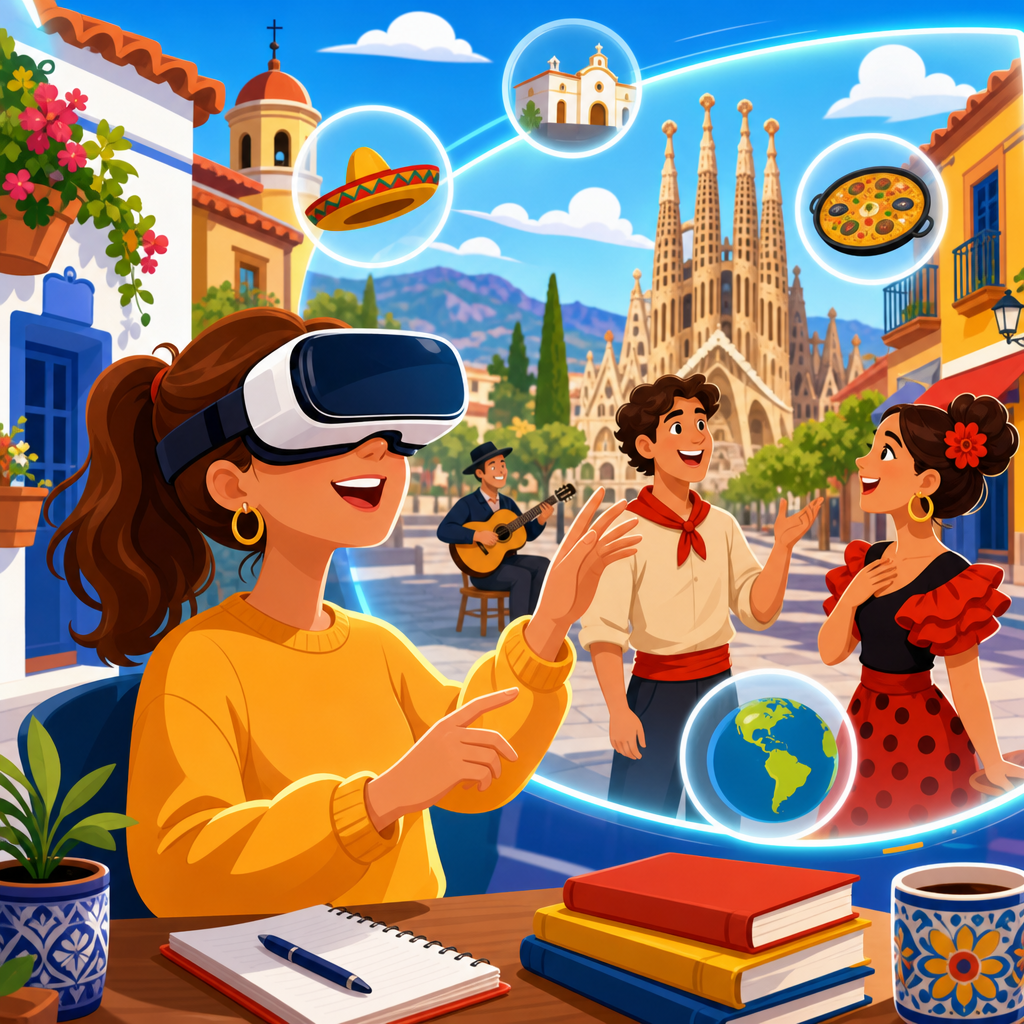
Virtual reality is no longer a novelty in language education; it is becoming a practical tool for Spanish learning that combines immersion, repetition, social interaction, and measurable feedback in ways textbooks and standard apps cannot match. In this context, virtual reality refers to computer-generated environments experienced through headsets such as Meta Quest, Pico, or HTC Vive, where learners can look around, move, speak, and interact with digital objects and people as if they were present in a Spanish-speaking setting. Spanish learning includes vocabulary growth, listening comprehension, pronunciation, grammar in context, cultural fluency, and the confidence to respond spontaneously. I have tested immersive language platforms with adult learners, classroom groups, and self-directed students, and the pattern is consistent: when learners feel present inside a meaningful situation, they remember more and hesitate less. That matters because one of the biggest barriers in Spanish is not access to content but lack of real interaction. Virtual reality addresses that gap by turning passive study into situated practice, making it an important hub topic within Spanish community and interaction.
What virtual reality changes in Spanish learning
The most important shift virtual reality brings is context. Traditional study often teaches words as isolated units: airport vocabulary on one page, restaurant phrases in another, and verb drills somewhere else. In a virtual environment, those pieces appear together in a usable scene. A learner checking into a hotel hears greetings, reads signage, chooses responses, asks follow-up questions, and reacts to unexpected problems. That mirrors how Spanish is used in real life. Cognitive research on situated learning and retrieval practice helps explain why this works. Information tied to action, place, and emotion is easier to recall than information memorized without context.
Presence also reduces the distance between knowing and doing. A student may understand the phrase ¿Dónde está la estación? on a flashcard but freeze when speaking to someone. In virtual reality, they practice finding the station while navigating a plaza, hearing traffic, and responding under mild pressure. That blend of realism and safety is powerful. Learners can repeat the task several times without social embarrassment, then transfer it to real travel or conversation. For Spanish community and interaction, this is central: confidence develops through doing, not just reviewing.
Another advantage is multimodal input. Good VR lessons combine audio, text, gesture, spatial cues, and object interaction. A learner hears la taza, sees a cup on a table, picks it up, and perhaps places it next to el plato. This creates multiple memory pathways. Pronunciation training can also improve because learners hear native or near-native speech in realistic pacing rather than isolated recordings. Some platforms provide speech recognition, though quality varies by accent and microphone setup. Used carefully, it can still help students notice when stress patterns or vowel sounds need adjustment.
Core use cases: travel, conversation, culture, and professional Spanish
Virtual reality is especially effective when Spanish learners need task-based practice. Travel Spanish is the clearest example. Instead of memorizing disconnected phrases for airports, taxis, hotels, and cafés, learners can complete those experiences in sequence. They ask for directions, solve booking errors, order food, and respond to clarifying questions. This trains listening under realistic conditions, including background noise and varied accents. For beginners, a structured mode with prompts works best. For intermediate learners, open-ended role-play creates stronger gains because it forces flexible language production.
Conversation practice is another major use case. Many students have grammar knowledge but not conversational stamina. Social VR spaces and tutor-led simulations can create low-stakes opportunities to sustain dialogue for ten or twenty minutes. In my experience, learners who struggle in video calls often perform better in headsets because the environment feels shared. Eye contact, turn-taking, and environmental references make the exchange more natural. Saying Mira, detrás de la puerta while both speakers face the same scene feels different from clicking through slides. That shared context supports interaction.
Cultural learning also improves when environments include authentic details. A virtual market can teach more than food words. It can show regional produce, common greetings, bargaining conventions, personal space norms, and forms of politeness. A simulated Spanish-speaking neighborhood can expose learners to murals, public announcements, transit language, and local routines. This matters because fluency is not only linguistic accuracy; it is knowing how to participate appropriately. Good VR content therefore includes sociolinguistic cues, not just translation exercises.
Professional Spanish is a growing area as well. Healthcare workers can rehearse patient intake in Spanish. Hospitality staff can practice guest interactions. Customer service teams can handle complaints, returns, and scheduling issues. Educators can simulate parent meetings. These scenarios benefit from repetition and branching outcomes. If a learner misses a critical question, the situation changes, and they must recover. That type of pressure-tested practice is hard to create with worksheets but relatively straightforward in immersive simulations.
Best tools, content formats, and platform types
Not every virtual reality product teaches Spanish well. The strongest options usually fit into four categories: dedicated language-learning apps, social VR platforms, custom enterprise or school simulations, and mixed reality tools that blend digital prompts with the learner’s physical room. Dedicated apps are best for structured progression. They often include lessons, vocabulary modules, guided dialogues, and speech tasks. Social VR platforms are less controlled but excellent for real interaction, language exchanges, and spontaneous conversation. Custom simulations are strongest for domain-specific Spanish, especially in workplaces. Mixed reality can be useful for object labeling and home-based vocabulary practice, though it is currently less mature for full conversation.
When evaluating a platform, I look for six concrete features: quality audio, native-speed and slowed-speed options, meaningful feedback, scenario variety, transcript support, and replayability. Audio quality matters more than visual polish because Spanish listening accuracy depends on clear consonants, vowels, and intonation. Speed controls help learners bridge the gap between classroom Spanish and real speech. Feedback should go beyond right or wrong; the best systems highlight missed information, unnatural phrasing, or pronunciation patterns. Scenario variety prevents learners from memorizing scripts instead of building communicative ability.
| Platform type | Best for | Main strength | Main limitation |
|---|---|---|---|
| Dedicated language app | Beginners to intermediate learners | Structured lessons and guided repetition | Less spontaneous conversation |
| Social VR space | Intermediate to advanced learners | Authentic interaction with real people | Inconsistent moderation and language level |
| Custom simulation | Professional or academic training | Highly specific task practice | Higher development cost |
| Mixed reality tool | Home practice and object-based vocabulary | Blends Spanish with daily environment | Limited full-scene immersion |
Hardware matters, but not as much as people assume. Standalone headsets such as Meta Quest devices are often sufficient for language learning because the key variable is interaction design, not graphics intensity. Comfortable fit, reliable controllers, and a good microphone matter more. Institutions should also consider hygiene protocols, session length, and accessibility settings. A technically impressive headset with poor onboarding will produce worse outcomes than a simpler device with strong instructional design.
How to build an effective VR Spanish study routine
Virtual reality works best as part of a system, not as a replacement for every other method. A practical weekly routine includes preview, immersion, review, and transfer. Preview means learning the core vocabulary and grammar patterns before entering VR. If the scenario is a restaurant, students should already know key food terms, polite requests, numbers, and common question forms. Immersion is the actual VR session, ideally fifteen to thirty minutes for focused practice. Review happens immediately after, using transcripts, error notes, or vocabulary logs. Transfer means using the same language in a different format, such as a voice note, tutoring session, or journal entry.
For beginners, shorter sessions are better. Cognitive load rises quickly in immersive spaces because learners must process language, visuals, navigation, and interaction at once. I usually recommend two or three weekly sessions of fifteen to twenty minutes, paired with traditional study. Intermediate learners can handle longer scenario-based sessions, especially if the lesson has clear goals such as resolving a travel problem or conducting a five-minute conversation entirely in Spanish. Advanced learners benefit most from open-ended social exchanges, debates, storytelling, and specialized content.
Assessment should focus on performance, not just exposure. Useful metrics include response time, number of successful turns in a dialogue, comprehension of follow-up questions, pronunciation intelligibility, and retention one week later. Teachers can track this with simple rubrics. Independent learners can record themselves after each session and compare samples over time. A learner who can describe a missed train, request help, and understand the response has made meaningful progress even if every verb form is not perfect.
To connect this hub with the wider Spanish community and interaction topic, pair VR with conversation clubs, local meetups, tutoring, and online exchanges. The strongest learners use virtual reality to rehearse for real interaction. For example, practice introducing yourself in VR, then join a Spanish language exchange the same week. Rehearse asking for recommendations in a virtual café, then message a tutor about favorite foods. This creates internal linking between study modes, and each mode reinforces the others.
Limitations, costs, and what to watch before investing
Virtual reality is effective, but it is not magic. The first limitation is content quality. Some products look immersive yet rely on shallow matching exercises or rigid scripts. Those may entertain learners without significantly improving spontaneous Spanish. The second limitation is speech recognition. Automated scoring can misread accented speech, background noise, or valid regional variants. That means learners should treat machine feedback as one signal, not a final judgment. Human correction still matters, especially for pronunciation and pragmatics.
Cost is another real consideration. A standalone headset, protective accessories, software subscriptions, and replacement parts add up quickly. Schools must budget for device management, updates, charging, sanitation, and staff training. Businesses creating custom simulations face larger costs for design, voice acting, testing, and maintenance. However, the economics can still work when the alternative is repeated live role-play staffing or travel-based immersion. For self-learners, the question is simpler: will the headset be used consistently enough to justify the expense? If not, tutoring or conversation memberships may produce faster gains.
There are also health and access issues. Some users experience motion discomfort, eye strain, or fatigue. Session design should minimize unnecessary movement and allow regular breaks. Learners with glasses, hearing differences, or mobility limitations may need adjustments. Good programs offer seated modes, subtitles, controller alternatives, and clear calibration. Privacy should not be ignored either. Voice data, account information, and social interactions on VR platforms require the same caution as other connected technologies. Read data policies carefully, especially in school and workplace settings.
The practical rule is this: choose virtual reality for Spanish when you need immersive interaction that other tools cannot easily provide. Do not choose it simply because it feels innovative. If a learner mainly needs grammar explanations, a strong textbook or tutor is more efficient. If they need to stop freezing in conversations, understand Spanish in context, and build confidence through repeated situational practice, virtual reality becomes a compelling option.
Why the future is here for Spanish community and interaction
Virtual reality and Spanish learning fit together because language is social, physical, and contextual. The best learning happens when people must listen, interpret, respond, and adapt inside meaningful situations. Immersive technology brings those situations within reach for learners who cannot travel, lack local conversation partners, or need specialized practice before using Spanish at work or in daily life. It supports travel preparation, real-time conversation, cultural awareness, and professional communication, all within repeatable environments that reduce fear and increase participation.
The key takeaway is not that virtual reality replaces teachers, books, apps, or communities. It strengthens them by filling a long-standing gap between study and action. Use it to rehearse common scenarios, test your listening under pressure, and build the confidence to speak with real people. If you are organizing your Spanish community and interaction resources, treat this miscellaneous hub as the starting point for immersive tools, conversation practice, and emerging formats. Explore a quality platform, set a simple weekly routine, and let your next Spanish session happen inside a world where you actually have to use the language.
Frequently Asked Questions
1. How does virtual reality actually improve Spanish learning compared with textbooks and standard language apps?
Virtual reality improves Spanish learning by placing learners inside simulated environments where the language is tied to action, context, and immediate response. Instead of only memorizing vocabulary lists or tapping through isolated exercises, learners can practice Spanish in situations that feel real, such as ordering food in a cafe, asking for directions in a city, checking into a hotel, or participating in a casual conversation. That kind of contextual learning matters because the brain tends to retain language more effectively when words and phrases are connected to visual cues, movement, emotion, and purpose.
Another major advantage is immersion. In VR, learners are surrounded by Spanish in a way that is difficult to recreate with a textbook or even a mobile app. They can hear spoken language, respond out loud, interact with objects, and often receive instant corrections or prompts. This engages listening, speaking, comprehension, and recall at the same time. Traditional tools can be helpful for grammar review and repetition, but they often lack the sense of presence that pushes learners to think and respond in Spanish more naturally.
VR also supports active learning rather than passive exposure. A learner is not just reading about how to use a phrase; they are using it while navigating a digital environment. That creates practical confidence, which is often one of the biggest barriers in language acquisition. For many learners, especially adults, the problem is not understanding every rule but feeling ready to speak. Virtual reality helps close that gap by making practice more lifelike, repeatable, and less intimidating than a high-pressure real-world exchange.
Finally, many VR platforms include built-in performance tracking, pronunciation feedback, task completion metrics, and adaptive difficulty. That gives learners measurable progress rather than vague impressions. In short, textbooks teach structure, apps support review, but virtual reality can bring Spanish to life through immersion, repetition, interaction, and real-time feedback.
2. Is virtual reality effective for beginners, or is it better suited to intermediate and advanced Spanish learners?
Virtual reality can be effective for beginners, intermediate learners, and advanced speakers, but the design of the experience matters. For beginners, the greatest value comes from exposure to essential vocabulary, basic phrases, listening comprehension, and simple interactions in highly visual settings. A novice learner may step into a virtual grocery store, for example, and connect words like manzana, agua, and pan to visible objects while hearing them pronounced clearly. That combination of audio, image, and action can make foundational Spanish much easier to understand and remember.
For intermediate learners, VR becomes especially powerful because it allows them to move beyond controlled exercises and into more fluid communication. They can practice conversations, improve their response speed, and reinforce grammar patterns in context. This is often the stage where learners know a fair amount of Spanish but still struggle with spontaneous speaking. Virtual reality gives them a bridge between studying and real communication by offering realistic scenarios without the full pressure of an unpredictable live environment.
Advanced learners can benefit as well, particularly through nuanced conversation, cultural simulations, role-play, and social interaction with other users or AI-driven characters. They may use VR to refine accent, practice profession-specific vocabulary, navigate complex dialogue, or build confidence in discussing abstract topics. In some cases, advanced learners can participate in virtual meetups, guided experiences, or collaborative tasks entirely in Spanish, which helps maintain fluency and deepen cultural familiarity.
The key point is that VR is not inherently too advanced for beginners. What matters is whether the program includes appropriate scaffolding, such as translations, visual prompts, adjustable speech speed, structured lessons, and guided repetition. When those supports are present, virtual reality can serve as an effective tool from day one and continue to scale with the learner over time.
3. What types of Spanish skills can learners develop in virtual reality?
Virtual reality can support nearly every major area of Spanish learning, though some skills benefit more directly than others. Speaking is one of the clearest strengths. Because VR encourages verbal interaction in realistic settings, learners get repeated opportunities to form sentences, answer questions, and practice pronunciation. This is especially useful for developing confidence and fluency, since many learners understand more Spanish than they feel comfortable speaking.
Listening comprehension also improves significantly in VR. Learners hear Spanish used in context, often with different voices, accents, speaking speeds, and conversational patterns. This is more dynamic than listening to isolated recordings because the language is tied to a scene, a task, or a social exchange. As a result, learners become better at understanding meaning from context, not just from individual words.
Vocabulary acquisition is another strong area. In virtual environments, words are connected to objects, actions, places, and goals. A learner is not simply memorizing the word for ticket, table, or door; they are seeing and using those items in a meaningful situation. That makes vocabulary more memorable and easier to retrieve later. Grammar can also be reinforced effectively, especially when learners repeatedly use sentence patterns in real scenarios, such as asking questions, making requests, describing locations, or talking about past events.
Reading and writing are possible in VR too, although they are usually secondary compared with speaking and listening. Some experiences include signs, menus, instructions, subtitles, chat functions, or written tasks that support literacy skills. However, if a learner’s main goal is academic writing or detailed grammar analysis, VR should probably be combined with more traditional study methods. Overall, virtual reality is especially strong for communicative competence: understanding spoken Spanish, responding naturally, building vocabulary in context, and developing the confidence to use the language in real situations.
4. Do learners need expensive equipment and technical expertise to use virtual reality for Spanish learning?
Not necessarily. While high-end virtual reality once required costly hardware, external sensors, and a powerful computer, the technology has become far more accessible. Many modern headsets, including standalone devices such as the Meta Quest line and similar systems, can run educational and language-learning experiences without needing a separate PC. That lowers the barrier to entry significantly for individual learners, schools, and training programs.
That said, cost still depends on the setup. A standalone headset is often the most practical option for language learners because it is simpler to use and easier to maintain. More advanced PC-connected systems can deliver stronger graphics or specialized simulations, but they are not always necessary for effective Spanish practice. In many cases, the quality of the educational software matters more than having the most expensive hardware. A well-designed VR lesson with clear goals, interaction, feedback, and useful dialogue will usually provide more value than a visually impressive but poorly structured experience.
As for technical expertise, most current platforms are designed for general consumers, not just technology specialists. Basic setup usually involves charging the device, creating an account, connecting to Wi-Fi, and learning a few hand controls. After that, learners can often launch lessons much like opening an app on a phone or tablet. There may be a short adjustment period, especially for people who have never used immersive technology before, but it is typically manageable.
Learners should also think about practical factors such as comfort, available space, session length, and motion sensitivity. Some people prefer shorter sessions to avoid fatigue, and others may need seated experiences rather than movement-heavy ones. These are usability considerations, not reasons to avoid VR altogether. In short, virtual reality for Spanish learning is more attainable than many people assume, and it no longer requires advanced technical skills to get started.
5. Can virtual reality replace traditional Spanish classes and study methods completely?
Virtual reality is a powerful tool, but it is best understood as an enhancement rather than a complete replacement for every traditional method. It excels at immersive practice, conversational confidence, contextual vocabulary, and experiential learning. Those are areas where textbooks and standard apps often fall short. However, traditional instruction still plays an important role, especially for structured grammar explanations, writing development, reading comprehension, academic assessment, and long-term curriculum planning.
For many learners, the strongest approach is blended learning. A class, tutor, or structured course can provide sequence, accountability, and explanation, while VR adds realistic practice and engagement. For example, a learner might study past tense forms in a lesson, review key vocabulary in an app, and then enter a virtual scenario where they describe what they did yesterday or ask someone about a recent event. That combination reinforces knowledge from multiple angles and makes it more likely that the learner will retain and use the language effectively.
There is also the human factor. Skilled teachers can diagnose errors, explain cultural nuance, adapt to a learner’s needs, and motivate progress in ways that software still cannot fully match. Even social VR environments, while promising, vary in quality and may not always provide the consistent instructional guidance that a trained educator can offer. On the other hand, VR can dramatically increase the amount of meaningful practice a learner gets between classes, which is often the missing piece in language development.
So, no, virtual reality should not be seen as a total replacement for all conventional Spanish learning methods. It is better viewed as one of the most exciting and practical additions to the language-learning toolkit. Used well, it can make practice more immersive, more frequent, and more realistic, helping learners turn passive knowledge into active communication.