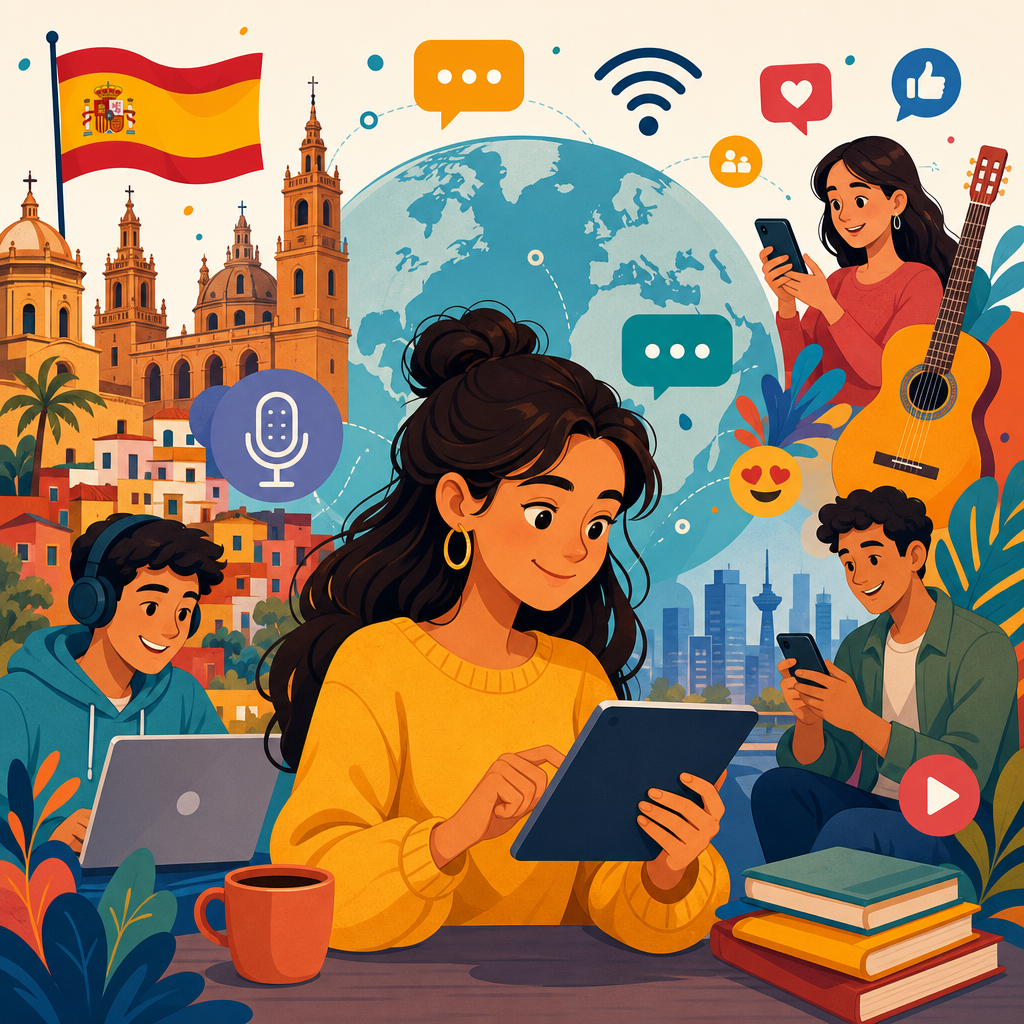
Spanish in the digital age is changing faster than at any other point in its recorded history, shaped by messaging apps, social platforms, streaming media, online learning, and the daily habits of hundreds of millions of speakers. In practical terms, digital Spanish refers to the vocabulary, grammar choices, pronunciation influences, writing conventions, and cultural references that emerge when Spanish is used through screens rather than face to face. As someone who has worked with Spanish-language content teams, localization workflows, and online communities across Spain and Latin America, I have seen the same pattern repeatedly: digital communication does not weaken Spanish; it multiplies its varieties, speeds up innovation, and exposes regional differences that used to stay local.
This matters because Spanish is one of the world’s largest languages by native speakers and one of the most important languages on the internet. Its digital expansion affects education, journalism, customer support, entertainment, e-commerce, and community building. A gamer in Mexico, a journalist in Bogotá, a student in Madrid, and a creator in Buenos Aires may all write in Spanish, but they may not choose the same pronouns, slang, punctuation, or tone. Understanding those differences is essential for anyone publishing for a Spanish-speaking audience. It is also essential for readers navigating a flood of content where machine translation, algorithmic recommendations, and viral trends shape which forms of Spanish are seen, repeated, and normalized.
At the center of this shift are a few key terms. Language evolution is the process by which a language changes over time in pronunciation, vocabulary, syntax, and use. Register refers to the level of formality used in a specific context. Localization is the adaptation of content for a regional audience, not just translation. Code-switching is the movement between languages, often Spanish and English, within the same conversation. Digital discourse includes everything from WhatsApp voice notes to comments, livestream chats, subtitles, and search queries. These concepts explain why digital Spanish often looks compressed, hybrid, and highly responsive to context. The same speaker may use perfect formal prose in an email, clipped colloquial spelling in a chat, and highly regional slang in a meme caption, all within one hour.
Because this page serves as a hub for miscellaneous topics within Spanish community and interaction, it covers the major patterns that connect the field: how online platforms reshape language, which trends matter most, where regional differences appear, how institutions respond, and what practical choices publishers should make. If you are deciding how to write, translate, moderate, teach, or market in Spanish online, the goal is simple: understand the language as it is actually used today, not as it was frozen in a textbook.
How digital platforms are reshaping Spanish
Every major platform rewards a different style of Spanish. Messaging apps encourage brevity, reaction speed, and intimacy. Users drop accents, shorten words, rely on emojis, and replace full sentences with audio notes or stickers. Social networks reward catchiness and identity signaling, so slang, irony, and compressed references spread quickly. Search engines reward clarity and explicit phrasing, pushing writers toward direct question-and-answer structures. Video platforms elevate spoken Spanish and subtitles, making pronunciation, cadence, and regional accent more visible than in earlier text-first internet environments.
I have seen brand teams fail when they assume one neutral digital Spanish exists. In reality, platform norms matter as much as regional norms. On X, users often favor sharp brevity and political shorthand. On TikTok, creators lean into spoken rhythm, humor, and localized vocabulary. On LinkedIn, professional Spanish tends to be closer to edited standard usage, though still more conversational than print business writing. On Twitch and Discord, gaming communities normalize English borrowings such as stream, lobby, ban, mod, clip, and leak, often adapted morphologically into forms like streamear, banear, moderar, and clipear. These are not random errors. They are productive patterns showing how Spanish integrates new concepts.
The rise of voice and video has also changed what counts as public Spanish. For decades, edited newspaper Spanish shaped prestige online. Now creators with strong regional identities can reach millions without passing through institutional filters. Caribbean Spanish, Rioplatense Spanish, Mexican Spanish, Andean varieties, and Peninsular forms all circulate visibly. This greater exposure reduces the old illusion that a single broadcast standard can represent everyone equally well.
Vocabulary change, internet slang, and borrowing
The fastest-moving area of digital Spanish is vocabulary. New terms enter through technology, fandom, activism, business, and youth culture. Some arrive as direct loans from English, especially in software and platform culture: post, link, spoiler, hashtag, feed, bot, scam, follower, scroll, and update. Others are translated or adapted: nube for cloud, cuenta for account, viralizar for to make viral, and desbloquear used both technically and metaphorically. Many are hybrid creations that feel fully natural to younger users even when older speakers resist them.
Regional slang also scales in a way it rarely did before. Words like chamba, guay, che, pana, parcero, bacán, pibes, and wey appear outside their home regions because memes and creators export them. Yet diffusion does not erase origin. A word can become widely recognized without becoming appropriate everywhere. That distinction matters for publishers. Recognition is not the same as local credibility.
Another major trend is semantic expansion. Existing Spanish words gain new digital meanings. Seguir is not just to follow physically but to subscribe socially. Muro, historia, perfil, tendencia, and cuenta all acquired platform-specific senses. Funar, especially in parts of Latin America, developed a digital public-shaming meaning. Cancelar and viral have expanded far beyond their older uses. This is how language usually changes: familiar words are repurposed before entirely new ones are invented.
Not every borrowing survives. Teams I have advised often overuse English where Spanish already has a strong native equivalent, producing copy that feels imported rather than natural. A useful rule is this: keep established industry terms when users actually say them, but prefer clear Spanish when the audience gains precision from it. In support content, for example, enlace often outperforms link, and actualizar may be better than update. In creator culture, however, forcing native alternatives can sound artificial.
Grammar, spelling, and style in online communication
Digital Spanish changes style more than it changes core grammar, but those stylistic shifts are still significant. Informal writing often omits opening question and exclamation marks, accent marks, and sometimes vowels. Users write porque and por que correctly in formal settings but may simplify in chats. Repetition of letters for emphasis, such as holaaaa or buenoooo, mirrors speech prosody. Capitalization becomes expressive rather than purely orthographic. All caps can signal anger, excitement, or mock seriousness.
These practices do not mean standards have disappeared. They mean writers switch registers quickly. In moderated communities and business channels, audiences still expect conventional spelling, punctuation, and coherent syntax. Poorly localized or machine-generated Spanish is easy to detect because it mishandles articles, prepositions, gender agreement, and regional collocations. Native users tolerate playful informality; they do not tolerate language that feels carelessly translated.
Pronouns are another area where digital communication highlights variation. Tú, vos, and usted all remain active, with strong regional and social meanings. Argentine, Uruguayan, and parts of Central American audiences may expect voseo. Colombian and Costa Rican communities may use usted in surprisingly warm contexts. Spain favors vosotros in informal plural address, while most of Latin America uses ustedes for both formal and informal plural. Any hub covering Spanish community and interaction must recognize this because pronoun choice is one of the fastest ways to signal belonging or distance.
| Area | Common digital pattern | Practical implication |
|---|---|---|
| Vocabulary | English loans and adapted verbs | Use terms audiences already say; avoid forced calques |
| Register | Rapid switching between formal and informal | Match channel expectations, not just brand tone |
| Pronouns | Tú, vos, usted, vosotros vary by region | Localize address forms for trust and clarity |
| Orthography | Relaxed punctuation in chats, standard writing in official contexts | Keep formal assets edited even if social copy is flexible |
| Meaning | Existing words gain platform-specific senses | Check current usage before translating literally |
Inclusive language is another digital flashpoint. Forms such as todos, todas, todes, Latinx, and Latino/a reflect political, cultural, and regional debates rather than settled universal norms. Institutions differ widely in acceptance. Some universities, activist networks, and community groups use inclusive forms routinely; many mainstream businesses and news organizations avoid them or use alternative phrasing such as la comunidad estudiantil. The right approach depends on audience, purpose, and editorial policy, not a single rule.
Regional diversity, identity, and online communities
One of the most important digital trends is the visibility of regional Spanish as identity performance. Before social media, many people mainly encountered standard textbook Spanish, dubbed television Spanish, or national media norms. Today they encounter creators speaking naturally from Monterrey, Seville, Lima, San Juan, Medellín, or Santiago. Accent, slang, and syntax become community markers rather than obstacles to reach.
This has social benefits and communication challenges. The benefit is authenticity. Audiences often reward creators and brands that sound local instead of flattened. The challenge is mutual comprehension across the Spanish-speaking world. A phrase that feels effortless in one country can confuse or amuse another. Consider coger, which is harmless in Spain for taking something but vulgar in parts of Latin America. Ordenador and computadora split along regional lines. Carro, auto, coche, and vehículo carry different naturalness depending on market. These are not trivia points; they influence search behavior, ad relevance, and conversion rates.
Online communities often solve this through layered language strategies. A pan-regional article may use broadly understood terms, while landing pages, ads, and community management are localized. Streaming subtitles may choose one neutral option while voice talent keeps a regional accent. In multilingual border communities, especially in the United States, code-switching produces forms of Spanish shaped by English contact. Spanglish is not one uniform variety, but a set of practices that can carry pride, practicality, and sometimes stigma depending on context.
Moderation also depends on regional knowledge. I have seen automated filters miss harassment because insults vary dramatically by country. Community teams need local lexicons and contextual review, especially in gaming, sports, and politics, where meanings shift quickly. A successful Spanish community strategy is therefore linguistic and cultural, not merely grammatical.
Institutions, education, and technology
Language institutions still matter, but their role has changed. Organizations such as the Real Academia Española and the Asociación de Academias de la Lengua Española document usage, standardize reference works, and offer guidance on orthography and lexicon. Their recommendations remain influential in publishing, education, and formal editing. However, digital adoption rarely waits for institutional approval. Users create forms first; dictionaries and style guides often follow after frequency and stability become visible.
Education technology has accelerated this cycle. Learners now encounter Spanish through Duolingo, YouTube teachers, podcasts, online tutoring, fandom spaces, and AI chat tools, not just classrooms. That broad exposure helps comprehension, but it can also produce mixed registers. A learner may know formal conjugation tables yet struggle with everyday texting conventions, or understand Mexican YouTube Spanish but not Rioplatense voseo. Good instruction now teaches both standard foundations and variation awareness.
Machine translation and generative AI have improved significantly, but Spanish still exposes weaknesses quickly. Systems often flatten regional distinctions, overtranslate idioms, mishandle gendered agreement in long sentences, or choose the wrong pronoun set for the market. Professional workflows therefore still require human review, terminology management, and style guidance. Tools such as DeepL, Google Translate, memoQ, SDL Trados Studio, and phrase-based translation memories can speed production, but they do not replace editorial judgment.
Speech technology brings another layer. Automatic captions, voice assistants, and speech recognition tools perform unevenly across accents. Speakers with Caribbean aspiration, rapid Chilean speech, or mixed Spanish-English code-switching can experience lower recognition accuracy. This matters for accessibility and discoverability because transcripts and captions increasingly feed search and recommendation systems. Better Spanish digital content is not only well written; it is also well transcribed, clearly structured, and easy for both humans and machines to parse.
What publishers, brands, and community leaders should do next
The clearest lesson from digital Spanish is that effective communication starts with audience definition. Decide whether you are writing for a single country, a regional cluster, or a broad international audience. Then choose vocabulary, pronouns, examples, and tone accordingly. If a page serves all markets, prioritize widely understood terms and avoid culturally narrow jokes. If conversion matters in one market, localize deeply. A Mexican checkout flow, an Argentine ad, and a Spanish help center should not sound identical.
Build editorial systems, not one-off fixes. Create a glossary of preferred terms, document pronoun choices, and note forbidden literal translations. Review search data by country because users do not query the same way everywhere. Test community moderation with native reviewers. Use subtitles and transcripts for video. When publishing educational or hub content, define terms clearly, answer obvious user questions directly, and link related pages so readers can move from general guidance to specific subtopics.
Most of all, treat Spanish as a living network of communities rather than a single monolith. The digital age rewards clarity, authenticity, and adaptation. Brands that listen to real usage produce stronger trust. Educators who teach variation prepare learners for actual interaction. Community managers who understand local signals prevent avoidable conflict. Writers who respect both standards and change create content that remains useful longer.
Spanish in the digital age is not becoming less legitimate, less rich, or less coherent. It is becoming more visible, more interactive, and more diversified in public. That creates complexity, but it also creates opportunity. If you publish, teach, translate, or lead communities in Spanish, audit your current content, identify where generic language is failing your audience, and update your approach to match how Spanish is truly used today.
Frequently Asked Questions
What does “digital Spanish” actually mean, and how is it different from traditional Spanish?
Digital Spanish refers to the way Spanish changes when it is used primarily through phones, computers, social networks, messaging apps, streaming platforms, online classrooms, and other screen-based environments. It is not a separate language, and it is not simply “incorrect Spanish.” Instead, it is a living, adaptive form of communication shaped by speed, audience, platform conventions, and constant contact with global media. In practice, digital Spanish includes shortened expressions, platform-specific vocabulary, borrowed terms from English and other languages, creative spelling, emoji-supported meaning, hashtags, voice-note habits, and more flexible punctuation than many people would use in formal writing.
The biggest difference between digital and traditional Spanish is context. Traditional Spanish, especially in academic, literary, journalistic, or institutional settings, tends to follow established grammar, spelling, and style norms more closely. Digital Spanish, by contrast, often prioritizes immediacy, personality, and efficiency. A speaker may write “tqm,” “xfa,” or “jajaja” in a private message, but use fully standard Spanish in a work email or published article. That does not mean one form replaces the other. Most fluent users move between registers naturally, adjusting their language depending on whether they are texting a friend, posting on social media, speaking in a video, or writing professionally.
Another important distinction is that digital environments make regional variation more visible. In the past, many speakers were exposed mainly to local Spanish plus formal standard forms. Today, people regularly encounter vocabulary, memes, pronunciation patterns, and expressions from Mexico, Spain, Argentina, Colombia, the Caribbean, and U.S. Spanish communities all in the same day. As a result, digital Spanish is not just faster; it is also more interconnected, more hybrid, and more transparent about how diverse the Spanish-speaking world really is.
How are social media and messaging apps influencing the evolution of Spanish vocabulary and grammar?
Social media and messaging apps are accelerating language change because they create enormous volumes of everyday writing from ordinary speakers, not just from authors, editors, or institutions. This matters because language evolves through repeated use, and digital platforms reward repetition, imitation, and rapid spread. A phrase that begins as a local joke, meme, or influencer catchphrase can cross borders in hours. Words gain traction because they are funny, efficient, emotionally expressive, or socially recognizable. That is why digital Spanish constantly generates new slang, revives older expressions, and adapts existing words for new online meanings.
Vocabulary change is the most visible effect. Speakers adopt terms linked to technology itself, such as words for posting, streaming, muting, scrolling, or going viral, while also reshaping older Spanish words for new digital contexts. Borrowings from English are especially common in areas like gaming, marketing, content creation, and software, but they are often adapted to Spanish pronunciation, spelling, or grammar over time. In many cases, speakers use both borrowed and native options side by side, choosing one or the other depending on region, age, and platform.
Grammar is changing more subtly, but still significantly. Messaging encourages omission when meaning remains clear, so subjects, punctuation, accents, and even articles may be dropped in casual exchanges. Short lines replace long sentences. Repetition of letters or punctuation can add emotion, as in “holaaa” or “qué???” Voice notes also influence syntax, because people increasingly write the way they speak and speak the way they message. In digital spaces, sentence boundaries are often looser, and tone is managed through formatting choices, capitalization, GIFs, emojis, and timing. None of this means Spanish grammar is disappearing. It means that speakers are using grammar more strategically, with different norms emerging for different digital situations.
Perhaps the most important point is that digital influence does not create chaos as much as layered communication. Spanish speakers today are developing a broader repertoire. They know when brevity is acceptable, when precision matters, and when online style carries social meaning. That flexibility is one of the clearest signs that the language is evolving in response to digital life.
Is the growing influence of English online changing Spanish permanently?
English is unquestionably influencing Spanish online, but influence does not automatically mean replacement. Spanish has always absorbed outside influences, adapted them, and integrated them according to its own structure and cultural needs. What feels especially noticeable in the digital age is the speed and visibility of that process. Because so much technology, software, internet culture, and platform design emerges first in English-speaking environments, Spanish speakers often encounter new concepts in English before a widely accepted Spanish equivalent becomes common. This leads to borrowed words, hybrid expressions, and code-switching, especially in bilingual communities and professional fields tied closely to global media.
Some English-derived terms remain relatively unchanged, while others become fully “Spanishized” in pronunciation, spelling, verb formation, or pluralization. Speakers may create verbs from borrowed nouns, adapt pronunciation to local norms, or alternate between English and Spanish terms depending on the audience. In many cases, these borrowed forms are practical rather than ideological. People use what is widely understood, easy to type, and socially current. Over time, some of these terms become normalized, while others fade as stronger Spanish equivalents emerge.
The long-term effect is not a simple takeover by English. Rather, Spanish is becoming more visibly hybrid in certain domains, especially technology, pop culture, gaming, business, and online identity. At the same time, institutions, educators, journalists, and creators continue to promote and circulate Spanish alternatives. The result is a dynamic balance: some English-influenced forms settle into everyday usage, some remain niche, and some are replaced by native expressions once the speech community stabilizes around a preferred term.
It is also crucial to remember that English influence is not uniform across the Spanish-speaking world. A bilingual speaker in Miami, a gamer in Mexico City, a student in Bogotá, and a journalist in Madrid may all handle English-derived language differently. The future of Spanish will likely include more contact with English, but the language is not becoming less Spanish. If anything, it is demonstrating one of its oldest strengths: the ability to absorb change without losing its identity.
Are younger Spanish speakers harming the language with internet slang, abbreviations, and informal writing?
No. Younger speakers are not harming Spanish; they are doing what younger generations have always done in every language: innovating, testing boundaries, signaling identity, and creating faster ways to communicate with peers. What has changed is that digital platforms make these innovations more visible, more permanent, and more shareable. Adults now see written traces of youth language constantly, which can create the impression that standards are collapsing. In reality, what we are seeing is not decay, but register expansion. Young people often know perfectly well how to distinguish between a casual group chat, a social caption, a school assignment, and a job application.
Internet slang and abbreviations serve real communicative purposes. They save time, create group belonging, express humor, soften tone, and reflect the rhythm of digital interaction. Forms like abbreviated phrases, meme-based language, exaggerated spelling, and punctuation play can communicate nuance that would otherwise require longer explanation. These are not random distortions. They are patterned, socially meaningful choices shaped by platform culture and peer expectations.
From a linguistic perspective, informal digital writing can even strengthen language awareness. Many young speakers become highly skilled at shifting style, tone, and vocabulary depending on context. That ability to switch registers is a sophisticated communicative skill. The concern only becomes valid when a speaker has not been taught how and when to use more formal Spanish. The real issue, then, is not that slang exists, but whether education supports competence across multiple registers.
It is also worth noting that many features criticized as “internet Spanish” have older roots in spoken language, youth culture, humor, and regional slang. Digital media did not invent language play; it amplified it. A healthy view of Spanish in the digital age recognizes that slang, abbreviations, and informal writing are part of the language ecosystem. They do not replace formal Spanish. They coexist with it and, in many cases, enrich the expressive range available to speakers.
What trends will shape the future of Spanish in the digital age?
Several major trends are likely to shape Spanish over the coming years, and they all point toward greater diversity, faster circulation, and more platform-driven variation. First, audio and video will continue to influence written Spanish. As voice notes, short-form video, livestreaming, and speech-to-text tools become even more common, written language will increasingly reflect spoken patterns. This means more conversational syntax, stronger regional visibility, and greater acceptance of informal structures in spaces that were once more rigidly written.
Second, artificial intelligence, automated translation, predictive text, and grammar-correction tools will have a growing role in shaping what people write. These technologies can standardize certain forms by nudging users toward common spellings or phrasing, but they can also flatten regional variation if not designed carefully. At the same time, they may help preserve access to Spanish by making writing, editing, and learning more efficient for millions of users. The key question will be whether digital tools reflect the full diversity of the Spanish-speaking world or privilege only a narrow standard.
Third, regional Spanish varieties will likely become even more visible and influential. Digital platforms reward creators