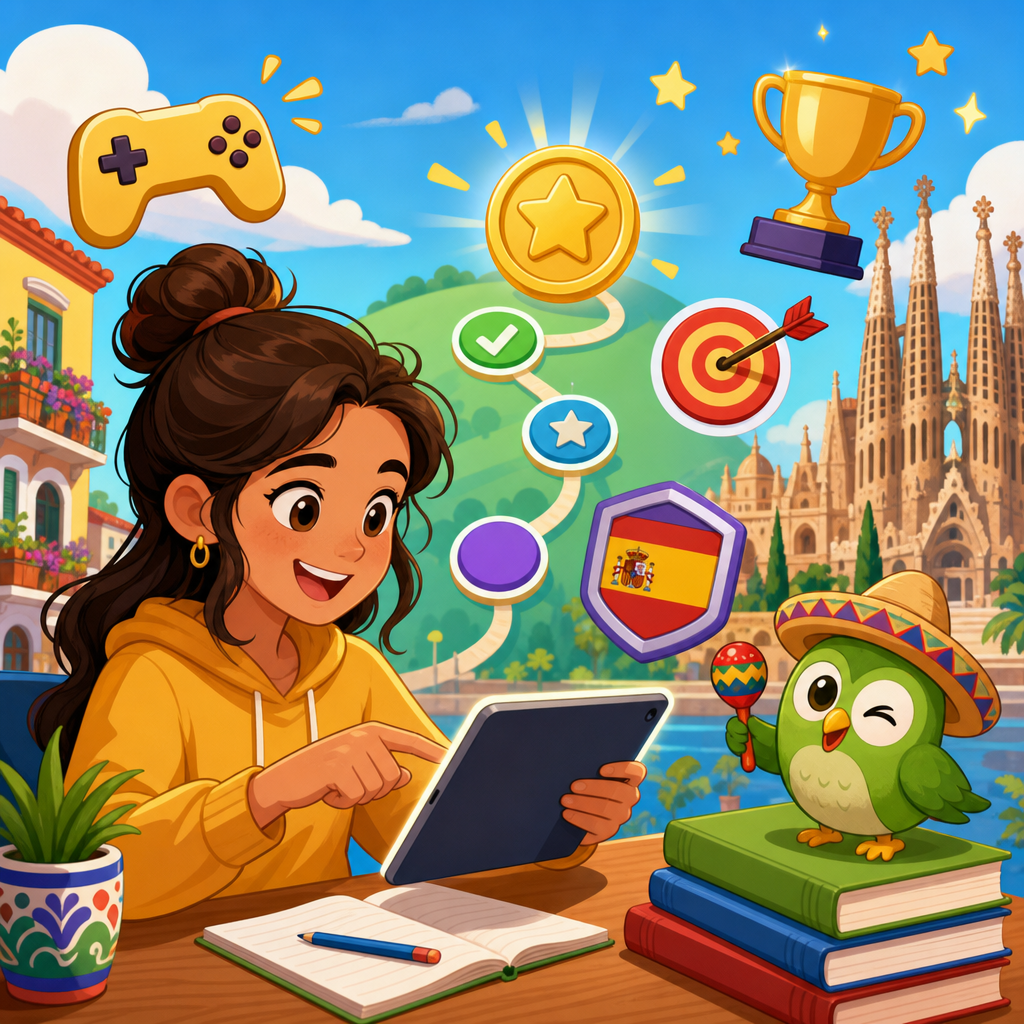
Gamification in Spanish learning turns practice into a system of goals, feedback, and rewards that keeps students participating long enough to build real skill. In language education, gamification means applying game mechanics such as points, levels, streaks, quests, badges, timed challenges, and social competition to non-game tasks like vocabulary review, listening drills, conversation practice, and writing corrections. It is not the same as simply playing games in class. A word search can be fun, but true gamification creates a structure around learning behaviors so progress is visible, repeatable, and motivating.
This matters because Spanish learners often struggle less with access to materials than with consistency. They download an app, memorize a few greetings, and then stop before grammar patterns or listening comprehension become automatic. I have seen this pattern repeatedly in community programs, tutoring groups, and online cohorts: motivation is highest at the beginning, drops during the first plateau, and only returns when learners can measure improvement clearly. Gamification addresses that middle stretch. It helps learners return tomorrow, not just study hard today.
For a hub page under Spanish Community and Interaction, this topic also connects many related articles naturally. Gamified strategies can support conversation clubs, peer challenges, cultural events, bilingual meetups, classroom participation, online accountability groups, and family learning routines. Whether the learner is a beginner practicing numbers or an intermediate speaker trying to survive a fast group chat, the right game structure can increase repetition, reduce fear of mistakes, and make interaction feel safer. The most effective systems do not distract from Spanish. They make Spanish use more frequent, more social, and easier to sustain over months.
At its best, gamification supports the fundamentals that actually grow fluency: retrieval practice, spaced repetition, immediate feedback, comprehensible input, output under light pressure, and meaningful social reinforcement. The rest of this article explains which strategies work, where they fit, and how to build a system that keeps learners engaged without turning Spanish into empty point collecting.
What effective gamification looks like in Spanish learning
Effective gamification starts with a learning objective, not a gimmick. If the goal is vocabulary retention, a points system should reward correct recall after delays, not only fast recognition. If the goal is conversation confidence, learners should earn progress for asking follow-up questions, negotiating meaning, and staying in Spanish for a set time. Good design aligns the reward with the exact behavior that leads to language growth.
In practice, the strongest mechanics are simple. Progress bars show movement toward a weekly target. Streaks encourage daily contact with Spanish, especially for listening and flashcards. Levels give a sense of advancement when learners master clear milestones such as present-tense verb use, restaurant vocabulary, or past narration. Badges work when they mark something concrete, like “Held a five-minute conversation” or “Understood a full podcast segment without subtitles.” Timers add urgency for retrieval, while team challenges add accountability and community.
Digital platforms have popularized these mechanics. Duolingo uses streaks, leagues, and experience points to drive daily usage. Quizlet adds test modes and match games for vocabulary review. Kahoot increases energy in classrooms with fast-response competition. Memrise and Anki support spaced repetition, which is critical because memory strengthens when learners retrieve words just before forgetting them. The lesson from these tools is not that one app solves everything. It is that repeated exposure plus visible progress changes behavior.
There is also a difference between extrinsic and intrinsic motivation. External rewards can start a habit, but long-term success comes when learners begin to value understanding songs, speaking with relatives, or joining Spanish-speaking communities. The best gamified Spanish learning systems bridge that gap. They use points and challenges to get students through early friction, then shift attention toward real communicative wins. When a learner realizes they ordered food confidently or followed a group conversation, the game mechanic has done its job.
Core strategies that keep learners engaged
Several gamification strategies consistently work across schools, tutoring programs, and self-study settings because they reinforce proven learning principles rather than novelty alone. The first is daily micro-challenges. Asking learners to complete a five-minute task in Spanish every day is far more sustainable than assigning a long weekly session. A micro-challenge might involve recording three sentences with new verbs, identifying ten food items in a kitchen, or replying to a prompt in a class chat using the imperfect tense. Small wins build momentum.
The second strategy is quest-based learning. Instead of presenting grammar as a flat sequence of worksheets, a teacher or program can package tasks as missions. For example, a “market quest” could require learners to review numbers, practice quantity phrases, listen to a vendor dialogue, and role-play buying fruit. A “travel quest” might cover directions, transport vocabulary, and polite requests. Quests work because they bundle language into a scenario with purpose. Learners feel they are preparing for a real interaction, not just completing isolated exercises.
Third, social competition can be highly effective when used carefully. Team-based formats usually outperform harsh individual leaderboards because they reduce embarrassment while preserving energy. In a community Spanish club I helped coordinate, we tracked points by small groups rather than by person. Teams earned scores for attendance, Spanish-only conversation minutes, peer encouragement, and completing weekend listening tasks. Participation rose because nobody wanted to let their group down, yet beginners still felt protected.
Fourth, variable rewards help maintain interest. Not every reward should be predictable. Surprise bonus rounds, mystery cultural trivia, or secret phrase challenges create curiosity. This works best when the surprise still supports learning. For instance, a teacher might reveal a bonus badge for correctly using regional expressions from Mexico, Spain, or Colombia during conversation hour. Learners remember those expressions because the moment feels distinctive.
| Strategy | Best use in Spanish learning | Example |
|---|---|---|
| Streaks | Build daily contact | Ten minutes of listening or flashcards for thirty consecutive days |
| Quests | Teach language in context | Restaurant mission with menu reading, ordering, and role-play |
| Team points | Increase accountability | Conversation club groups earn points for attendance and Spanish-only time |
| Badges | Mark milestones | Badge for completing a five-minute voice conversation |
| Timed retrieval | Strengthen recall speed | Sixty-second challenge to produce ten household nouns from memory |
Finally, immediate feedback is nonnegotiable. Gamification fails when learners collect points without understanding errors. Corrective feedback should be fast, specific, and actionable. If a student says “yo fui comiendo ayer” when they mean “I ate yesterday,” the system must show why the preterite works better than a progressive form in that context. Whether the feedback comes from a teacher, app, rubric, or peer, it turns a game from entertainment into instruction.
Using gamification in classrooms, online groups, and self-study
In classrooms, gamification works best when it structures participation that would otherwise be uneven. Teachers can assign role cards, challenge rounds, or speaking ladders that require every student to contribute. A simple example is a “conversation ladder” in which pairs must ask and answer increasingly complex questions to move up levels: name and origin, family, daily routine, preferences, weekend plans, then opinions. Students advance only when they respond fully in Spanish. This creates repetition without the dead feeling of random drill work.
For online groups, asynchronous mechanics matter more. Discussion boards, shared trackers, weekly challenges, and video reply threads keep learners engaged across time zones. Discord servers, Slack channels, and private community spaces can host vocabulary battles, meme translation contests, and pronunciation check-ins. The most successful communities moderate for quality. They do not reward any post equally; they reward useful Spanish use, respectful correction, and consistent participation. That standard prevents spammy behavior and keeps the culture focused on learning.
Self-study learners need systems that replace external accountability. Habit trackers, app reminders, calendar streaks, and scheduled review cycles are powerful because they reduce decision fatigue. I usually recommend assigning points to behaviors that cover all four major skills: reading an article, listening to a short video, speaking aloud, and writing a few original sentences. A balanced scorecard prevents the common mistake of overinvesting in passive vocabulary apps while neglecting speech and listening.
Parents and families can also apply gamification effectively. Younger learners respond well to sticker charts, treasure hunts, scavenger games, and cooperative missions like labeling objects around the house in Spanish. Teenagers often engage better with challenge formats tied to music, sports, or media. For example, a family might create a weekly challenge to identify five new words from a soccer broadcast or summarize a scene from a Spanish-language series. The principle is the same across ages: tie rewards to real language use and make success observable.
In every setting, the most durable programs connect game mechanics with community interaction. A learner who earns points alone may stay active for a while. A learner who earns progress by speaking with others, helping peers, or joining shared challenges develops both skill and belonging. That is especially important in Spanish, where real progress often depends on frequent interpersonal exchange rather than private study alone.
Common mistakes and how to avoid shallow engagement
The biggest mistake in gamified Spanish learning is rewarding activity that looks productive but does not produce retention. Tapping matching pairs on a screen can create speed, but it often measures recognition rather than recall. Learners feel successful because they move quickly, yet they cannot produce the same words in conversation. To avoid this, high-value points should go to retrieval, sentence creation, listening comprehension, and live interaction.
A second mistake is overusing leaderboards. Public rankings can motivate advanced or competitive learners, but they often discourage beginners, older adults returning to study, or anyone anxious about making mistakes in front of others. I have seen participation drop when the top three students dominate visible scores week after week. A better option is to compare learners against personal goals, use tiered milestones, or combine individual progress with team success.
Another problem is confusing entertainment with pedagogy. Trivia, spinning wheels, and classroom races can create a burst of energy, but if they are disconnected from the lesson objective, the effect fades immediately. Every mechanic should answer a simple question: what specific Spanish skill becomes stronger because this exists? If the answer is vague, redesign it. A timed challenge on gender agreement, for example, has value because quick pattern recognition supports accurate speech. A random race with no language target does not.
Feedback quality is another dividing line. Automated systems often mark answers wrong without explaining register, accent variation, or acceptable alternatives. Spanish has regional vocabulary, pronoun differences, and flexible phrasing. Learners need guidance that recognizes nuance. “Computadora” and “ordenador” are both valid; “ustedes” and “vosotros” depend on region; some pronunciation variation is normal. Strong gamification keeps standards high while acknowledging legitimate variation.
Finally, rewards can crowd out purpose if they never evolve. If students care only about points, they may choose easy tasks, avoid difficult speaking practice, or memorize just enough to win. The fix is progressive design. Early stages can emphasize consistency and confidence. Later stages should reward complexity, accuracy, comprehension depth, and authentic interaction. When the system matures with the learner, engagement remains meaningful rather than superficial.
Building a sustainable Spanish learning game plan
A sustainable gamified plan begins with measurable goals. Instead of saying “learn Spanish,” define outcomes such as “hold a ten-minute introduction,” “understand the main idea of a beginner podcast,” or “use the preterite accurately in a short story.” Each goal should map to repeatable tasks and a reward structure. That makes progress visible and prevents random study sessions.
Next, choose a cadence. Daily exposure is ideal, but intensity should match real life. Ten to twenty focused minutes per day beats a heroic weekend session followed by silence. Build a weekly cycle that includes vocabulary review, listening, speaking, reading, and writing. Add one community touchpoint such as a language exchange, class, group challenge, or recorded speaking submission. That social anchor is often what keeps a plan alive beyond the first month.
Use tools deliberately. Anki is excellent for spaced repetition if cards contain useful phrases, not isolated word lists alone. Duolingo can support habit formation, but it should not be the only source of input or output. Google Forms, Kahoot, Quizizz, and classroom LMS platforms can deliver quizzes and track progress. Voice tools such as WhatsApp, Telegram, or Flip make speaking challenges easy to run. The tool matters less than the design: clear targets, frequent feedback, and increasing communicative demands.
The most effective hub approach is to treat gamification as a connector across the wider Spanish Community and Interaction topic. Link it with conversation strategies, study groups, cultural immersion, peer correction, event participation, and online community norms. A learner who completes a streak in isolation improves modestly. A learner who completes a streak, joins a speaking circle, attends a cultural meetup, and reflects on mistakes improves much faster because every element reinforces the others.
Gamification in Spanish learning works when it makes the right behaviors easier to repeat and the results easier to see. Use points, badges, quests, and challenges to support recall, confidence, and community, not to decorate weak instruction. Start small, measure what matters, and build toward authentic interaction. If you are organizing this subtopic hub, map each related article to one practical learner goal and one community-based activity, then help readers turn practice into a system they will actually keep using.
Frequently Asked Questions
What is gamification in Spanish learning, and how is it different from just playing games in class?
Gamification in Spanish learning is the use of game-style mechanics to make language practice more motivating, structured, and consistent. Instead of treating study as a one-time activity, gamification turns it into a system with clear goals, immediate feedback, visible progress, and rewards for effort. Common examples include points for correct answers, levels that unlock harder material, streaks for daily practice, badges for specific achievements, timed challenges for fluency, and quests that organize lessons into small, winnable tasks. These mechanics can be applied to vocabulary review, grammar exercises, listening drills, speaking practice, reading comprehension, and writing correction.
The key difference is that gamification is not simply “playing a game” during class. A classroom game may be fun, but if it does not support repetition, feedback, progression, and skill-building, it may not lead to lasting improvement. Gamification is more intentional. It connects motivation to real learning outcomes. For example, a student might earn points for correctly conjugating verbs, maintain a streak by completing a daily listening activity, or unlock a new conversation challenge after demonstrating mastery of common greetings and responses. In other words, gamification is a design approach, not just entertainment. When used well, it keeps learners engaged long enough to develop genuine Spanish skills.
Why does gamification work so well for Spanish learners?
Gamification works well because language learning requires repetition, patience, and regular exposure, and many learners lose momentum before those habits become strong. Spanish learners need to review vocabulary multiple times, hear patterns repeatedly, practice speaking even when it feels uncomfortable, and receive correction often enough to improve. Game mechanics help make that process feel more rewarding and manageable. Short goals, progress bars, levels, and streaks give students a sense of movement, even when mastery takes time. That feeling of progress is powerful because it encourages learners to keep showing up.
Another reason gamification is effective is that it provides immediate feedback. In traditional learning, students may wait until the end of a lesson or test to know how they did. In a gamified system, they can see right away whether an answer was correct, how close they are to the next level, or what skill needs more practice. This creates a tighter learning loop. It also lowers the emotional weight of mistakes. Instead of seeing an error as failure, students are more likely to see it as part of the challenge. For Spanish learning in particular, where confidence often affects speaking and listening performance, that mindset shift can make a major difference.
Gamification also supports motivation in multiple ways. Some learners respond to competition, while others prefer collaboration, achievement, collection, or personal milestones. A well-designed Spanish program can use leaderboards, team quests, badges, mastery paths, and self-paced missions to appeal to different personalities. Because of that flexibility, gamification can help beginners stay involved, intermediate learners push through plateaus, and advanced students keep refining accuracy and fluency.
Which gamification strategies are most effective for building real Spanish skills?
The most effective strategies are the ones tied directly to actual language performance rather than surface-level participation. Vocabulary challenges work best when they require active recall instead of passive recognition. For example, earning points by producing the correct Spanish word from memory is more valuable than simply matching terms visually. Streaks are useful when they encourage daily listening, speaking, or reading practice, because consistency matters enormously in language learning. Levels can be effective when they reflect increasing difficulty, such as moving from basic present-tense sentences to more complex conversation tasks involving past tense, opinions, and real-world situations.
Quests are especially powerful because they give structure and purpose to learning. A Spanish quest might ask a student to learn restaurant vocabulary, listen to a short dialogue, write a mini-order in Spanish, and then practice speaking it aloud. That sequence feels interactive and goal-driven, but it also builds multiple skills at once. Badges can work well when they mark meaningful milestones, such as completing ten conversation sessions, mastering common irregular verbs, or finishing a listening module with high accuracy. Timed challenges can improve fluency and recall, but they should be used carefully so they motivate rather than overwhelm.
Social elements can also be highly effective when they stay focused on encouragement and accountability. Team competitions, peer challenges, and shared progress boards can increase participation, especially in group settings. However, the best gamification systems always keep learning first. The mechanics should guide students toward better pronunciation, stronger comprehension, wider vocabulary, and more confident communication. If a feature is exciting but does not help learners use Spanish more accurately or more often, it is not the strongest strategy.
Can gamification help with speaking and listening in Spanish, or is it mainly useful for vocabulary practice?
Gamification can absolutely support speaking and listening, and in many cases it can make these harder skills less intimidating. Vocabulary is the easiest area to gamify because it fits naturally into quizzes, flashcards, and point systems, but strong gamified Spanish learning should go much further. Listening practice can be turned into challenges where students earn rewards for identifying key words, answering comprehension questions, or successfully following audio instructions. Progression systems can move learners from slow, clearly spoken Spanish to more natural speech with regional variation, which helps build real listening resilience over time.
Speaking can be gamified through missions, role-play tasks, timed response rounds, pronunciation goals, and conversation streaks. For example, learners might complete a daily speaking quest by recording a short response in Spanish, describing their routine, asking for directions, or reacting to a prompt. They can earn badges for pronunciation milestones, longer speaking sessions, or successful completion of real-life communication scenarios. This works because it breaks speaking practice into smaller, repeatable actions. Instead of feeling pressure to “speak perfectly,” students focus on completing one challenge at a time.
In fact, gamification may be especially helpful for speaking because it reduces hesitation and builds confidence through repetition. Many learners avoid speaking because they fear mistakes. A gamified system makes speaking feel more like practice rounds than performance. Listening benefits in a similar way. Repeated audio tasks, instant feedback, and level-based progression make it easier to stay engaged with material that might otherwise feel frustrating. So while vocabulary often gets the most attention, gamification can be highly effective across all major Spanish skills when designed with real communication in mind.
What should teachers and learners avoid when using gamification in Spanish learning?
The biggest mistake is focusing on rewards while ignoring actual learning. If students are only chasing points, badges, or leaderboard positions, they may complete activities quickly without developing strong Spanish skills. Gamification should never reward empty participation more than real progress. For instance, clicking through easy tasks for a streak is far less valuable than earning recognition for accurate speaking, careful listening, or improved writing. The game mechanics should support meaningful practice, not distract from it.
Another common problem is overusing competition. Some learners thrive on leaderboards, but others become discouraged if they constantly compare themselves to stronger classmates. In Spanish learning, that can reduce confidence and participation, especially in speaking activities. A better approach is to balance competitive elements with personal progress tracking, collaborative goals, and mastery-based rewards. Students should feel challenged, not punished. Timed exercises can also backfire if they create anxiety before learners have built enough comfort with the material. Speed should come after accuracy, not replace it.
It is also important to avoid shallow or repetitive task design. If every activity feels the same, the gamified system quickly loses its appeal. Strong gamification includes variety, progression, and a clear connection to useful Spanish communication. Teachers and learners should also remember that motivation tools are not a substitute for good instruction. Students still need explanation, modeling, correction, review, and opportunities to use Spanish in realistic ways. The most successful approach combines engaging mechanics with sound teaching principles. When that balance is in place, gamification becomes more than a fun layer—it becomes a practical strategy for long-term language growth.