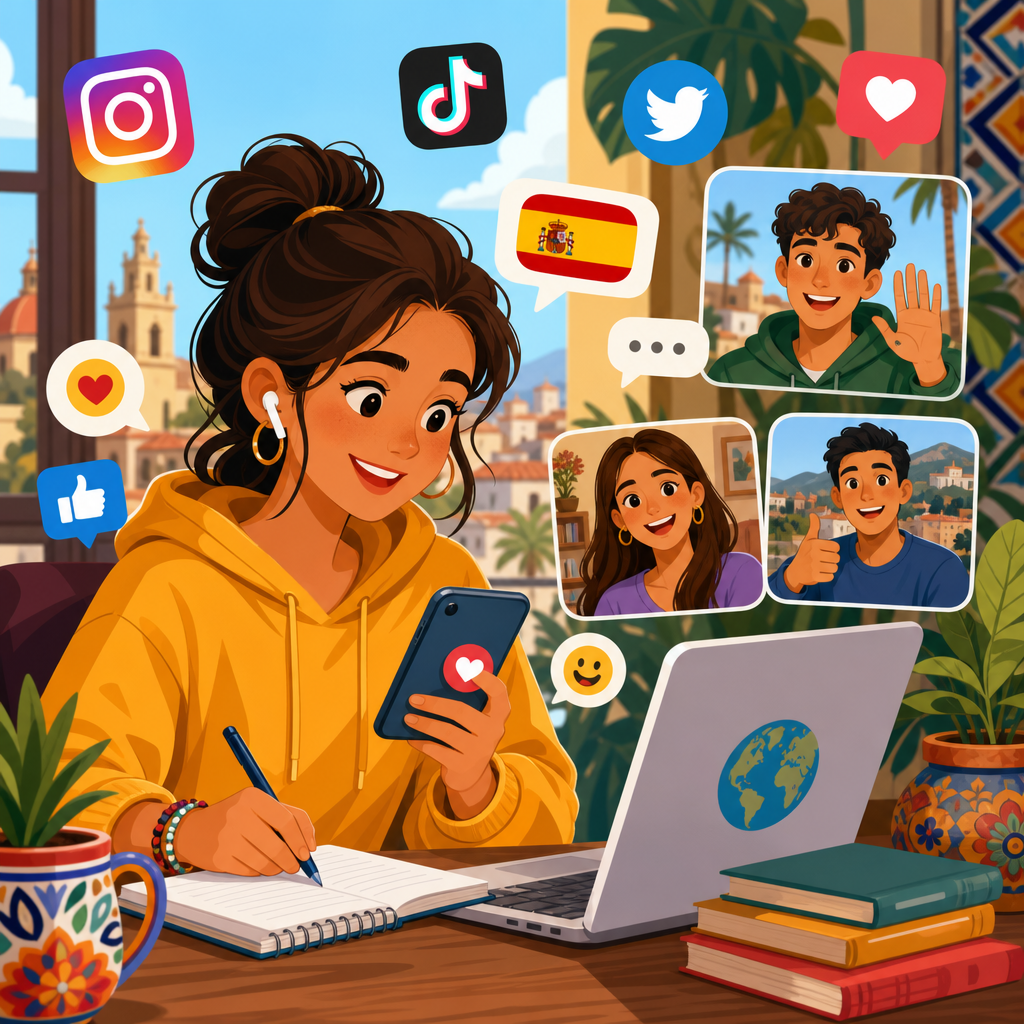
Social media has become one of the most influential environments for Spanish language acquisition because it combines authentic input, daily repetition, community interaction, and cultural context in a format people already use for hours each week. Spanish language acquisition refers to the process of developing comprehension, speaking, reading, and writing skills in Spanish through exposure, practice, feedback, and meaningful use. Unlike a traditional classroom, social platforms place learners inside living language: regional slang on TikTok, current events on X, recipe videos on YouTube, discussion threads on Reddit, and voice notes in WhatsApp groups. That immediacy matters. Spanish is spoken by more than 500 million people worldwide, and the language varies across Spain, Mexico, Colombia, Argentina, the Caribbean, and the United States. Learners who rely only on textbooks often understand standardized grammar but struggle when faced with speed, accent variation, humor, or informal phrasing. I have seen this repeatedly when coaching adult learners: a student can conjugate the preterite correctly on paper, then freeze when a native speaker says, “¿Qué onda?” or “Ahorita te mando el link.” Social media narrows that gap by exposing learners to the language as it is actually used. It also supports motivation. Progress in Spanish depends on consistency, and social media can turn consistency into habit by delivering short, frequent encounters with vocabulary and structures. Used well, it becomes a practical bridge between study and real interaction, making Spanish feel less like a subject and more like participation in a community.
Why social media works for Spanish language acquisition
Social media helps learners acquire Spanish because it supplies three things that research and practice consistently show are essential: comprehensible input, meaningful output, and timely feedback. Comprehensible input means language that is understandable enough to follow but challenging enough to extend ability. A cooking reel in slow, clear Mexican Spanish, for example, gives visual support for verbs like cortar, hervir, mezclar, and servir. A football commentary clip adds emotion and repetition around phrases such as golazo, falta, and tiempo extra. These cues make meaning easier to infer without translation. In my experience, learners remember vocabulary better when it is attached to faces, gestures, jokes, or a recognizable routine than when it appears on isolated flashcards.
Meaningful output is equally important. Social platforms invite low-pressure production through comments, captions, duets, voice messages, and direct messages. Writing “Me encantó esta receta” under a video is small, but it is still real communication. Over time, those small interactions build confidence and automatize common structures. Feedback comes from multiple sources: native speakers may correct a phrase, bilingual creators may explain a distinction, and platform features such as subtitles or replay allow self-correction. The result is a loop of exposure, attempt, and adjustment. That loop is one reason learners who combine study with social interaction often develop better listening stamina and pragmatic awareness than learners who study grammar alone.
Best platforms and what each one teaches
Not every platform supports the same skills, so smart learners match the tool to the outcome. YouTube is the strongest platform for structured listening because long-form videos allow context, repetition, and deeper explanations. It is ideal for interviews, vlogs, tutorials, travel channels, and graded learner content. TikTok and Instagram Reels are effective for short bursts of vocabulary, pronunciation, slang, and cultural references. Their weakness is fragmentation; learners can absorb many disconnected expressions without building sustained comprehension unless they intentionally review. WhatsApp, Telegram, and Discord are especially useful for interaction because they support voice notes, group chat, and ongoing conversation. Reddit, Facebook groups, and online forums are better for reading and writing because discussions are text-heavy and often topic-specific. X can be useful for headline language and current events, but its brevity and fast pace make it less helpful for beginners.
A practical way to evaluate a platform is to ask what kind of Spanish it gives you. A Spanish teacher on YouTube might model carefully articulated standard pronunciation. A Colombian lifestyle creator on Instagram may expose you to colloquial fillers like pues, o sea, and bueno. A gaming server on Discord introduces spontaneous spoken language, interruptions, and turn-taking. Each is valuable, but the learner should know the tradeoff. Beginners usually benefit from creators who speak clearly, add captions, and explain vocabulary. Intermediate learners should mix educational accounts with native-content feeds. Advanced learners gain the most from unedited conversation, debate, livestreams, and niche communities where language is less simplified and more culturally specific.
Building vocabulary, listening, pronunciation, and grammar through social content
One of social media’s biggest strengths is that it teaches language systems in context rather than as disconnected rules. Vocabulary grows quickly when learners follow repeated themes. Someone interested in fitness will hear rutina, fuerza, descanso, repeticiones, and saludable across dozens of posts. A learner following beauty creators will repeatedly encounter aplicar, brocha, reseña, tono, and cuidado de la piel. Repetition within a domain creates strong memory because the same words appear in slightly different contexts. This is more durable than memorizing long lists that never get used.
Listening also improves because social media exposes learners to accent diversity, speech rate variation, and real-world reductions. Spanish in a classroom recording is usually neat and paced. Social media Spanish is not. Speakers swallow syllables, overlap, laugh, interrupt, and use fillers. At first that can feel discouraging, but it is exactly the kind of input that prepares learners for actual conversation. For pronunciation, short clips are ideal for shadowing: listening to a sentence and repeating it immediately to imitate rhythm, vowel quality, and intonation. I often recommend choosing a 15-second clip, replaying it five times, and recording a mimic version. This works especially well for mastering linked speech, question intonation, and high-frequency chunks such as no sé, claro que sí, and ¿me explico?
Grammar is often absorbed indirectly through patterned exposure. Learners repeatedly hearing iba a decir, me di cuenta, and se me olvidó begin to internalize aspect, reflexive usage, and idiomatic constructions. Explicit grammar study still matters, especially for tense contrast and agreement, but social media gives the examples that make rules usable. A learner who studies the difference between por and para in a workbook may still hesitate. After seeing para + infinitive in dozens of recipe, productivity, and travel posts, the structure starts to feel natural.
How to use social media intentionally instead of passively
The difference between improvement and distraction is method. Passive scrolling rarely produces consistent gains, but active use does. Effective learners curate their feeds, save useful posts, review phrases, and respond in Spanish. They also balance easy content with harder material. I advise learners to create a separate account devoted to Spanish so recommendation systems can be trained quickly. Follow a mix of teachers, native creators, news sources, and interest-based accounts. Then turn viewing into a study cycle: watch, note, reuse, revisit.
| Goal | Recommended social activity | Why it helps |
|---|---|---|
| Build vocabulary | Save niche posts and collect repeated words in a notes app or spaced-repetition tool like Anki | Repeated thematic exposure improves retention and recall |
| Improve listening | Replay short clips with captions, then without captions | Trains decoding of connected speech and reduces subtitle dependence |
| Speak more naturally | Shadow reels, voice notes, or podcast clips and record yourself | Builds pronunciation, rhythm, and automatic phrasing |
| Write with confidence | Comment on posts, answer stories, and join discussion threads in Spanish | Creates low-stakes output with immediate real-world purpose |
| Stay consistent | Set a 15-minute daily routine and track interaction, not just watching | Consistency beats occasional long sessions for language growth |
This intentional approach turns social media from entertainment into a language lab. The tools are ordinary, but the habit design matters. A learner who spends 20 focused minutes daily engaging with useful Spanish content will usually outperform someone who spends two unfocused hours on random videos.
Cultural competence, community participation, and identity
Spanish language acquisition is not only about grammar and vocabulary; it is also about learning how communities express identity, humor, politeness, disagreement, and belonging. Social media is valuable here because culture is embedded in the language. Through memes, holiday posts, music commentary, family humor, and local news, learners discover what words mean beyond dictionary definitions. Consider the phrase ahorita. In some contexts it means right now; in others it means soon, later, or simply not immediately. A textbook can mention this. Watching native speakers use it across contexts makes the nuance clear.
Community participation also keeps learners engaged long enough to improve. Many people quit Spanish because study feels solitary. Social platforms counter that isolation by offering book clubs, conversation exchanges, fandom spaces, professional groups, and diaspora communities. A learner interested in Latin American cinema can discuss films in Spanish. A heritage learner in the United States can reconnect with family language through creators who share familiar food, humor, and intergenerational experiences. That emotional relevance matters. When Spanish becomes part of identity and relationships, persistence increases.
This is why social media belongs within the broader Spanish Community and Interaction topic. It connects learners to adjacent practices: conversation partners, local events, clubs, online tutoring, language exchange etiquette, and community-specific vocabulary. As a hub topic, it supports articles about Spanish Discord servers, WhatsApp study groups, bilingual content creators, online language exchanges, Hispanic digital culture, and how to navigate regional variation respectfully. Social media is not a side tool. It is often the entry point into real Spanish-speaking communities.
Risks, limitations, and how to avoid common mistakes
Social media is powerful, but it is not sufficient on its own and it has clear limitations. First, algorithmic feeds prioritize engagement, not pedagogical sequence. Learners may see advanced slang before basic sentence structure, or absorb catchy but infrequent phrases instead of core high-frequency language. Second, not all creators are accurate. Grammar explanations are sometimes oversimplified, pronunciation advice can be misleading, and “one phrase all natives use” claims are often regionally narrow. Third, passive consumption can create an illusion of progress. Recognizing words in a reel is easier than producing them in conversation.
There are also cultural risks. Learners can imitate slang without understanding register, sounding rude or unnatural. Expressions common in one country may be strange in another. I have seen learners pick up peninsular Spanish phrases from one creator and combine them with Mexican slang from another, producing a mix that is understandable but socially odd. That is not a disaster, but it shows why learners should notice source variety and ask where an expression is used.
The solution is balance. Pair social media with structured study, whether through a course, tutor, grammar reference, or CEFR-aligned curriculum. Verify uncertain explanations with trusted sources such as the Diccionario de la lengua española, WordReference discussions used carefully, Linguee for usage examples, or established textbooks and instructors. Focus on high-frequency language first, then enjoy slang and niche expressions as enrichment. Most importantly, convert input into output. If a phrase matters, use it in speech or writing within 24 hours. That is how exposure becomes acquisition.
Social media plays a meaningful role in Spanish language acquisition because it delivers authentic input, repeated exposure, interaction, and cultural context at a scale no textbook can match. It helps learners hear living Spanish, notice regional variation, build vocabulary around real interests, and participate in communities that make the language personally relevant. Used intentionally, it strengthens listening, pronunciation, reading, writing, and confidence. Used passively, it becomes noise. The key is to curate sources, engage actively, verify what you learn, and combine social platforms with structured practice. For anyone exploring Spanish Community and Interaction, this hub topic matters because it connects digital habits to genuine language growth and community access. Start by choosing one platform, following ten high-quality Spanish accounts, and committing to a focused daily routine. Small, consistent engagement with real Spanish speakers will do more for long-term fluency than occasional bursts of study ever can.
Frequently Asked Questions
How does social media support Spanish language acquisition?
Social media supports Spanish language acquisition by giving learners constant access to authentic, real-world Spanish in a format that feels natural and engaging. Instead of only studying vocabulary lists or grammar rules in isolation, learners encounter Spanish as it is actually used by native speakers in videos, captions, comments, stories, livestreams, and direct messages. This kind of exposure is valuable because it builds comprehension through repeated contact with common words, expressions, sentence patterns, and conversational rhythms. Over time, learners begin to recognize frequently used structures and understand how Spanish changes depending on context, tone, region, and audience.
Another major advantage is repetition. Most people use social media daily, which means Spanish learners can create a habit of consistent exposure without needing to schedule long formal study sessions. Even short periods of interaction with Spanish content each day can reinforce listening, reading, and vocabulary retention. In addition, social media makes language learning interactive rather than passive. Learners can comment on posts, respond to stories, ask questions, and engage with Spanish-speaking communities, which creates opportunities for meaningful use. This combination of authentic input, frequent repetition, and social participation makes social media a powerful environment for developing comprehension, speaking confidence, cultural awareness, and practical communication skills in Spanish.
Can social media really improve speaking and listening skills in Spanish?
Yes, social media can significantly improve both speaking and listening skills in Spanish when used intentionally. For listening, platforms such as YouTube, TikTok, Instagram, and podcasts shared through social channels expose learners to many different Spanish accents, speaking speeds, and communication styles. This matters because real language acquisition depends on understanding Spanish as it is spoken in everyday life, not just in slow, scripted classroom audio. Learners hear natural pronunciation, informal phrasing, filler words, slang, and emotional tone, all of which help train the ear for real conversations. Rewatching videos, turning captions on and off, and following creators from different Spanish-speaking countries can strengthen comprehension in a practical way.
Speaking also improves because social media reduces the barrier to participation. Learners can begin by repeating phrases from videos, recording themselves, reading captions aloud, or responding to prompts in Spanish. As confidence grows, they can join livestream chats, voice message exchanges, language partner communities, or discussion groups where they actively produce the language. This kind of low-pressure speaking practice helps learners move from recognition to use. While social media alone may not replace full conversation practice, it is highly effective for building pronunciation awareness, fluency habits, and comfort with spontaneous expression. In many cases, it serves as the bridge between studying Spanish and actually using it in communication.
What are the biggest advantages of learning Spanish through social media instead of only in a traditional classroom?
The biggest advantage is that social media places learners in contact with living Spanish rather than only academic Spanish. A traditional classroom can provide structure, grammar explanation, and guided practice, which are important, but it often cannot match the volume and variety of language available online. On social media, learners see how Spanish is used across humor, news, daily routines, relationships, travel, education, entertainment, and professional life. This helps them understand not just what words mean, but how people actually communicate. It also strengthens cultural literacy, because language and culture are deeply connected. Learners pick up references, customs, gestures, trends, and values that shape meaning in real interactions.
Another advantage is personalization. In a classroom, all students generally follow the same pace and materials. On social media, learners can choose content that matches their level, interests, and goals. Someone interested in cooking can follow Spanish-speaking chefs, while a business professional can follow finance creators or entrepreneurs. This makes learning more relevant and easier to sustain. Social media also increases exposure frequency because learners are already spending time there. Instead of separating language learning from daily life, it integrates Spanish into existing routines. That said, the strongest results usually come from combining social media with more structured study. Social media excels at immersion, motivation, and real-world usage, while traditional instruction can help clarify grammar, correct errors, and provide systematic progression.
Are there any risks or limitations to using social media for Spanish language acquisition?
Yes, social media has clear benefits, but it also has limitations that learners should understand. One challenge is that not all content is accurate, well-spoken, or appropriate for every level. Social media often includes slang, abbreviations, incomplete sentences, regional expressions, and fast-paced informal speech, which can be confusing for beginners. Learners may also imitate mistakes if they rely too heavily on user-generated content without checking reliable sources. In addition, algorithms prioritize attention-grabbing content, not educational quality, so a learner may spend time scrolling without making meaningful progress unless they use the platforms purposefully.
Another limitation is imbalance. Social media is excellent for input and casual interaction, but it may not fully develop all areas of Spanish language acquisition on its own. Reading captions and watching videos can strengthen comprehension, but learners still need focused practice in grammar, writing, pronunciation, and extended conversation. There is also the issue of distraction. Because social platforms are designed to keep users engaged, it is easy to consume content passively rather than actively study. The best approach is to use social media as one part of a broader learning strategy. Learners should follow credible Spanish-language creators, verify unfamiliar phrases, save useful vocabulary, practice producing the language, and pair social media exposure with deliberate study and feedback whenever possible.
What is the best way to use social media effectively for learning Spanish?
The most effective approach is to use social media with clear goals rather than scrolling randomly. Start by following native Spanish speakers, educators, media outlets, and creators whose content matches your interests and current level. This ensures that your exposure is both authentic and sustainable. Next, turn passive viewing into active learning. For example, save posts with useful expressions, write down unfamiliar vocabulary, repeat short clips aloud, summarize videos in Spanish, and read comments to notice how people interact informally. You can also switch parts of your device or app settings to Spanish to increase everyday exposure. These small actions help transform social media from entertainment into a practical language environment.
Consistency matters just as much as method. It is better to spend fifteen focused minutes engaging with Spanish content every day than to binge-study occasionally. Learners should aim to build a balanced routine that includes listening, reading, writing, and speaking. One useful strategy is to watch a short video, note key phrases, say them out loud, and then use one or two of them in a comment or message. Another is to compare content from different countries to notice variations in vocabulary and pronunciation. Over time, this repeated exposure develops stronger comprehension, faster recall, and more natural expression. When social media is used intentionally, it becomes a highly effective tool for making Spanish part of daily life, which is one of the most important conditions for long-term language acquisition.